
My sister text me on the morning of the 7th May.
“Are you registered to vote in the UK still?”
Yes I replied, I always renew my application as an overseas voter whenever it comes up for renewal (I live in Dublin, Ireland now but can still vote back in my last lived UK constituency of Greenwich, London as a UK citizen).
But then I realised… I hadn’t had my postal vote through. And today was the day of the election.
In the busy-ness of family and work life of late, I hadn’t noticed. And it was too late to fix it and cast my vote now on election day, I’d missed the window.
I checked the confirmation email from 6 months ago to see if something had gone wrong – only to see that while I registered as an overseas voter I didn’t select between postal or proxy as the next step.
That really annoyed me.
I’ve always voted when I’ve been able to – the idea that women in the generations before us literally died to get me the right to vote – it feels disrespectful to not.
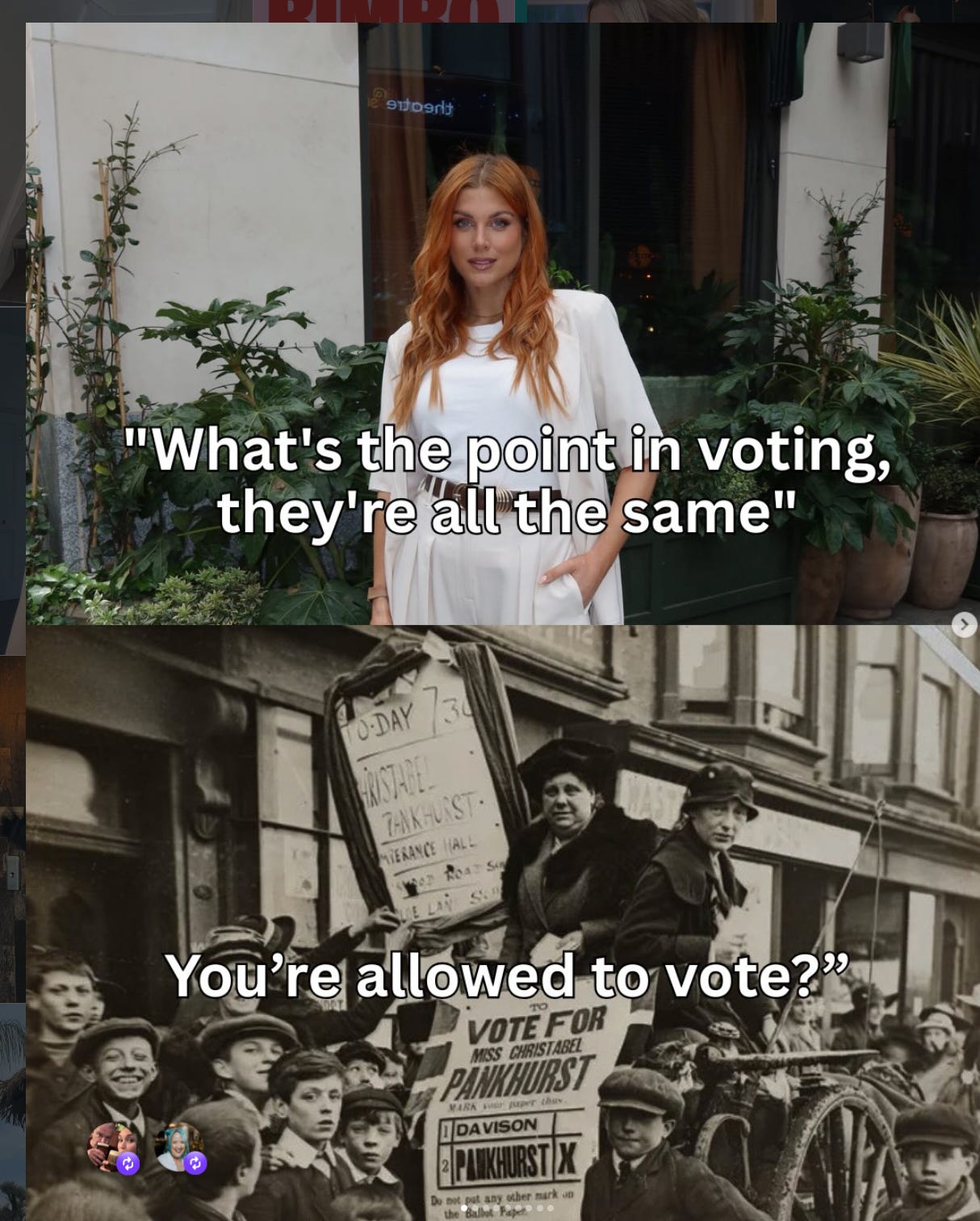
And here was my sister, still living in the UK, asking to make sure every single woman (and man!) she knows voted for things she felt strongly about in a country she still lives in.
And whilst I don’t have any intention of returning to the UK, I still hope and wish and have a tiny say in trying to make the country a wonderful haven of equity, rather than a cesspit of anger and blame.
So when the results started coming through the next day I was kicking myself.
But the more I looked at what was happening, and acknowledging with the First Past The Post system my vote sadly wouldn’t have had a huge effect even if it had been cast on time (even though the principle of voting is still important and I won’t stop doing it!), I started to reflect on what was really going on see Reform win so many seats.
And it comes down to one word:
Emotion.
In this Instagram video, Kirsty Hulse made an excellent point which I think really captures what strikes me about political campaigning vs. online business marketing, and how unfathomable it is that some parties just do not market themselves effectively, while those led by people like Nigel Farage and in the US Donald Trump, do.
Because the reality is this:
Logic didn’t win in these local elections, and it rarely does – in business marketing or politics.
Reform didn’t persuade people with policy detail – in fact when people are confronted with the reality of what their policies actually are sometimes the very people who vote for them are horrified!
The reason they get votes is they made people feel something.
Reform – like all good marketers – make people feel seen and understood. They speak to their current experience. And they articulate clearly the desired outcome they promise to be able to deliver (regardless of whether they have the skill or policies to actually make it a reality).
And feeling moves people to action.
This is not a new observation about politics, nor in marketing.
It’s been effective for centuries. It’s how humans are wired.
People make decisions emotionally. And then back it with logic.
Whether that’s voting. Or making a buying decision. Like investing in your services.
We know it – ironically – at a logical level.
Every marketing or social media expert is probably screaming it at you.
USE EMOTION. Make people FEEL the change you can create. SPEAK THEIR LANGUAGE. Paint the picture of the outcome they want.
Sound familiar?
And yet… using ‘emotion’ is one thing women in particular consistently apply to themselves in reverse, suppressing the very thing that connects, in two very distinct ways.
Firstly, our own emotion:
Women have absorbed the message from society that being passionate, direct, or visible is “too much.”
In business this shows up as softening your prices, hedging your opinions, hiding your actual views, making your impact claims smaller or holding back in case you upset someone or get it ‘wrong’. Keep it bland and vanilla and you’ll get along just fine.
I am not immune to this. I live it myself – if you read my Substack on my observations about my style consultation and how I didn’t even think I could wear lipstick because it was taking up too much space and offending people, you’ll know my thoughts on this!

The fear isn’t irrational. The social cost is real.
If we hold strong opinions and come across passionately ourselves, we run the risk that our ‘emotion’ is criticised and receives judgement. Fears that most of us consciously or subconsciously work to avoid.
So of course most of us avoid being seen as emotional.
The second thing we’re told is that to ‘use’ people’s emotions is wrong too.
That marketing or appealing to people at an emotional level is ‘manipulative’ and that we should stick to our qualifications, our evidence, our facts, our stats and logic to get people to do things.
To be the opposite of the emotional tug and pull of overconfident, unqualified leaders and those only interested in their own power and gain, we have to be straight-laced and use the facts and just stick to the data.
And again, I am not immune to this. I notice in myself an avoidance of speaking emotionally in my content to realities and fears.
And when I get curious I can see that’s because I don’t want to ‘overpromise’ or be found to disappoint or let down the people that invest in me. That I can’t guarantee everyone will feel better while or after working with me, so I’d better not mention the potential benefits at all.
Being the ‘opposite’ therefore is not the solution. Staying quiet and small, or sticking just to the logical facts in the way we market ourselves isn’t going to change the world we live in.
And even though we think hiding our emotion or not appealing to it keeps us safe from criticism and judgement, it actually leaves us with a lot of internal frustration and criticism as we feel frustrated and hampered, rather than empowered to speak.
You can be furious about the election results. I am.
I’m furious that the parties I would love to see gain more votes aren’t using the best and most effective marketing methods to gain a majority.
Instead (by all accounts from my U.K. friends and what I see on socials) they are wasting precious airtime and flyer space bitching about the other parties and not telling us what we’ll actually get voting for them.
But how can we channel this? What can we learn? What can we apply to ourselves as solo business owners?
Ask yourself this:
What kind of business owner do I want to be in this climate?
One that shrinks because the world feels hostile?
Or one that shows up more clearly, more honestly, more visibly, as an example of a different way of doing things?
Because I know which is really firing me up right now.
The version that is really motivated to use these same emotional tools to help people transform in amazingly positive ways.
And not let those who have no integrity highjack the use of emotion for their own ends - with no thought or care for others, only lip service that what they’re doing is betterment for everyone.
This doesn’t mean being political in your business content if that doesn’t feel right.
It means whatever your work is, trusting your own values enough to lead from them.
Backing yourself. Saying the thing out loud. Not waiting for the culture to make it easier. Seeing this not as a bad time but the BEST time to stand out and be seen because you are so bloody needed.
See your reaction to what you see as injustice (in whatever sphere it might be), as a chance to be a vocal alternative option.
How can you use emotion - your own and your ideal clients’ - to better spread the word about what you do this week?
You can find out more about working with me here.

You show up, you sell, you network, you post.
But something between your effort and your results isn’t adding up - and you know the gap isn’t strategy.
Trust Club is where established solopreneurs do the specific self-trust work that finally makes their business match what they’re actually capable of.
Find out more and join ⬇️
No posts
Comments
Nothing yet. Say the first thing.
Sign in to join the conversation.