
Surtitles and accessibility in opera
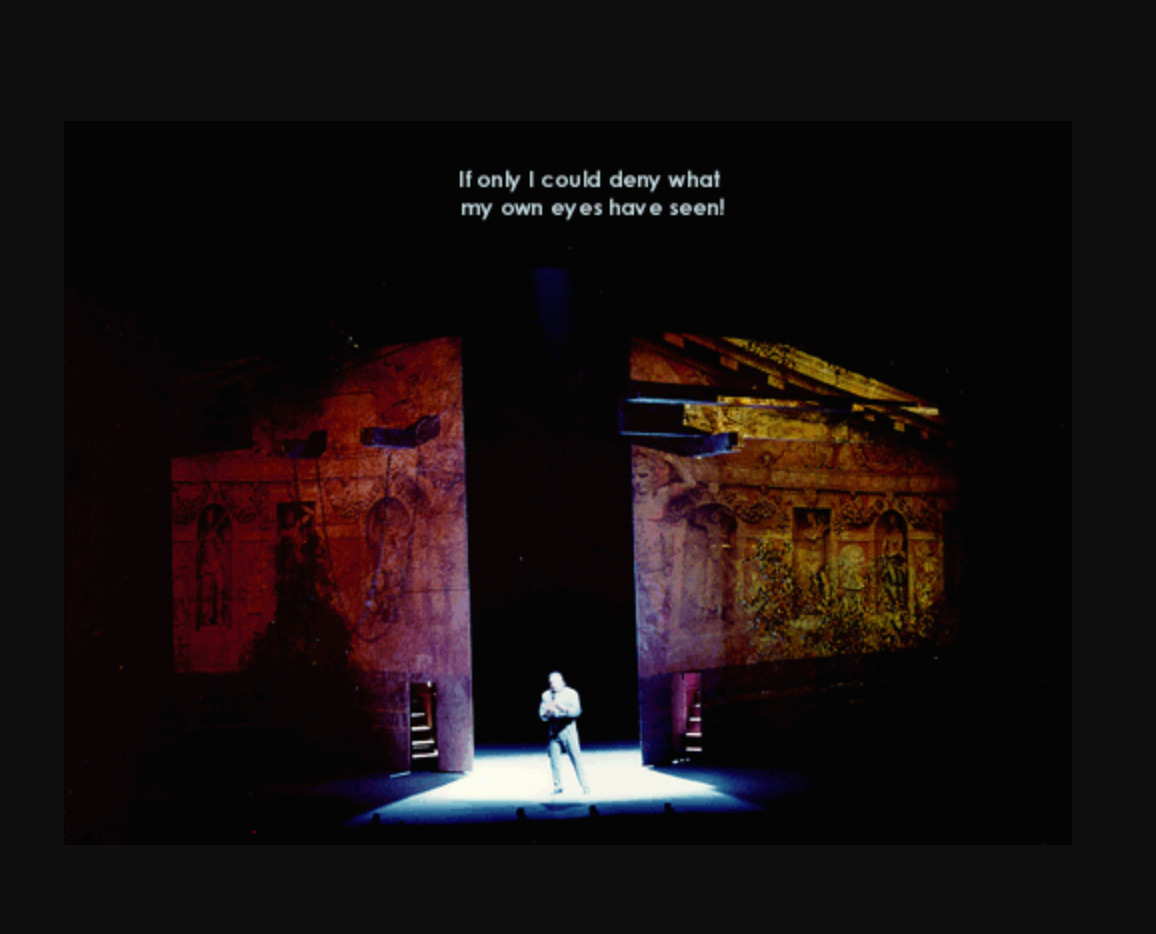
For many years it has been customary across the world to caption the text of an opera - when sung in a foreign language - in the language of the audience and (sometimes) in a second, ‘universal’ language such as English. The most common form of caption is the surtitle - so called because it traditionally sits above the stage, on the proscenium. Where sightlines do not permit this, or in touring contexts, these captions often also exist via repeater video screens in the auditorium, and in some opera houses, such as the Metropolitan Opera of New York and the Vienna State Opera, seat-back surtitles are available and can be customised by the user to display in a variety of languages.
The surtitle operator cues the captions manually following a vocal score of the opera and there is significant skill involved in this - in comic operas and operettas, for example, it is important that the text does not appear on the screen before the joke has been played on the stage, and the most sensitive operators learn not only the music but also the production to avoid distracting the audience’s attention at a particular moment of stagecraft.
This helpful page on the WNO website gives a useful history of surtitles. WNO titles all its productions, irrespective of language, and for performances in Wales, titles are offered in English and Welsh.
At English National Opera, where all repertoire is performed in English translation, a controversial decision was taken in 2005 to use surtitles following audience feedback. The General Director, Sean Doran, made it clear that this decision was being taken for the purposes of accessibility, and that this was consistent with the founding mission of ENO. Moreover, audiences were ‘really crying out for it’. In 2005-6 a number of un-captioned performances were retained in order to satisfy those who objected, but this policy was quite quickly dropped. Interestingly, in the 2021-2 season ENO resumed offering its audiences the choice of whether to attend captioned or un-captioned performances. Although not all patrons would have been able to make their date selection on this basis alone, or perhaps were even aware of it, informal reports I have heard suggest that the box office results and subsequent feedback reflected the same preference as the audience surveys - surtitles were preferred and they are here to stay. In the current season (2023-24) this policy seems to have vanished.
ENO also offers a BSL signed performance of each title in its season. ROH offers BSL signed performances of some of its operas, likewise Opera North. WNO does not currently offer any live-signed performances. These performances are offered with live-signing in addition to captioning. English Touring Opera under its current management performs all its works in English translation, with English surtitles at all performances. Birmingham Opera Company also performs its operas in English, but in promenade, in non-theatre spaces. Their productions are not titled and it would be impractical to do so.
There remains some disagreement on the subject of surtitles. The most common objection (which comes typically from the artists) is that titles distract from the action of the stage, and in cases where the opera is performed in the language of the audience, they are (or should be) redundant. Comedy is often cited as a primary form which should do without - the artists onstage want the audience to laugh when they sing (or speak) a punchline, and not when they read it. There is also a cost implication - titles have to be created, there is equipment cost, and an operator must be present to cue them live.
And yet, audience surveys confirm that those who buy the tickets want surtitles, no matter the language or genre of the opera. In the English-speaking world, where the standard repertoire is dominated by the European 19th century canon, unless the work is given in translation, operas tend to be in a foreign language. We are used to foreign-language TV and film with subtitles and original audio - dubbing is much less common in the English-speaking world than in, for example, Germany and Italy. It is now an audience expectation that all performances should be titled - and this can provide a challenge for smaller and touring companies that may not have the financial or technical resources to provide it.
Many operagoers complain that today’s singers have become worse at delivering sung text. This accusation is levelled particularly at ENO, where pronunciation is perhaps more acutely noticeable because its work is produced in English, and because the London Coliseum has a a challenging acoustic because of its cavernous stage and auditorium.
My theory has long been that the way we consume vocal music has changed beyond all recognition. Recording techniques are now very high, and we are able to experience audio at previously unimaginable quality via headphones which provide an affordable studio-level audio experience. Opera recordings can also be mastered in high detail so that the balance of orchestra and vocal lines can be optimised, various takes can be edited together and sound clarified, meaning that the experience we get at home is almost impossible to duplicate in a live theatrical environment where the acoustic of the venue differs from seat to seat and there is no sound engineer controlling what we hear. This is particularly relevant to the question of clarity. Furthermore, the existence of titles has meant that we no longer have to listen as carefully as before, because we are not totally reliant on our hearing to understand what the characters are singing onstage - in short, I don’t believe opera singers are worse today than they were in the past, but our ability to listen attentively is. And, of course, those who remember the great singers of yesteryear will be older than they were then, and very little audio equipment, from amplifiers to ears, improves with age.
But there is another, in my opinion, much more important element to the question of titling, and that is one of access. Opera struggles to present itself accessibly, and titles are one of the tools opera companies have at their disposal to address this issue. If you don’t speak the language of the opera and you don’t know the story in advance, you will have experienced how crucial they are for comprehension. And for those who have difficulty hearing, or cannot hear at all, they are crucial in all languages. For everyone it can be challenging to understand what the characters are singing in ensembles or even duets whatever the language, and for much of its history, opera was experienced by an audience in full house-light, following along with a libretto text in hand. Now that productions have become more complicated, and because stories that might have been familiar to a 19th century audience cannot be taken for granted today, our brains are also processing much more information at the same time, so for the first-timer, it can be hard to understand what is going on.
…. to be continued
…
No posts
Comments
Nothing yet. Say the first thing.
Sign in to join the conversation.