
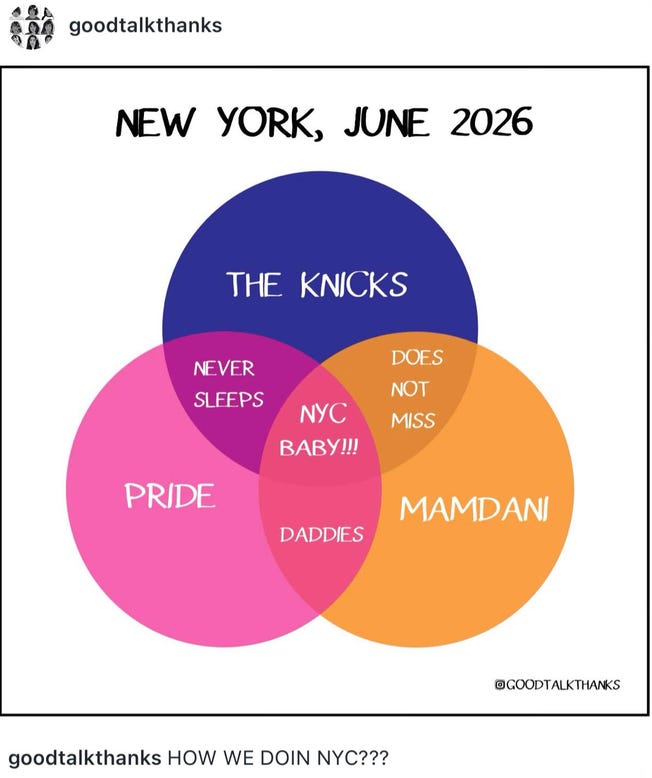
On the eve of this country’s 250th birthday, we’re seeing two very different Americas — the one playing out on the sparsely populated green grass of the National Mall at the Great American State Fair, and the crowded one full of joy that I’ve been privileged enough to live through in New York recently.
I spent a lot of time thinking about American masculinity in the early days of June. The World Cup was approaching, the Knicks were on a historic run, and President Trump was building a UFC fight cage on the White House lawn. Everywhere I looked, I saw different visions (and projections) of strength: men in jerseys hugging each other after victories, consoling one another after losses; the performative toughness of an aspiring strongman versus world-class athletes who spoke openly about grief, fear, and pressure. There was the universal appeal of a young mayor announcing free childcare by making joyful videos with New York City schoolchildren. And I kept thinking how different many of these traits are to the people who supposedly represent us on the world stage (and how 77 million Americans supported the model that Trump represents in 2024).
When Trump came to town for the NBA Finals Game 3, the city united in its desire to not have him here (with the exception of Knicks/Madison Square Garden Sports Executive Chairman James Dolan, who invited him). But even more importantly, once he left, citizens saged Madison Square Garden and the Knicks got back to winning. The city was outside like it’s never been outside before. We had Pride, Juneteenth, the Puerto Rican day parade, the Tonys, World Cup games — it was a nonstop, month-long party. At first I thought it was the most celebratory we’ve been since pre-pandemic times, but when the Knicks actually won the whole damn thing, making history for the first time in fifty-three years, and we had “Spike Lee paraded around Fort Greene like the Pope” (as captured by Danya Issawi) — I realized it’s even more historic than that. Every walk home became a run-in with another celebration.
The more I paid attention, the less I thought it was just about masculinity. It was about what kind of community these different visions are trying to create. One keeps making room for more people. The other grows smaller by insisting fewer people belong.
I have lived in New York for 17 years now, and I have never experienced a month like the past one in the city. The collective joy — or collective effervescence, to borrow the sociological term from Emile Durkheim — was inescapable. It wasn’t just visible in parks and at parades. It showed up in politics, too. The June 24 primary became one more example of New Yorkers embracing a vision of community that felt expansive rather than exclusionary. Mayor Zohran Mamdani and his slate of candidates’ victories weren’t the whole story of the month — but they were part of the same current I kept noticing everywhere I looked.
I remember speaking to a student journalist once who wanted advice on pitching sports stories in an ecosystem that seemed either obsessed with celebrities or news and politics. I said then that sports remains one of the only things that brings people together across political lines in our deeply polarized society, and that the sense of community, identity and belonging found there can spawn countless stories. It’s seemingly never been more true than this summer, or perhaps it’s just been a long, long time since we had this contrast so readily available: the America that welcomes all visiting World Cup teams with open arms (and bars), the ones that prompt teams to leave thank you notes or place them in the pages of the Boston Globe. Versus the vindictiveness and aggression of our federal government, preventing players’ moms from coming on time to see them play in a game in its generally harsh immigration crackdown. (She ultimately made it for the second match after high-level intervention and public support, but the U.S. federal government has not backed down in most other cases, especially those involving less famous people.) If “the cruelty is the point” of one vision of America, neighborliness is the point of the other. One vision of America asks who belongs — and gives a very narrow, racist answer. The other keeps making room.
There are the people who perform patriotism — wrapping themselves in the flag while insisting fewer and fewer people deserve to share in what America has to offer. Practicing patriotism looks different. It looks like welcoming visitors, filling public parks, cheering with strangers, volunteering for neighbors, and believing that our country grows stronger when more people belong.
June reminded me that many Americans are hungry for joy, community, and belonging — and New York became the place where I saw that most clearly.
Maybe that’s why this month has felt so hopeful. Not because our politics suddenly became less polarized or our problems disappeared, but because I kept stumbling into evidence that Americans still know how to build community. Sometimes through sports. Sometimes through neighborhoods. Sometimes through politics that asks neighbors to care for one another instead of fear one another.
That’s the America I want to keep practicing.
Letters of recommendation, or things that bring me joy:
Shout out to the hard-working photographers who have braved intense crowds and so brilliantly captured the joy on multiple occasions: Amir Hamja, who regularly takes some of my favorite photos for the New York Times, New York Magazine, and others; Billy Dinh, who also captured excellent, historic scenes for New York Mag; and Poppy.visuals, who took this epic photo of my friend Tom McKenna’s dad being an absolute legend and chugging a beer after climbing on top of a crowded truck. Tom and his dad are both lifelong Knicks fans and I am very happy for all McKennas, among others.
Jordyn Woods’ lucky orange bag is on display at the Guggenheim, now through July 12. Another lifelong Knicks fan and friend, Jasmine Amjad, has already pre-ordered hers (sorry, I think they sold out).
Mayor Mamdani is planning to spend July 3 surrounded by newly naturalized Americans as he reflects on what the country’s 250th birthday means. Whether or not you support him specifically, I think it’s worth watching as another vision of patriotism — one centered on welcoming people into the American story rather than narrowing who gets to be part of it.
🎵 listening to: “96,000” from In The Heights (still a banger)
Stay cool out there. I highly recommend buying a neck fan; I got one last summer and have never looked back. Here’s what Wirecutter recommends. (I bought the JisuLife one; not an affiliate marketing thing, just worried for everybody.)
See you soon, and thanks for reading.
No posts
Comments
Nothing yet. Say the first thing.
Sign in to join the conversation.