
Listen to this essay here, or wherever you get your podcasts.
“Don’t try to take me to a disco
You’ll never even get me out on the floor
In ten minutes I’ll be late for the door
I like that old time rock and roll”
– Bob Seger
This short essay is not actually about Disco. But since we’re on the subject, let’s talk about it a little bit. As most of you are probably aware, and as some of you may even remember, in the late seventies Disco was all the rage. You couldn’t escape it: it was in the clubs, in the supermarket, at the school dance, and, perhaps most importantly, all over the radio, most people’s main source of music at the time. Naturally, this oversaturation ticked some people off. More than anyone, it ticked off racists and homophobes, but it also profoundly ticked off many people, bigoted and non-bigoted alike, who really loved Rock music. Rockers didn’t hate disco simply because they didn’t happen to enjoy it and it happened to be everywhere— they hated it because they saw it as a threat. They were somewhat justified in doing so: radio stations across the country devoted to Rock music were suddenly becoming Disco stations; Pop singers who were Rock-adjacent started incorporating Disco influences instead. There was, therefore, genuine worry that Disco could be the death of Rock.
Now, what’s important to understand here is that for someone whose identity is tied to Rock culture, this sort of threat is not merely an annoyance, but an existential alarm. Silly as that may sound, it’s true: as Ernest Becker trenchantly identified in The Denial of Death, when something we consider a pivotal part of our identity or worldview comes under fire, we are tempted to viciously and viscerally react as if our very lives are being threatened, because, in a sense, they are: we are our identities, and if the system of meaning that we construct for ourselves to stave off the terror of mortality is called into question, it can provoke primal responses which seem irrational and extreme to outsiders. This, Becker argued, was the root cause of all ideological violence throughout the bloody annals of world history.
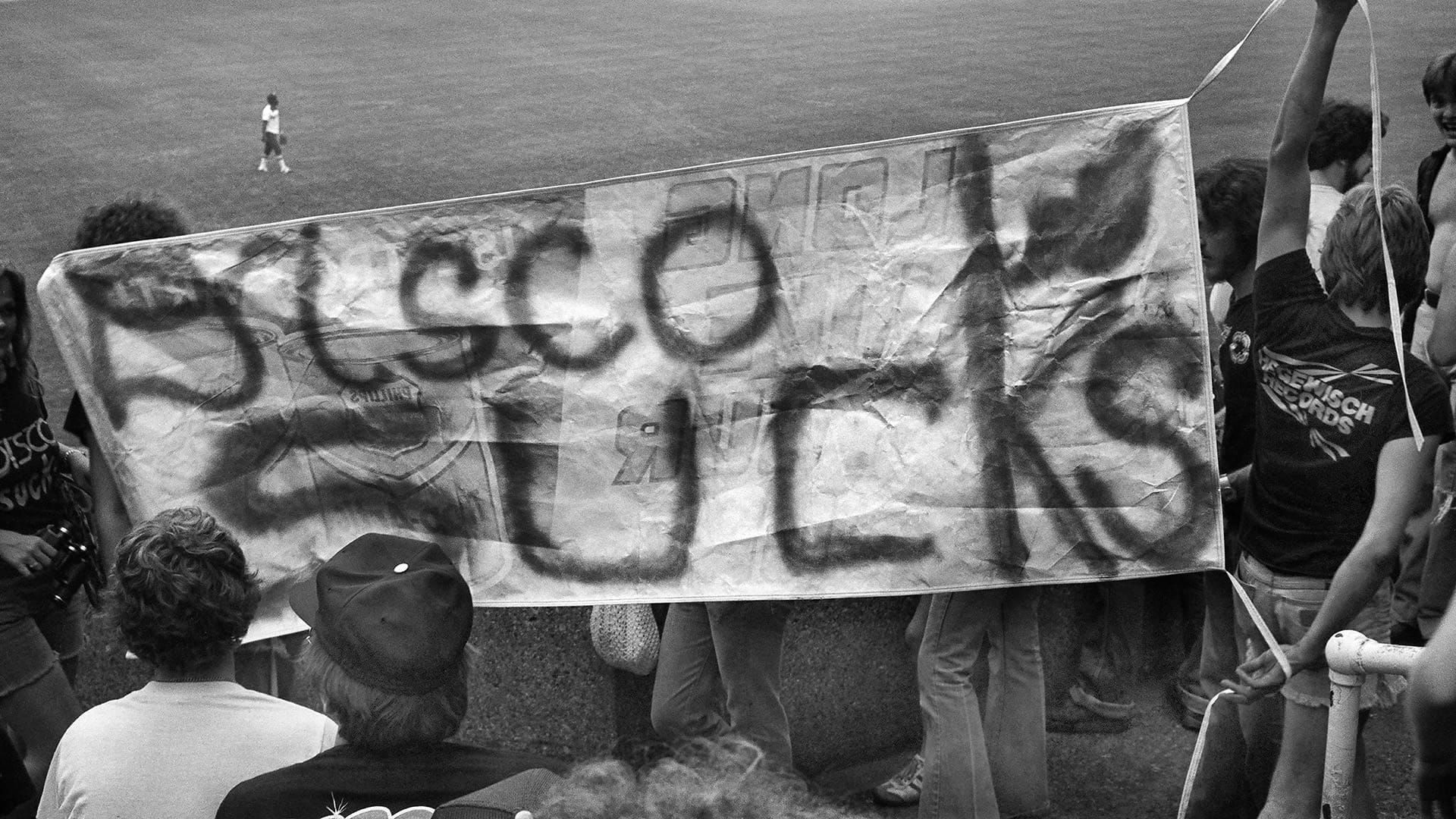
And thus, what became known as the “Disco Sucks” movement. In my own city of Chicago, on Christmas Eve, 1978, a twenty-four year old Rock DJ named Steve Dahl was fired from the radio station WDAI, one of the casualties of the nationwide radio shift from Rock to Disco. Naturally resentful, when he was then hired by rival Rock station WLUP, he knew there were others who felt as he did, and made it his mission to destroy Disco. Whenever he was on the air, he issued a call to arms to everyone who was, quote, “dedicated to the eradication of the dreaded musical disease known as Disco,” and cultivated thousands of gang-like followers in the Chicago area united by the motto: “Disco Sucks,” a sentiment that soon became famous nationwide. Dahl’s followers, known for some arbitrary reason as “cohos,” would show up by the hundreds to support Rock events and harass Disco events. In May of 1979, Bob Seger released his nostalgic anti-Disco anthem, “Old Time Rock ‘n Roll,” which would go on to become one of the biggest hit songs of the 20th century. The backlash had arrived.
The owner of the Chicago White Sox, Bill Veeck, certainly thought so. His people reached out to Dahl, and a promotional event known as “Disco Demolition Night” was soon on the calendar, scheduled to occur at Comiskey Field on the night of a Sox doubleheader against the Tigers. Fans who showed up to the games with a Disco record would be admitted at a discount, and each record would be added to a pile which would then be literally blown up by Dahl as a half-time stunt between the games. Everyone involved worried that they wouldn’t be able to get a big enough crowd.
As it turned out, 50,000 people showed up, 20,000 of whom had to wait outside. There were too many records and too many people, so eventually patrons just took their albums to their seats. As the first game started, Disco records began flying onto the field from all sides like wax frisbees, sometimes striking the players. After the game, true to his word, Dahl detonated a mountain of vinyl on the field to a crowd roaring: “Disco sucks!” The explosion inflamed not only the records, but the masses, and mayhem ensued. Fans rushed on to the field, throwing bottles, burning records, and the White Sox turf was almost completely destroyed. When the story of the riot appeared in national papers the next morning, people around the country took it as an opportunity to vent their own fury about Disco, and soon enough, the genre was finished. By 1980, Disco was effectively dead. Steve Dahl had won.
If you had gone up to Dahl or any of his cohos during this time and said to them: “But surely there must be some Disco records that have value!” they probably would’ve laughed in your face, because you’d be missing the point. “Disco sucks” was never about being fair or objective. It was about survival and conquest.
Already, many of you can probably sense where I’m going with this. Over its three years of existence, I have said many incendiary things on Versecraft. I have proclaimed, infamously, that so-called “free verse” is not poetry. I have, at various times, made Romanticism, Modernism, and Postmodernism my whipping boys. I have condemned confessional poetry and spat upon the avant-garde. I have fired volleys at such illustrious names as T.S. Eliot, Walt Whitman, and even Robert Frost. I have even turned on some of my own formalist brethren, calling on my tribe to be less milquetoast and commonplace. Through all these polemics, I have attracted many people who feel inspired, enthused and vindicated by my words, and for those people I am extraordinarily thankful. Yet I fear that I have also genuinely hurt more people than I previously realized. That is what I would like to address today.
Comments
Nothing yet. Say the first thing.
Sign in to join the conversation.