
Welcome to the Portfolio Career Series: a weekly email series to help you build your portfolio career strategically, sustainably and mindfully.
In previous episodes of the Portfolio Career Series, we covered:
Episode 1: What the heck is a Portfolio Career
Episode 2: How to launch your 1:1 coaching from zero
Episode 4: How to build and scale a paid community
We will wrap up the series with a Portfolio Career Business Roundtable:
📍Session America: 19 August 8pm
📍Session Europe: 20 August 8am UK
Register now for 59 US$ (free for paid subscribers) .
Today we talk about books and how book authoring can help you build your brand and strengthen your Portfolio Career.
In Spanish, we say that there are three things one must do in life.
One of them is to write a book.
I wholeheartedly agree.
I believe everyone has something worth leaving behind: a message, a story, a fairy tale, or simply a legacy for their loved ones.
Although I only published my first book at 42, I can tell you that being an author has changed my career (and my life) in unexpected ways. From speaking at international literary festivals to moderating panels with bestselling authors, turning my books into courses and keynotes, and even helping my daughter publish a children’s book when she was 6.
Becoming an author is one of the smartest ways to elevate your profile and your Portfolio Career but getting your book out is only the first step and it doesn’t guarantee anything. Nada.
Today, everyone and their mother can publish a book. Regardless of talent, which is annoying. Regardless of integrity, which is terrifying.
Amazon has decimated the entry-level barrier, which means easier access at the expense of governance and quality.
AI is the new steroids for authors. No wonder in 2023, Amazon set up a maximum of 3 titles per author…per day! And as we know, quantity and quality seldom walk hand in hand.
Consumer trust is at an all-time low and readers are spending more time acting as the AI police than actually reading a good book.
And when an industry drops regulation and checks and balances, it becomes the freaking Wild West, and everyone is desperate to get a chunk.
Scams are at an all-time high with predatory publishers and fake book clubs harassing us weekly, and so-called “book publicists” promising to turn your book into the next NYT bestseller.
PS: Never trust a business that sends you an email from Gmail.
Where does all of this leave us, authors?
According to industry reports, 90% of self-published books sell fewer than 100 copies. In their lifetime. Yikes.
The gap between publishing a book and selling a book has never been bigger.
So, before you jump into your next book, make sure you have a plan to bridge the gap.
That’s why today’s episode focuses on the strategic side of publishing and how to move from royalty peanuts to an actual business around your book.
We are going to cover 3 main topics:
1. Self-publishing vs traditional publishing: choosing the right path
2. How to get a book deal with a traditional publisher
3. Turning your book into a business beyond royalties
No BS, no fake promises. Just a clear roadmap to make sure your book actually moves the needle in your Portfolio Career.
I recently launched this debate in my Lemon Tree Mindset Group Chat:
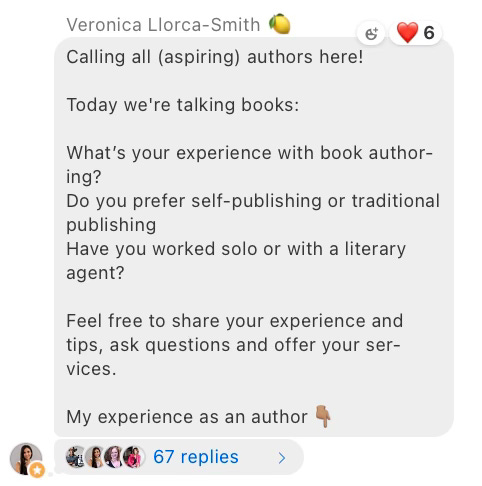
As many members are authors, it was great to have 67 first-hand experiences. You can join the group for free and check the answers here.
The long story short is this: The best path to publish your book is the one that supports your primary goal:
- Do you want to build your brand as a subject matter expert in your field?
- Is your goal to create a new income stream?
- Is your book a lead magnet for your business?
- Do you want to grow a career as an author?
You will likely pick 2 or more but it’s important to be crystal clear on the main objective because it will have a direct impact on your strategy.
My only rule of thumb is this: never pay a publisher. I don’t trust hybrid publishers that ask you for money to publish. It’s risky, you have zero guarantees and I haven’t heard a single real success story yet. I said what I said. If they really believe in your book, then they should have skin in the game too; otherwise they will have zero incentive to promote it once they get their pay cheque.
Having published 4 books (2 self-published, one with an indie publisher and The Anti-Procrastinator with a Big Five), this is my fully caffeinated opinion:
- For writers with small audiences, self-publishing is a no-brainer as you’ll learn the ins-and-outs of the publishing world and will have full ownership of the end-to-end journey (editing, marketing, design…). If you are waiting for a traditional deal, it can be years in the making and it’s great to get a pulse in the game early on (I self-published my first book 6 months after I started writing online and it was a great confidence-builder that helped me negotiate later from a place of knowledge and experience).
- For entrepreneurs and creators whose goal is to promote their business, self-publishing can be a smart tactical move too as they are not looking for authority building but rather a leads’ incubator for their business. That’s exactly what my friend Petra Zink did with The Trusted Authority, a book that lays out her proprietary methodology for brand-building. Your book becomes a gateway into your sales funnel, which is also the strategy my friend and book coaching client Michael Lim is adopting for his new book on solopreneurship.
- For authors who are looking for professional support without the rigidity of a large publishing group, indie publishers can be a great option as they tend to be more flexible and open to negotiating, all while involving the author in the process. They typically have limited distribution power compared to the larger players but they can be a great stepping stone into a Big Five, which was my case. I personally like niche indie publishers as they are very focused in their topic and distribution and will help you reach your ideal readers instead of blindly targeting a humongous market.
I was recently contacted by the publisher SAGE. I did some digging, and while they are not a huge player, they are well established in the business and academic niche (think books for education and corporate training), so it could be a great partner for authors who want to establish their name in a more technical/ professional field.
- For authors with large audiences, self-publishing is extremely profitable because they already control the distribution and in the publishing world, distribution is king. It’s no wonder that Alex Hormozi self-publishes all his books through his own company, Acquisition.com. Having a big audience is the best way to bypass the traditional gatekeepers: you don’t need them because your name does the selling for you but this only applies to a tiny percentage of authors.
- If your dream is to become a world-known author (yes, we are here to dream big!), a publisher deal will enable you to participate in literary festivals and join international literary events (the most prestigious ones only accept published books), which can be an incredible propeller for your career. Also, if your publisher sees potential in your book, they are likely to invest in it and fund the audiobook as well as the translation to foreign languages, which can 10X your distribution and sales.
- If your goal is to be recognized in your industry, the stamp of a publisher (ideally a well-known publisher) is a big deal. That’s why psychologists, sociologists, and economists usually opt for the traditional route. Yes, the royalties are peanuts (8% on average) but they do it for the recognition and credibility.
Here are some examples:
James Clear: Atomic Habits by Avery (an imprint of Penguin Random House)
Ryan Holiday: Portfolio (an imprint of Penguin Random House)
Adam Grant: Viking (an imprint of Penguin Random House)
Any of these powerhouse names could easily self-publish and hit the top sales rank on Amazon tomorrow, yet they all went with a big publisher for a reason.
Getting a book deal is the dream of many authors, especially one with a Big Five and there is no easy way to get there.
These are the Big Five and together they control around 80% of the US book distribution market:
1. Penguin Random House
2. HarperCollins
3. Simon & Schuster
4. Hachette Book Group
5. Macmillan Publishers
In 2025, I managed to sign a book deal with Penguin Random House and while mine was not the typical journey (I went without an agent and pitched to the publisher without having a book), I learned a lot by working side by side with them for an entire year and this is the strategy and steps I recommend to land your deal:
Your best shot is honestly investing in proximity: get close to the source.
- Go narrow: Don’t target “Penguin” or “HarperCollins”. Identify the specific “imprints” (subdivisions) that are the best fit for your book. Get familiar with their submission requirements and analyze the authors they represent. Treat each submission like a pitch to an investor and don’t send a book idea: send a business proposal.
Comments
Nothing yet. Say the first thing.
Sign in to join the conversation.