
Digg shut down over the weekend (again). It made something I’ve been feeling lately even more clear, I think we have destroyed all the best parts of the internet.
First, a little history for anyone that didn’t come up during the earliest/earlier days of the public internet. Around 1991, Tim-Berners Lee made the internet publicly accessible. I really started finding my way around the internet probably around 1994 from school computers and my actual addiction to the internet kicked off around 1997 which I detailed in painstaking length when I launched the fund.
For my 2000’s babies, there was a time in the mid-2000s where we had a set of community driven platforms emerge and Reddit and Digg (okay and 4chan) were the ones that really caught traction. Within the developer community, Hacker News was the center of the universe. For everything else, Reddit and Digg upvotes were driving what people were exploring online.
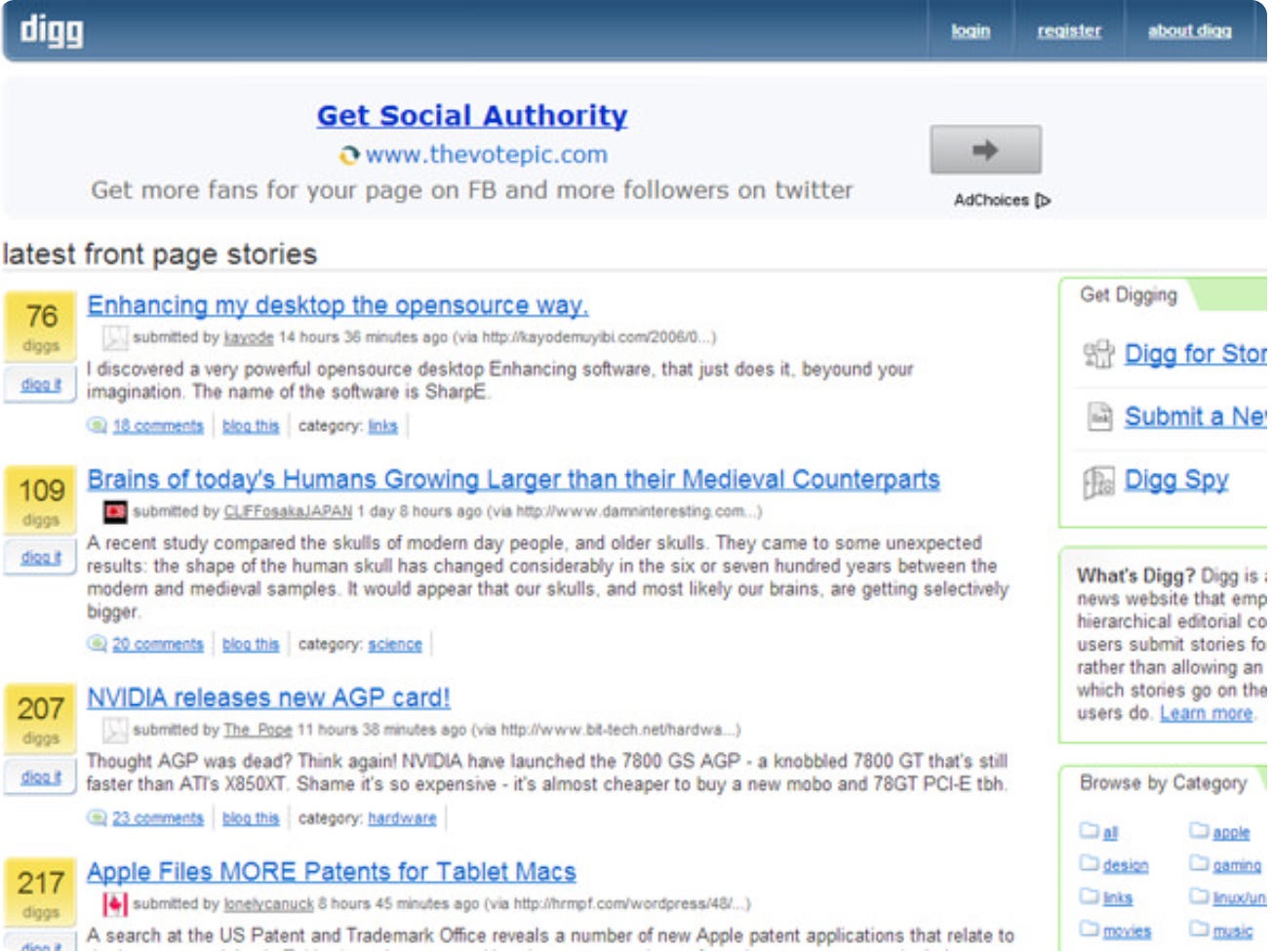
Screenshot from the front page of Digg circa 2008. It is not lost on me that the ad displayed is to help you get more fans on FB or followers on Twitter. Evil foreshadowing.
I think what was super special about that time on the internet for me (any many others) was that it was a place where all of your interests would combine under one umbrella and it was organic. You were into indie music, math, yoga, and cooking? There was a subreddit for that. You could find your people. You could find conversations that were authentic.
As a child of the internet, I’ve been addicted to online communities since I got my first computer at the age of 12. The connecting thread between the chatrooms of the 90s (Yahoo Chat please come back) and the message boards of the 2000s was always humans interacting around a topic, interest, or location that everyone had in common, for better or worse.
A lot of these interactions were based in anonymity and while a lot of us made offline friends out of online friends from those times (I still have several that I’ve now known for over 25 years), it was a great way to connect.
Social media came along and de-anonymized the internet. Suddenly, we knew what every person in our social circles were doing. All the time. Then came the monetization of social media and the influencer of it all.
Social media and message boards always felt pretty separate from one another and then the algorithms and content machines came along and it felt like the fake profiles and bots started to grow. Bots had always been present but it started to feel malicious in the mid 2010’s. People were buying followers and likes and even worse people were influencing elections. The bot economy ramped up.
The pandemic changed how people interacted socially, both offline and online. TikTok and Instagram pushed things even further. Algorithms started delivering content that felt like community. But the monetization layer made it feel less organic. This felt like some blended world of social media and message board communities.
So here we are in present day. AI agents came along and content is getting ruined by bots using AI to generate content then promote it across all the social networks and online communities. It’s sort of hell. The internet which once felt so free and authentic is now full of fake people (non-human, not just influencers) and inauthentic content supercharged by AI agents.
This brings me back to Digg. Around 2010 Digg did a terrible redesign and killed their product. Everyone left for Reddit. Digg died a slow death. The learning here is don’t change your entire product and ignore the VERY LOUD complaints from your community.
Fast forward through social media’s rise (and fall), influencer culture, algorithms, bots, and now AI agents, and we’re in a time when I think everyone is craving authenticity and communities that aren’t full of AI generated content, influencers, and bots, DIGG ANNOUNCED IT WAS RE-LAUNCHING. Maybe this was the fresh start we all needed online?
Or not.
After 3 months in beta Digg shutdown again. The message on their homepage is sobering.
via Digg:
Building on the internet in 2026 is different. We learned that the hard way. Today we're sharing difficult news: we've made the decision to significantly downsize the Digg team. This wasn't a decision made lightly, and it's important to say clearly: this is one of the strongest groups of people we've ever had the privilege of working with. This is not a reflection of their talent, their effort, or their belief in what we were building. It's a reflection of the brutal reality of finding product-market fit in an environment that has fundamentally changed.
We faced an unprecedented bot problem
When the Digg beta launched, we immediately noticed posts from SEO spammers noting that Digg still carried meaningful Google link authority. Within hours, we got a taste of what we’d only heard rumors about. The internet is now populated, in meaningful part, by sophisticated AI agents and automated accounts. We knew bots were part of the landscape, but we didn’t appreciate the scale, sophistication, or speed at which they’d find us. We banned tens of thousands of accounts. We deployed internal tooling and industry-standard external vendors. None of it was enough. When you can’t trust that the votes, the comments, and the engagement you’re seeing are real, you’ve lost the foundation a community platform is built on.
This isn’t just a Digg problem. It’s an internet problem. But it hit us harder because trust is the product.
Building social is hard, incumbents are harder
We underestimated the gravitational pull of existing platforms. Network effects aren’t just a moat, they’re a wall. The loyalty users have to the communities they’ve already built elsewhere is profound. Getting people to move is a hard enough problem. Getting them to move and bring their people with them is something else entirely.
So where does that leave us? Is this what we get for monetizing attention?
AI, agents, bots, and inauthenticity are starting to feel like a core societal problem, not just a product problem. When you can’t trust that the posts you’re reading, the comments you’re replying to, or the engagement you’re seeing are actually from real people, something fundamental about the internet breaks.
Harvard has been publishing reports about the epidemic of loneliness in America, and it’s hard not to see the connection. The internet was supposed to connect us. For a while, it did. But if more and more of what we interact with online isn’t real, it starts to have the opposite effect. You feel like you’re participating in something social, but the room is half (maybe more?) bots.
The irony is that the technology industry helped build the systems that are now eroding the very communities that made the internet magical in the first place. It’s all sort of collapsing in on itself.
Which makes me think (and hope) something else is about to happen.
If the internet is less trustworthy, the value of actual human interaction goes up. This is why we are seeing so many events and in person events in tech (and beyond tech). Events are fun again. People are getting creative with the meetup style community events we saw begin to emerge in the mid 2000s and really spike in the early 2010s.
People are meeting people IRL again. It’s pretty nice, even for an introvert. Apparently a walk down the West Side Highway in NYC or Marina Green in SF (The Sluttiest Mile on the West Coast) is the easiest way to get a date these days. We even ruined online dating which you all already know if you’ve talked to any of your single friends trying to sift through Hinge or Grindr. Romantic wasteland.
I think the swing back towards in person gatherings, meetups, and communities where you know the people around you are actually people is a welcomed change after living in the false reality that’s been created on the internet lately.
The early internet was magical because it helped humans find each other.
Right now it feels like we’re losing that. Facebook just acquired Moltbook, a social network for AI agents.
Someone please solve the bot problem before the internet becomes a ghost town full of machines talking to each other. Or at least create what comes next.
Until then, I’m trying to read more books, meet strangers in person, and turn my iPhone into a flip phone. Fuck, I might get a landline.
Ashley, what does this have to do with VC, investing, and developers? Everything. And maybe just a little bit of me entering my Old Man Yells At Cloud era. I’m tired of seeing the printing press analogy but it might be real. What is next.
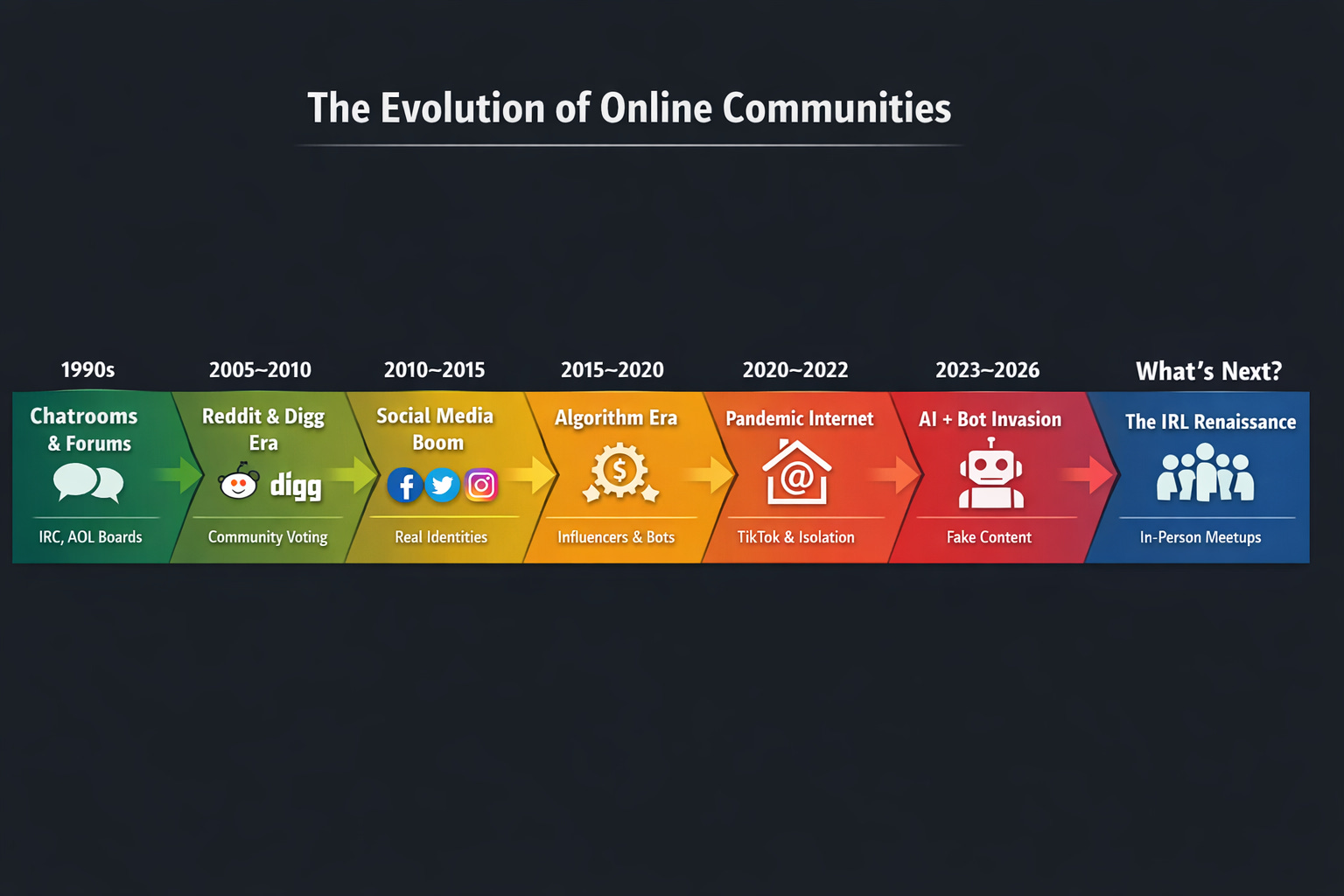
I copied and pasted this entire rant into ChatGPT and told it to create a timeline visual. It made this hideous sales Powerpoint-looking visual circa 2009. Deep belly laugh. Thanks Chat.
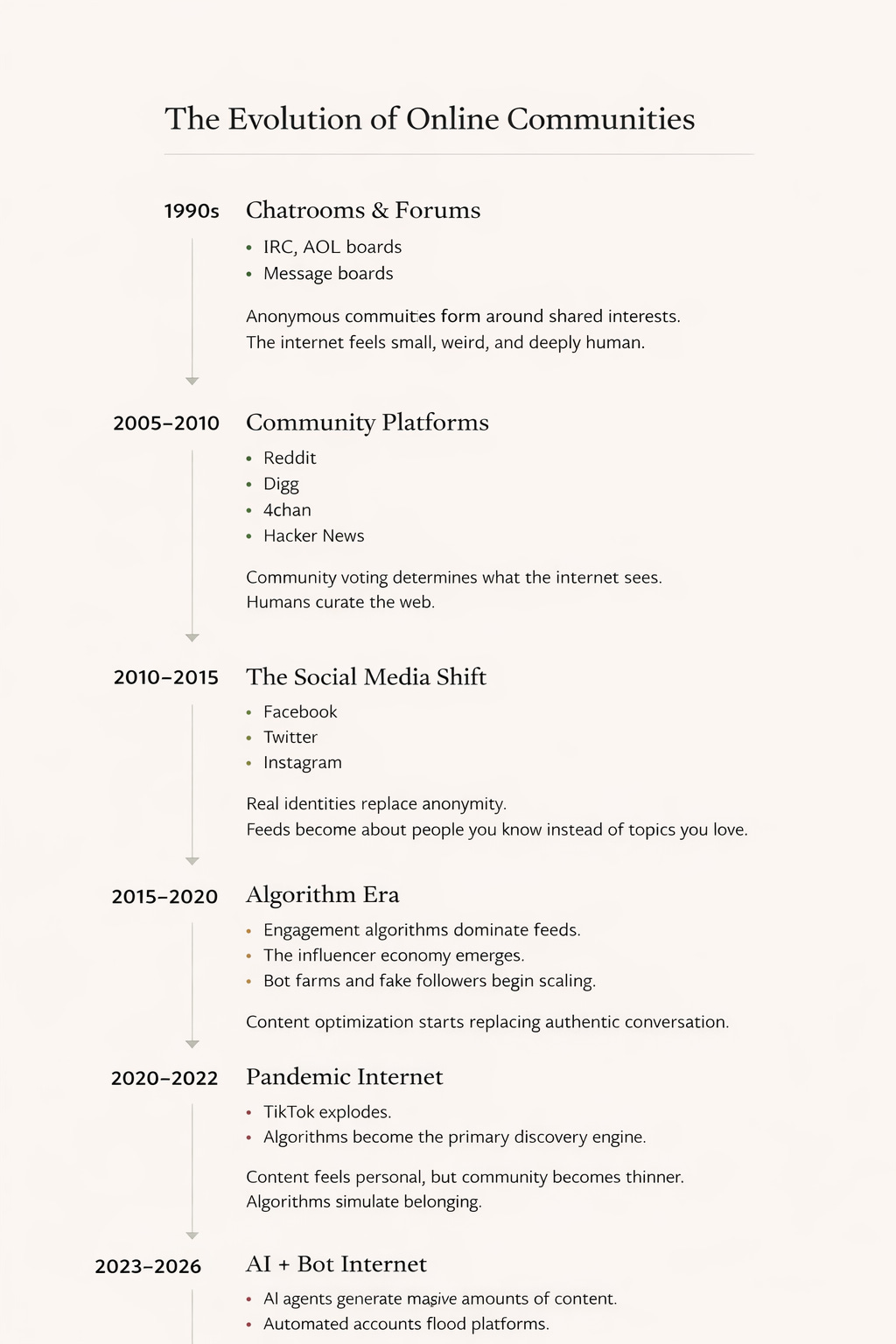
This was ChatGPT’s second try after I shamed it for using old Powerpoint templates. Sigh. Thanks for the resume styling.
No posts
Comments
Nothing yet. Say the first thing.
Sign in to join the conversation.