

Most people picture a vault with their name stenciled on it — perhaps a stack of bills, or a digital file in a fortress somewhere, set aside for them and waiting. That picture is, in nearly every important respect, wrong. What your bank actually has is a line in its accounting books that says, in effect, we owe this person $5,000. The dollars themselves are elsewhere. A portion of them is held in reserve, a much larger portion is loaned out to other people’s mortgages and businesses, and another portion is invested in Treasury bonds, money-market instruments, and whatever else the bank’s treasurer thinks will earn a return. Your balance is not a thing in storage. It is a promise — a claim against the institution — recorded in a ledger that only the institution can read in full.
This isn’t a scandal. It’s how banking has worked for centuries, and the system runs on the simple statistical bet that not all customers will ask for their money on the same day. When that bet fails, you get a bank run. Most of the time the bet holds and the arrangement is invisible. But it’s worth being clear-eyed about it: when you have money in the bank, what you actually have is an IOU from the bank, denominated in dollars, written in a private book you don’t get to audit. The same is true of a credit union, in slightly gentler form. The institution is trustworthy or it isn’t, regulated competently or it isn’t, well-managed or it isn’t, and you have no real-time way to tell.
There is now another model — newer, much-discussed, often misunderstood — that handles the same question in an entirely different way. It is called a blockchain, and the simplest way to understand it is to drop most of the technical language and reach for a few homely pictures.

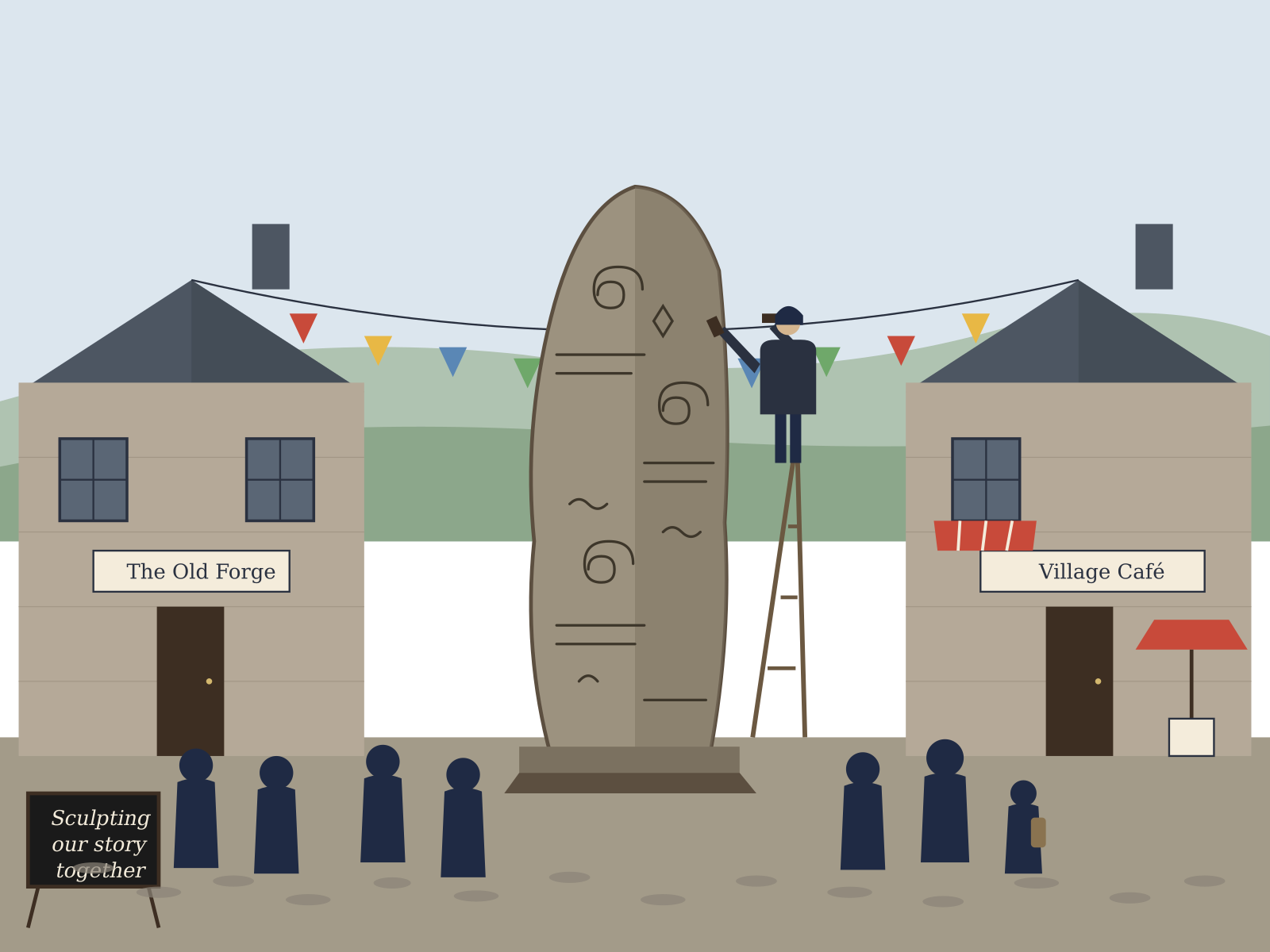
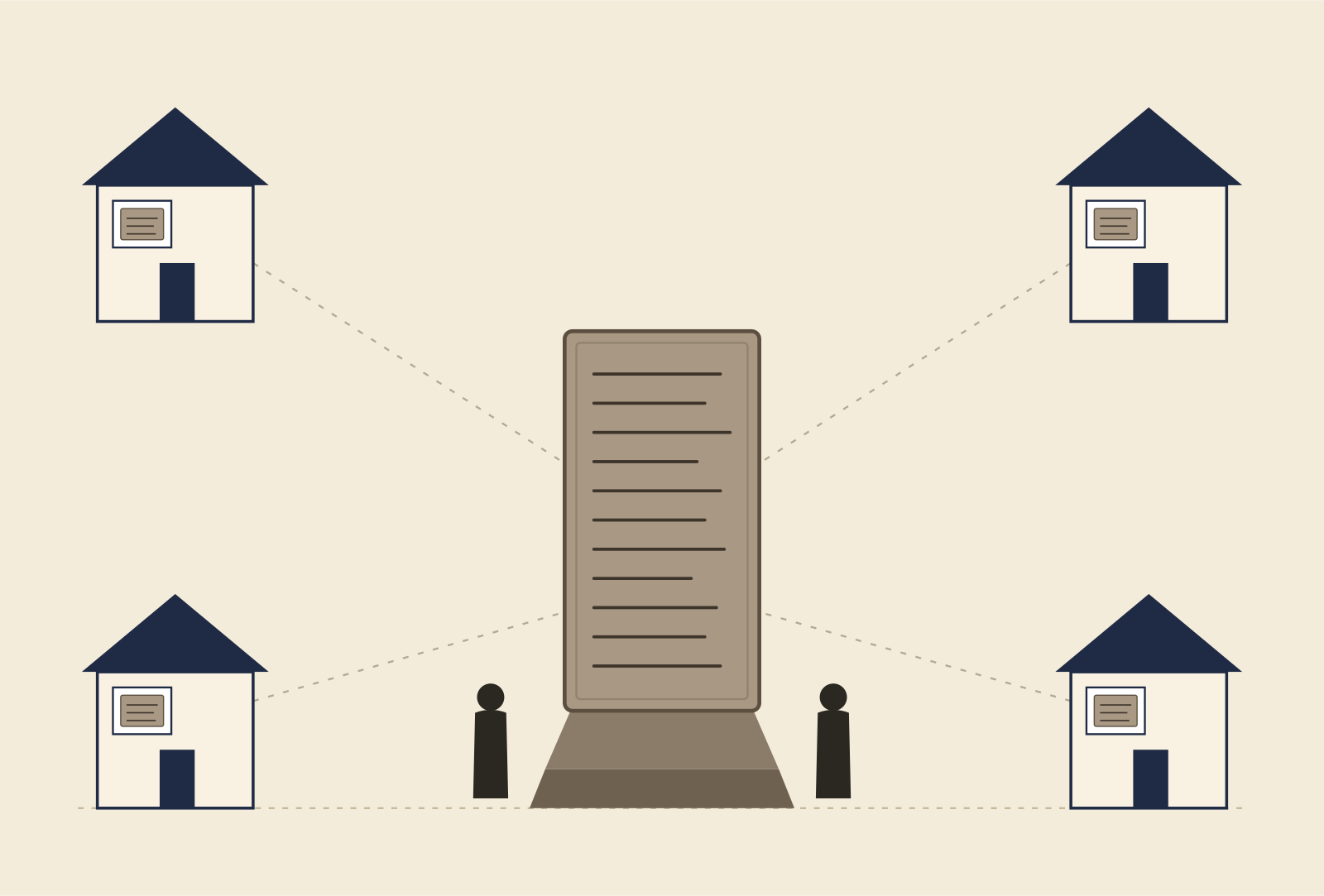
Imagine that instead of one bank keeping a private ledger, an entire town keeps a single public ledger — a great stone tablet in the town square — and that every transaction in the town is carved onto it in front of witnesses. Now imagine that thousands of people in the town each keep their own exact copy of the tablet at home, and every time something new is carved, all the copies are updated at once. To cheat — to add an entry that didn’t happen, or to scratch out one that did — you would have to alter every copy in every home, all at once, faster than the witnesses could notice. In practice, you can’t.
For the first time in the long history of money, having a thing and being owed it can be the same thing.
The trick that makes a real blockchain work is mathematical rather than physical, but the picture is exact. Each new page of the ledger contains a tiny cryptographic fingerprint of the page before it. Tamper with any earlier page and the fingerprint of the next page no longer matches, and the next, and the next — the chain visibly breaks. Thousands of independent computers hold synchronized copies and accept new pages only when the fingerprints check out. This property has a name: immutability. Once a transaction is recorded, it cannot be rewritten, hidden, or quietly reversed by any single party, including the parties who built the system.
The other change is what it means to own something on this ledger. There is no institution holding it for you. Your holdings are recorded directly to an address — a wallet — that only your private cryptographic key can spend from. The value isn’t on loan to anyone. It isn’t pooled with anyone else’s. It hasn’t been put to work in a mortgage in Ohio or a Treasury bond in Washington. It sits there, in its entirety, recorded as yours, until the moment you sign it over to someone else. The reserve, in other words, is one hundred percent, unleveraged, and visible. The vault with your name on it actually exists this time, except it isn’t really a vault — it’s a line in a public book everyone can verify and no one can quietly edit.
The contrast is sharp once you see it. A bank account is a private ledger entry showing what an institution owes you, held in a book you cannot inspect, while the underlying funds are leveraged and lent out by people you will never meet to purposes you will never see. A blockchain wallet is a public ledger entry showing what is yours, held in a book everyone can inspect, with nothing happening to it between deposits and withdrawals. One is a promise. The other is a possession. Both have trade-offs — we’ll come to those — but they are not the same kind of thing.
Before going further, three words that the next sections use repeatedly are worth pinning down. They are often used interchangeably in casual conversation, but they are not interchangeable.
Cryptocurrency — usually shortened to crypto — is any digital token that lives on a blockchain (the kind of public, copies-everywhere ledger described above) and that isn’t issued or guaranteed by any government or bank. Bitcoin is the original example. Its value rises and falls with what people are willing to pay for it, the way the price of gold or a share of stock does. Nothing about a bitcoin says it is worth a dollar today; the market sets that, minute by minute. Most of the headlines you read about crypto going up or crashing are about this kind of token. There are many thousands of them, of wildly varying quality.
Stablecoin is a particular kind of digital token, engineered not to go up and down with the market. Each one is intended to be worth exactly one of something real — usually one U.S. dollar, sometimes one euro or one British pound — and the issuer holds that real money (in cash, in Treasury bills, in regulated bank accounts) one-for-one for every token in circulation. If a million stablecoins exist, there should be a million real dollars in a real reserve behind them. The point of a stablecoin is to combine the convenience of a digital token — instant transfers, no bank in the middle — with the predictability of a regular dollar. The best-known examples are USDC (issued by a company called Circle) and USDT (issued by Tether), and PayPal has issued one called PYUSD. Stablecoins are now used heavily for cross-border payments and as the unit of account inside the wider crypto market.
The shorthand difference is this: crypto is value that floats; a stablecoin is a dollar (or another currency) in a digital wrapper. Both run on blockchains; one is a bet on price, the other is a promise about price.
A sovereign digital currency — more formally a Central Bank Digital Currency, or CBDC — is what you get when a government issues its own digital token directly, with no intermediary. It is, in effect, a cash dollar (or euro, or yuan, or rupee) in digital form, issued by the same central bank that issues the paper notes in your wallet. The difference from a stablecoin matters: a stablecoin is a private company’s promise backed by reserves, while a sovereign digital currency is the underlying money itself, with no promise and no third party in the middle. The difference from cryptocurrency matters even more: a sovereign digital currency has no market-driven price; one digital dollar is always worth one dollar, by definition. The trade-off is that the issuing government can typically see every transaction and, depending on how the system is designed, can program rules directly into the money — making sovereign digital currencies powerful, but also, in some hands, an invitation to surveillance.
It is tempting to talk about blockchain as either the future or a fad, and both descriptions are now wrong. The technology has, quietly, become part of the financial furniture. The crypto sector as a whole is measured in the trillions of dollars. Stablecoins — digital tokens that are backed one-for-one by dollars (or euros, or other currencies) held in regulated reserves — have grown to a few hundred billion dollars in circulation and are increasingly the rails on which serious money moves: PayPal has issued its own; Visa and Mastercard are integrating them; Stripe has acquired one of the major stablecoin infrastructure companies; remittance flows in corridors like Latin America and Sub-Saharan Africa are quietly migrating to stablecoin rails because they are cheaper and faster than the banks. The European Union has put a comprehensive regime in place (the Markets in Crypto-Assets regulation, MiCA). The United States has moved, with characteristic Congressional drama, toward a formal stablecoin framework of its own.
At the same time, more than 130 countries are actively exploring central bank digital currencies — sovereign digital money issued directly by the state. Roughly twenty are running pilots or have launched, including China’s e-CNY at very large scale, India’s e-Rupee, Nigeria’s eNaira, and the Bahamian Sand Dollar; the European Central Bank’s digital euro project is well advanced. Whether these will be true peer-to-peer (customer to customer) instruments or merely a digital façade over the existing banking system is one of the live political questions of the next decade, and the answer will vary by jurisdiction.
Meanwhile, traditional finance has begun tokenizing itself. BlackRock now runs a tokenized money-market fund on a public blockchain. Major banks settle interbank transfers on private blockchains of their own. The line between crypto and finance is dissolving — not because crypto won, but because the underlying record-keeping technology has turned out to be genuinely useful, and the institutions that once dismissed it are quietly adopting the parts that suit them.
Two practical things confuse most newcomers: how to know that the money you have on a blockchain is really there, and how to move ordinary dollars in and out of the system. Both are simpler than they look.
Verification first. Because the ledger is public, any wallet on a public blockchain can be looked up by anyone, at any time, on a free website called a block explorer (Etherscan and blockchain.com are common examples; no account is needed). You type in the wallet’s address — a long string of letters and numbers, the digital equivalent of a phone number — and you see the full balance, every deposit, and every withdrawal, going back to the day the wallet was created. For stablecoins, you can do the same and then go one step further: the issuer publishes regular statements showing the real-money reserves it holds in bank accounts and government bonds, alongside the total number of tokens in circulation. The two numbers should match. The technical name is proof of reserves, but the practical idea is much simpler than the term: anyone with an internet connection can verify that the dollars backing the tokens actually exist.
This is the structural reason a properly built blockchain wallet cannot suffer a bank run. A bank run happens when more customers want their money back than the bank has on hand, because the bank doesn’t keep all of it on hand — it has lent most of it out. A wallet is different: the entire amount recorded as yours is present, on the ledger, every minute of every day. There is nothing to run on, because nothing has been loaned out, lent away, or invested without your consent. The reserve is one hundred percent, and you can confirm it with a click.
On-ramps and off-ramps are the bridges between the regular financial world and the digital one. An on-ramp is anywhere you can hand over dollars (or any other national currency) and receive digital tokens in return; an off-ramp is the reverse, where you hand over tokens and receive regular dollars back into your bank account. The most common on-ramps and off-ramps are large regulated exchanges (Coinbase, Kraken, and many country-specific equivalents), payment apps that have built digital-token features in (PayPal, Cash App, Revolut), and a growing number of banks and payment processors that handle the conversion on behalf of business customers. Walking onto an on-ramp typically requires the same identification process — name, address, ID document — that opening any regulated account does; this is regulators making sure the system is not used for money laundering or sanctions evasion. The off-ramp works in reverse: you sell your tokens, and the equivalent dollars land in your linked bank account, usually within a day and sometimes within minutes. For ordinary users, the on-ramp and off-ramp is the part that feels like banking; everything that happens in between, on the blockchain itself, is the part that doesn’t.
None of this means blockchain is automatically good for ordinary people, and pretending otherwise is its own form of dishonesty. The same technology that can put a wallet in your hand can also be wielded by concentrated mining pools, dominant exchanges, large stablecoin issuers, and venture capital allocators who control most of the tokens and most of the governance. Lose your private key and there is no customer service to call; the money is gone. Volatile tokens with no backing are not stablecoins, and unbacked speculation has produced real victims. State-issued digital currencies could, in some hands, become tools of surveillance rather than instruments of freedom. The technology is a possibility, not a promise —
Comments
Nothing yet. Say the first thing.
Sign in to join the conversation.