
Q: What do these have in common: a smoke detector, a dog’s nose, Vladimir Putin, and spiritual rites?
A: Four words having identical pronunciation (in American English), spelled in every possible combination.

This fascinating group shows, once again, what a maddening and elegant amalgam is the English language. We who speak it as our native language can hold empathy for new learners when we really examine its complexities.
Adding to the confusion, there is another word with very similar pronunciation, slightly different spelling, and vastly different meaning—
Let’s untangle these four homophones (same-sounding) and their plus-one. Etymologies trace to a hodgepodge of language roots to help keep the modern words behave.

noun
“a device giving a signal about some physical activity”
noun and verb
Middle English, from Anglo-French or Latin; Anglo-French sen, sens sensation, feeling, mechanism of perception, meaning, from Latin sensus, from sentire to perceive, feel; perhaps akin to Old High German sinnan to go, strive, Old English sith journey
First known use
noun - 14th century
verb - 1598

noun
one who senses something
etymology is the same as for sensor

noun
1 - a person who supervises conduct and morals, such as
a: an official who examines materials (such as publications or films) for objectionable matter
b: an official (as in time of war) who reads communications (such as letters) and deletes material considered sensitive or harmful
2 - one of two magistrates of early Rome acting as census takers, assessors, and inspectors of morals and conduct
Cato the Censor accused Africanus and his senior officers of running an army riddled with moral laxity. - Colleen McCullough
transitive verb
to examine in order to suppress or delete anything considered objectionable
noun
borrowed from Latin cēnsor "Roman magistrate tasked with registering citizens, removing persons from the register whose conduct was found wanting, and leasing public contracts," from cēnsēre "to give as an opinion, assess, appraise, perform the duties of a censor" (going back to an Indo-European verbal base *ḱems- "announce, evaluate publicly," whence Sanskrit śaṁati "declares solemnly, praises," Avestan sənghaitī "announces, names") + -tor, agent suffix
verb - derivative of censor entry 1
First known use
noun - 1526, in the meaning defined at sense 1
verb - 1882, in the meaning defined above
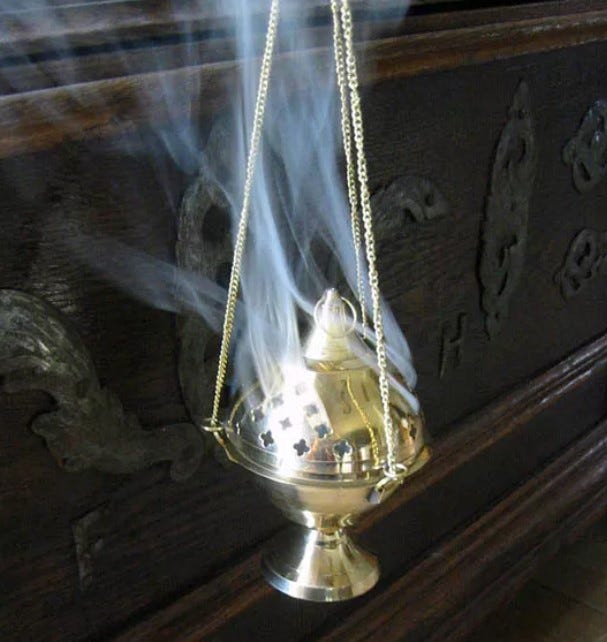
noun
“…a vessel for burning incense, especially: a covered incense burner swung on chains in a religious ritual.”
[ed. note: the latter also being specifically called a thurible*]
"vessel used for burning incense before an altar," mid-13c., from Old French censier, a shortened form of encensier, from encens "incense" (see incense).
late 13c., "gum or other substance producing a sweet smell when burned," from Old French encens (12c.), from Late Latin incensum "burnt incense," literally "that which is burnt," noun use of neuter past participle of Latin incendere "set on fire" (see incendiary). Meaning "smoke or perfume of incense" is from late 14c.
noun
“…a metal incense burner suspended from chains, in which incense is burned during worship services.”
The word thurible comes from the Old French thurible, which in turn is derived from the Latin term thuribulum. The Latin thuribulum is further formed from the root thus, meaning 'incense'. Thus is an alteration of the Ancient Greek word θύος (thuos), which is derived from θύειν (thuein) "to sacrifice."
censure, pronounced sen(t)’ shur
noun
1 - a judgment involving condemnation
unorthodox practices awaiting the censure of the city council
2 - the act of blaming or condemning sternly
The group faces international censure for its alleged involvement in the crime.
3 - an official reprimand
The lawyer's misconduct resulted in a letter of censure from the judge.
4 - archaic: opinion, judgment
transitive verb
1 a: to find fault with and criticize as blameworthy
She would tell him it was … no sign of a good pastor to be eternally censuring his flock. - Charlotte Brontë
b: to formally reprimand (someone): to express official censure of (someone)
2 - obsolete: estimate, judge
censurer
noun
Middle English, borrowed from Anglo-French & Latin; Anglo-French censure, borrowed from Latin cēnsūa "office of censor, assessment, moral oversight," from cēnsēre "to give as an opinion, perform the duties of a censor" + -ūra
verb - derivative of censure, probably after Middle French censurer
First known use
noun - 14th century
verb - 1590

Thank you for making sense out of nonsense at the Verbihund Café!
Please help spread the word to friends, students, family, and colleagues!
support the love of language and learning with a paid subscription
restack this post
forward to people you know
share on social media
Comments
Nothing yet. Say the first thing.
Sign in to join the conversation.