
Welcome to Capital for Nature, a 10-week learning series by Brainforest that makes nature investing practical and understandable. Every week, we will unpack one topic, from where the money can flow, to how deals actually work, to what it takes to create both impact and financial returns. Short, clear, and grounded in what we see every day with founders, investors, and philanthropists.
A barren landscape. Dry soil. Years of degradation.
Now imagine a swarm of drones flying overhead, releasing carefully designed seed pods, each tailored to the local ecosystem, each placed with precision.
What once took months of manual labor can now happen in hours.
This is not science fiction.
It’s Nature Tech.
For a long time, nature-based solutions were seen as:
Local
Manual
Hard to scale
Difficult to measure
Important, but limited.
That is changing fast.
A new wave of startups is combining technology, data, and biology to fundamentally transform how we restore ecosystems.
And investors are taking notice.
In 2022 alone, more than $2 billion flowed into nature tech startups, reflecting growing confidence that innovation can unlock environmental solutions at scale.
Nature Tech is not about replacing nature.
It’s about working with nature, more intelligently, more efficiently, and at scale.
Here are three areas where this is already happening:
Startups like Ceres Seeding are using drones to restore degraded land faster and more cost-effectively than traditional methods.
Instead of planting trees one by one, they deploy native seed mixes across large areas, dramatically increasing speed and lowering costs.
What used to be a bottleneck is becoming scalable.
One of the biggest challenges in conservation has always been measurement.
How do you verify impact?
Today, AI and satellite data are changing that.
Platforms like Xilva are building digital tools to assess forest projects, making due diligence faster, more transparent, and more data-driven.
This is critical.
Because what gets measured gets funded.
Regulation is often seen as a burden.
But in nature markets, it can be a catalyst.
Startups like Orijin are using technology to bring transparency into supply chains, helping companies comply with regulations like the EUDR while actively preventing deforestation.
What used to be a compliance cost becomes a driver of better practices.
This wave of innovation changes something fundamental:
It makes nature investable at scale.
Restoration becomes faster and cheaper
Impact becomes measurable and verifiable
Business models become viable and repeatable
For investors, this reduces uncertainty.
For entrepreneurs, it unlocks growth.
For ecosystems, it means impact can scale beyond individual projects to entire landscapes.
Nature-based solutions are no longer just small, local interventions.
They are becoming:
Tech-enabled
Data-driven
Scalable
Investable
This is the emergence of a new category:
Nature Tech.
A space where drones, AI, biotech, and digital platforms are not separate from conservation, they are accelerating it.
We are still early.
But the direction is clear.
As technology continues to evolve, the potential to regenerate ecosystems at scale becomes more realistic and more investable.
The question is no longer:
Can nature-based solutions scale?
But rather:
How fast can we build and fund the tools that allow them to?
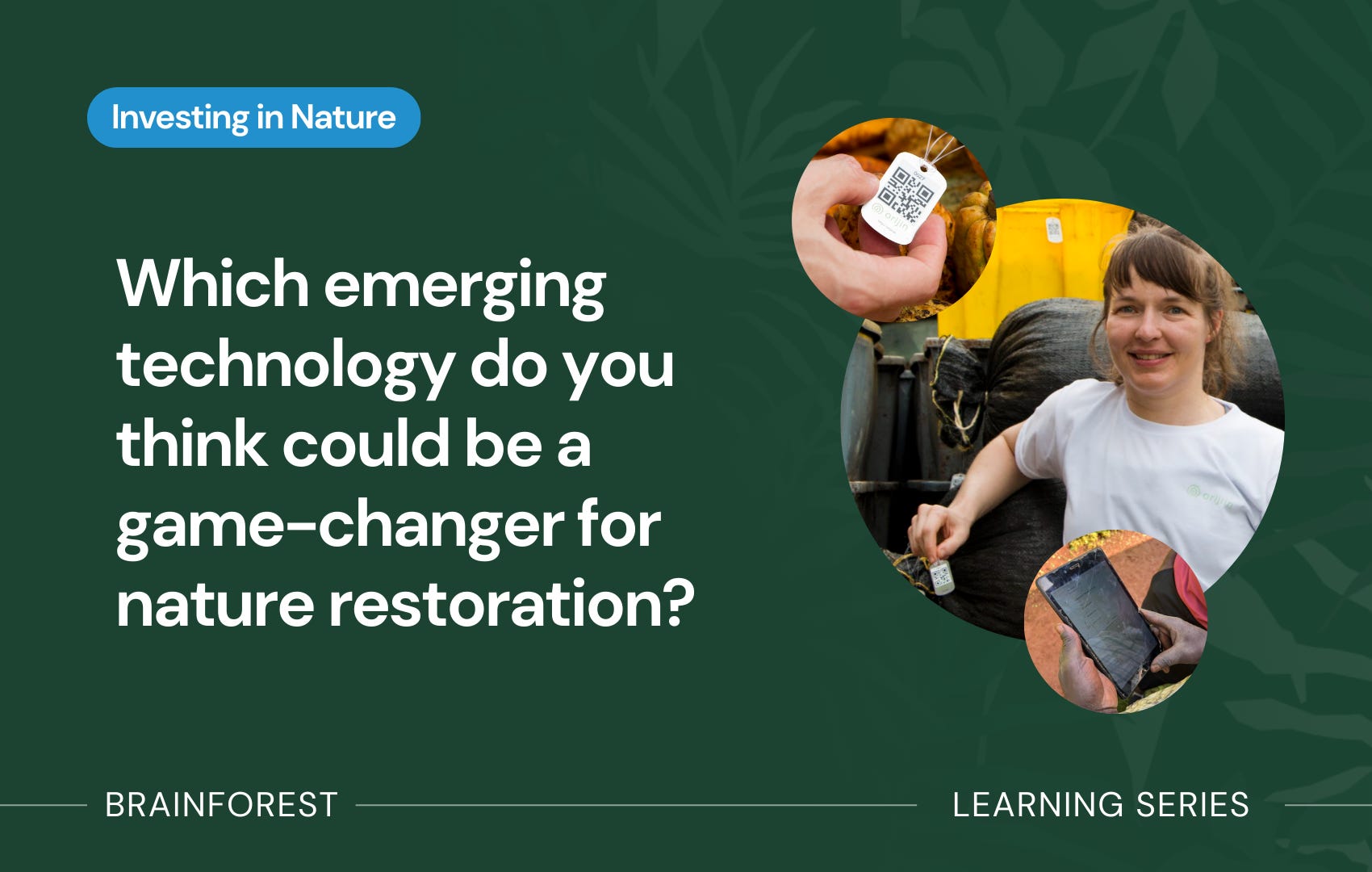
Which emerging technology do you think could be a game-changer for nature restoration?
Let’s explore what the next decade of Nature Tech could look like… together!
Comments
Nothing yet. Say the first thing.
Sign in to join the conversation.