

The allure of being 'venture-backed' often overshadows its true purpose. While it's seen as a status symbol, venture funding, at its core, is a tool, not a destination. VCs offer jet fuel, perfect for jets but not ideal for motorcycles.
Reflecting on recent benchmarks in venture financing, founders often face significant equity dilution—surrendering around ~20-30% for ~$4M and ~50% by Series A. This dilution, however, is often a necessary tradeoff. The intrinsic risk-reward relationship in early-stage investments means higher equity costs align with more significant risks, a hallmark of venture dynamics.
But what if a founder could, in the right situation, buy back some of that equity once an investment is de-risked? In some situations, that may be a better outcome for both the investor and the founder–especially when a founder builds a motorcycle, not a jet plane.
A redeemable instrument grants a party the right to buy back or “redeem” the equity previously sold at a particular time or under specific conditions. A company might receive the right to buy back the equity sold to an investor at a specific price in certain situations (e.g., the option to buy back shares sold for $1 per share at $4 per share).
A founder whose company sold shares to an investor for $1 per share may be willing to repurchase those shares for $4 if she believes the shares are worth more than $4 and such repurchase doesn’t jeopardize its long-term prospects.
Those same terms may be suitable for the investor even if the investor believes the shares are worth more than $4, such as if the timeline for receiving the liquidity is inconsistent with the investor's goals and objectives.
Remember, one of the key metrics for an investor is the Internal Rate of Return, which measures an annualized effective compounded return rate, accounting for the timing and the magnitude of cash flows in and out of an investment.
Consider a practical example of a startup receiving an investment via a SAFE on a $5M cap with a redemption feature allowing the company to buy out the SAFE at 3x the original investment. The company, profitable (or near profitable) with steady growth, does not anticipate raising a priced round or exiting soon. If it did raise money, the valuation would be ~$15-20M. The founders estimate the business could sell for ~$100M in about ten years. In this situation, a redemption at 3x the original investment within 18 months of the investment may make sense for both the founders, who retain equity, and the investor, who receives a liquid multiple.
Innovative Finance Newsletter goes into depth on the range of outcomes here.
Led by Jonathan Bragdon, Capacity Capital is an early-stage fund focused on revenue-generating startups with an eye toward early profitability. Besides traditional investments, Capacity invests under its “Capacity Capital Agreement,” akin to the post-money SAFE but with a redemption feature. This feature allows redemption of up to 90% of Capacity’s equity at a multiple of the original investment (e.g., 3x).
This redemption mechanism comes in two forms: discretionary and mandatory. Discretionary redemption allows the company to make payments before a specified date (e.g., 18 months). In contrast, mandatory redemption requires payments based on a percentage of revenue after this period if no priced round or sale occurs. These terms are collaboratively tailored to each company’s strategy and business plan.
An illustration of how such an investment may be structured:
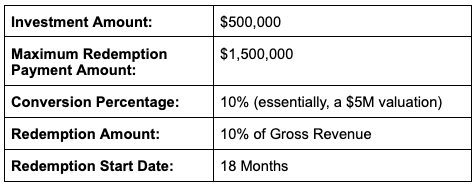
Comparing this with market data, the median pre-seed amount raised is $500k at a ~$5M pre-money valuation, converting into 8-10% equity. For seed rounds, it’s $3.3M at a $13.3M valuation, buying 20%. A 3x multiple on valuation between pre-seed and seed.
These ratios align with the 3x multiple in Capacity's redemption feature. If the company raises another round and never makes any discretionary redemption payments, the investment will convert into preferred stock, and the redemption payments will disappear. If a subsequent round isn’t raised, 10% of gross revenue pays back the investment until the maximum redemption amount is met, leaving Capacity with a reduced equity conversion right (reduced to 1%).
*Shayn Fernandez is a partner at Capacity, but Capacity developed the Capacity Capital Agreement before his involvement.
Investing in founders often overlooked by traditional VC, Collab Capital employs a unique redeemable equity strategy combined with profit-sharing through its SPACE (Shared Profits and Collaborative Endorsement) Agreement. Collab invests in companies with a viable path to annual revenues above $1M within one year of their investment and $10M within three years at 40%+ profit margins.
With the SPACE, once a company achieves a revenue target predetermined in collaboration with Collab, Collab shares a portion (e.g., 20-25%) of the company's profits as a repurchase of a portion of Collab’s equity for every profit-sharing multiple returned.
An example of how such an investment might be structured is:
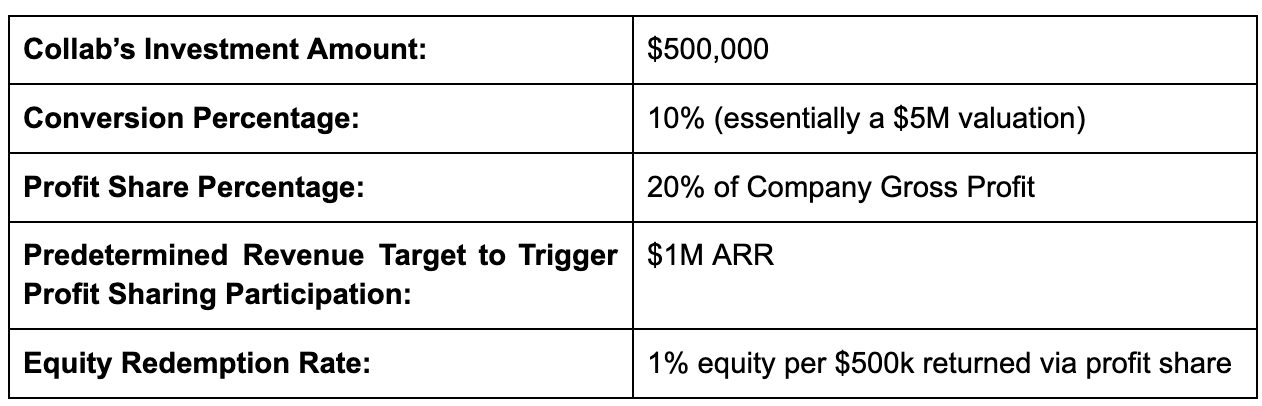
In this example, once the company reaches the $1M ARR revenue target, Collab will take 20% of the company's profits to return capital to the fund. Collab may also defer profit share payments if reinvesting the money into the business is more beneficial.
Then, for every $500k Collar receives from profit sharing, Collab reverts 1% of its 10% equity back to the company. For example, if Collab retains $500,000 from the company’s profit sharing in year 2, $1M from profits in year 3, and $1.5M in year 4 ($3M total), Collab has effectively received a 6x return on its investment and has dropped its equity stake from 10% to 4%.
With this model, Collab Capital seeks to build alignment with its companies and to re-imagine what success looks like for venture-backed companies and venture capital investors through the SPACE Agreement.
Even if the market isn’t as big as expected, or customers don’t want to pay as much, it doesn’t mean the business shouldn’t exist. The company may need a different type of fuel to go.
In an ever-evolving venture landscape, tools like redeemable equity reshape how startups approach capital acquisition and investors pursue liquidity. These instruments foster financial alignment and strategic collaboration between founders and investors. Don’t get me wrong, just like a traditional venture investment, redeemable equity isn’t for every situation or company–but it can be a tool to reach the ultimate destination.
If you like this post, you should follow me on Twitter, check out what we are building, or set a time to chat.
Disclaimer: While I am a lawyer who enjoys operating outside the traditional lawyer and law firm “box,” I am not your lawyer. Nothing in this post should be construed as legal advice, nor does it create an attorney-client relationship. The material published above is only intended for informational, educational, and entertainment purposes. Please seek the advice of counsel, and do not apply any of the generalized material above to your facts or circumstances without speaking to an attorney.
Comments
Nothing yet. Say the first thing.
Sign in to join the conversation.