

Data rooms come in all shapes and sizes—from seed rounds to M&A data rooms. A data room collects and displays relevant information to facilitate a desirable outcome. Investors use data rooms to analyze opportunities but to present that analysis to their partners and investors—often through an investment memo. A good data room makes it easy to write and defend that investment memo.
Your data room should include (and be organized around) helping an investor justify making an investment. Fundraising is a momentum game, and nothing kills momentum like back-and-forth data collection. In this post, we will explore the key components of a data room.
A good data room should include the key forms of delivering your pitch.
Pitch Deck.
A good pitch deck tells a story of a clearly defined problem. A problem that is so big and urgent it needs to be fixed now. Fortunately, you have a clearly defined solution for this clearly defined problem. Not only do you have the solution, but now is the right time, and you have the team to solve this problem. You have evidence that customers will pay you to fix this problem, and you have a path to doing so profitably. And like any good story, there is a call to action, which is an invitation to help conquer this problem.
Executive Summary.
This is your opportunity to tell that story in more detail—to better define the problem and the path to solving it (how you will do it). It is also important to lean in the call to action—what is the next milestone, how will capital be used, and why is it the best use of capital to reach that milestone.
Demo Video.
This is often overlooked, but what better way to show your understanding of the problem and how customers want it solved than by demonstration? This is your opportunity to show why your solution is sticky, and why your road map for saying goodbye to the problem works.
This varies dramatically by stage. However, don’t discount the importance of financials even at the seed or pre-seed stage.
Financial Model.
Your financial model will be wrong, but that doesn’t matter–you should be thinking about your financial model through the next milestone(s), but avoid detailed projections covering 3-5 years. Investors want to see how you are seeing the business's cash flows, when you will need to push on the accelerator, and the outcomes of those variables. Importantly, you should be updating your model—you don’t want to look like a fool when your historical financials are significantly different than the time periods covered in your model (or are left unexplained).
Historical Financials.
The detail depends on the stage, but even businesses that do not have significant revenue should include basic financials. For instance, even without revenue, you can show how much runway you have as well as your monthly expenses. Investors will look at how far their check will take you based on your current situation and anticipated expansion.
Key Metrics.
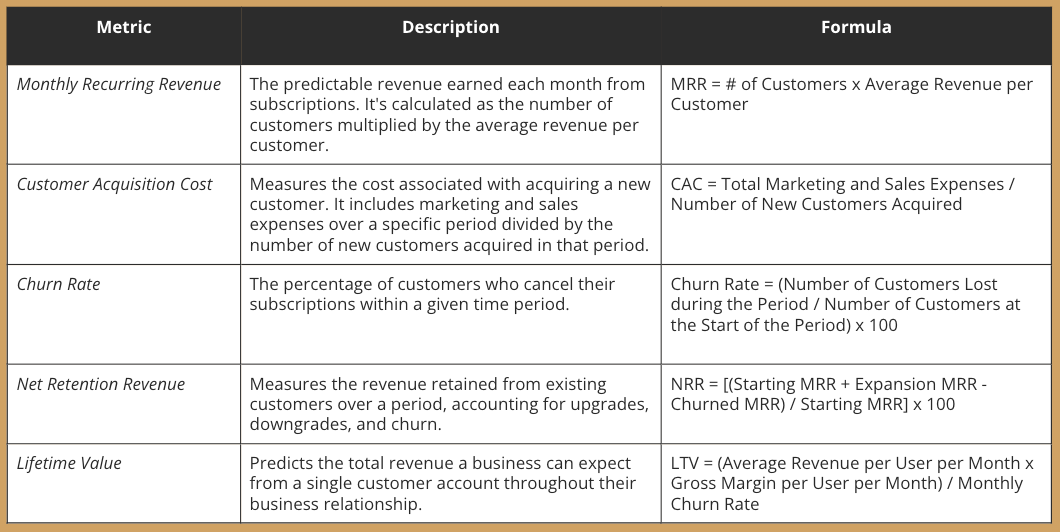
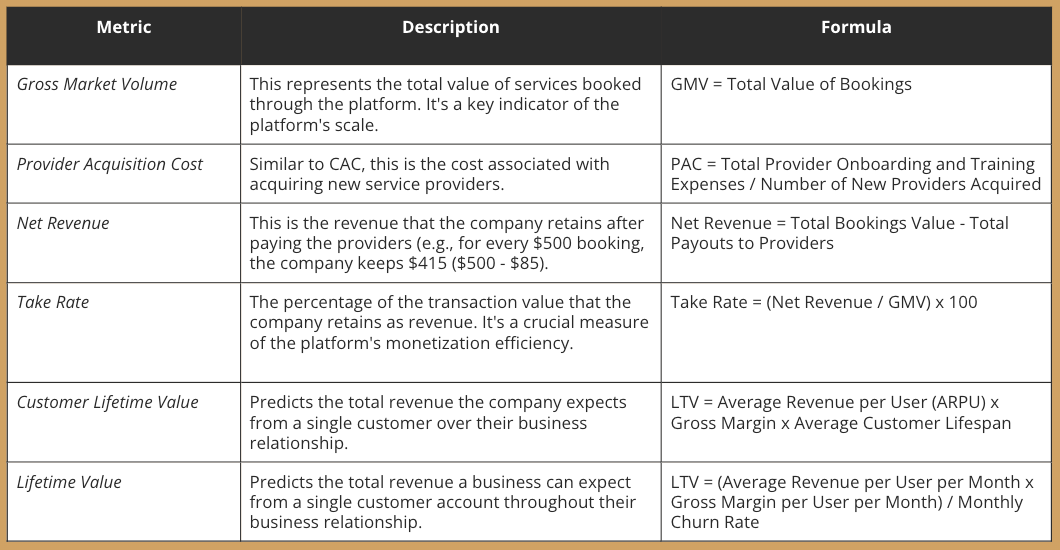
Different business models have different key metrics (e.g., subscription-based vs. marketplace). However, many models have overlapping metrics such as customer-acquisition-cost and burn rate. Here are a few key metrics based on common models:
Subscription-Based (e.g., Slack, Notion, Spotify)
Marketplace (e.g., Airbnb, Upwork, Uber)
a16z goes into a bit more detail on key metrics based on the business model here.
What is your target market, ideal customer profile, and how will market and sell your products to customers?
Market Research and Competitive Analysis.
Avoid broad statements about market size and how you’ll capture 80% of that market. Instead, include a concise analysis of how you view the market and your place within it. You should showcase that you not only understand this market well but also understand your competitors and their strengths and weaknesses. Hesitate before you create a chart that shows your competitors have significantly fewer features and solutions than you; especially if those are features that you do not currently have–they are simply features on your roadmap and are not accounted for in your financial projections (e.g., the costs and expenses of those features are not accounted for but you’ve booked the revenue related to those features).
Marketing and Sales Strategy and Traction.
Be clear on how you view your ideal customer profile and showcase how you will go to market with your product. You should include the channels you are using to acquire customers, those you’ve explored, and where you believe you will succeed most. You should also include general information about your sales pipeline (e.g., large sales that are in the pipeline) and process (e.g., in-bound v. out-bound strategy).
Retention and Cohort Analysis.
Are you keeping customers over time, and are users using your product more? Companies with significant customers should also consider providing a cohort analysis, which groups customers together based on shared characteristics and allows the investor to analyze things like customer retention, engagement, and revenue generation over time. Case studies and references can also be helpful here.
The degree of detail depends on the nature of the product. For instance, biotech, medical devices, or hardware might require much more information on the technology or product than a SaaS product or a consumer good.
Include a short written description of the current state of the product as well as the future roadmap and timelines. Those timelines will be inaccurate, but they will provide investors with insight into how you view the development of the product. Also, include demo videos of current and developing features. I would also be hesitant to consider an investor serious if they are not actively testing or using the product.
A few important categories of information investors are looking for here:
Cap Table.
You should have a fairly detailed cap table showing the current stockholders, issued options, available option pool, and a schedule of convertibles and their terms (e.g., SAFES with related valuation caps). The cap table can be appropriately redacted to protect certain personal information, such as the names of employees or investors. A great cap table also includes information such as the vesting start date and the vesting end date for founders and key personnel.
Governing Documents.
Include your most up-to-date Charter, bylaws, founder grant documents, and any other key documents that govern the company (e.g., Investor Rights Agreements, Right of First Refusal and Co-Sale Agreements). If you have anything other than a vanilla “Delaware C-Corp from the start” history (e.g., conversion from an LLC to a corporation), include those documents as well, along with a short explanation.
Investment Documents.
If you are closing out a round under a term sheet, you should include the signed term sheet. You should also include any other relevant investment documents, like a form of the SAFE that investors in the previous round signed and any side letters that are relevant to the current round (e.g., if previous investors have pro-rata rights in the current round).
Intellectual Property.
Include relevant information on registered IP or the status of applications for registration (e.g., trademark or patent applications). You should also include appropriate information about disputes regarding IP (e.g., cease and desist letters received). Everyone who touches your product or technology should sign a Confidential Information and Invention Assignment Agreement; you should include that form agreement in the data room and include a statement clarifying that all relevant personnel have signed such agreement or something similar (so long as that is true).
Obvious Disclosures.
Of course, you need to disclose any litigation, threats of litigation, regulatory disputes, etc. You should also include any specific regulatory or compliance information that is relevant (e.g., if you are a medical device company, the status of FDA approval). If the founders have personally funded a large portion of the company out of their personal savings at the early stages and have evidenced this with something like a founder note (e.g., a Convertible Note or SAFE), then make sure you disclose that as well.
You should include background information about the key personnel, such as founders, executives, and (maybe) key advisers. For instance, the founders’ track record and experience in the industry or solving similar problems. You should also include raw numbers on headcount—however, hiring plans may be better suited in the discussion of the use of the investment funds (see executive summary or pitch deck).
I’ve started seeing this lately and it is super helpful. Basically, it is a chronological collection of the various investor updates that have been sent over time. This provides investors with a bit of a time machine to see where you’ve been and how far you’ve come. Knowing that each investor update will be included in a full collection will also focus your headspace for each investor update.
The days of investments without diligence are (hopefully/probably) behind us, but that doesn’t mean that startups shouldn’t be prepared to move quickly. Ultimately, the purpose of a data room is to make it easy for an investor to make an investment. If investors have to do a ton of work to track down relevant information, your startup is at a huge disadvantage. Yes, every data room is different, and investors may be looking for different information—but hopefully, this provided you with a general framework of the contents and purpose of a data room.
Hey, I am Shayn. I am the Founder of Junto Law, and a partner at Capacity Capital. If you like this post, follow me on X or set a time to chat.
Disclaimer: While I am a lawyer who enjoys operating outside the traditional lawyer and law firm “box,” I am not your lawyer. Nothing in this post should be construed as legal advice, nor does it create an attorney-client relationship. The material published above is only intended for informational, educational, and entertainment purposes. Please seek the advice of counsel, and do not apply any of the generalized material above to your facts or circumstances without speaking to an attorney.
Comments
Nothing yet. Say the first thing.
Sign in to join the conversation.