
Happy New Year, everybody! We’re back sailing on the Ventorship, and we’ve got our first Vent of the year from Kate Fussner, telling us about the years it took to bring her latest book, 13 WAYS TO SAY GOODBYE, to bookshelves. I’ve had a lot of talks with authors about the pluses and minuses of multi-book deals, and Kate gives some great perspective on what those journeys can look like. Good info to keep in mind as we prepare for the book deals that are coming our way in 2026! Let’s dive in!

Jason June (JJ): When you started your writing journey, what was the biggest frustration you encountered as you tried to find an agent and/or went on sub to editors for the first time that you wish you could have vented about?
Kate Fussner (KF): For me, querying and going on submission are both leaps of faith; or, if not leaps of faith exactly, they are moments where you as a writer must decide if your art and your heart are up to the task of asking, “Are we ready?” I realize this sounds a little out there, but for me, trying to determine if I was ready was the hardest part. After all, how do you know if a book is ready? And how do you know if your book and spirit are ready for the inevitable slog of rejections? When I was querying, lots of friends liked to remind me, “It only takes one yes.” When Eric Smith (my agent) and I were ready to go out on submission, Eric reminded me again, “It only takes one yes.” But do you know how many NO’s it also takes?! So many! Dozens! More than dozens! Obviously, putting in the work into your writing is one way to help lessen the number of no’s that are headed your way, but the reality is: there will always be more no’s than yes’s (rude). And back when I was beginning to query, I wasn’t sure if my heart was up to the task of hearing all of the no’s, and I wasn’t sure if there was someone out there that would say, “Yes.” I started querying by testing the waters in a Twitter (RIP) pitch contest. When I saw I was getting interest from agents I hadn’t even researched yet, I realized that if I was going to pitch any agents then I might as well pitch the ones that I had spent time and energy researching to find my “best” matches.
JJ: How about after you got your first book deal and continued on to publish multiple books? How did your frustrations (if you had any) change, and what would you have vented about or did vent about to author friends?
KF: When I signed a two-book deal for my debut novel, I thought I had truly made it (insert millennial lol here). Alas, this was not the case. While it was, in many ways, a great blessing to sell two books in one go, I had no plans for a sequel and no idea what the process would be like for pitching a second standalone novel. Add to it a strike at HarperCollins when I could have been getting started on pitches for my second book and I felt very, very lost. Don’t get me wrong: I am a big supporter of unions and am glad that the strike resulted in contract improvements for union members. But it also meant delaying the ability to work with my editor and thus fumbling alone through a draft of a middle grade novel that I loved but ultimately could not sell as my second book. When my editor and I decided on a second book idea, it was a vast re-write of a story I had been trying to tell in another form (more about this in a moment). Basically, from delaying my second book to writing an entire draft of a book I couldn’t use to stumbling through a revision that essentially meant fully reimagining a story, nothing about my second book in my two-book deal felt “easy” or like I’d “had made it.” It felt like that moment right after you trip but before you hit the ground where you aren’t sure if you’re going to catch yourself or fall, but for months on end. On top of that, I felt bad about feeling bad. Wasn’t a two-book deal a dream? If I could offer readers a piece of advice, it might be this: don’t feel bad about your feelings. It doesn’t help. You might want to be selective about who you share your venting to, because not every group chat is right for a “my second book that’s already under contract is soooooo hard” chat and that’s reasonable! Finding your people who can help celebrate you and hold the hard with you is critical in this industry.
JJ: Tell us about your latest book! And (I bet you know where this is going) what’s the biggest vent you’ve got about the process of creating this novel?
KF: My latest book, 13 Ways to Say Goodbye, is a queer middle grade novel-in-verse about 12-almost-13 year old Nina, who sets out to finish her deceased older sister’s “13 Before 13” birthday goal list only to discover something magical happens each time she completes one of Lily’s unfinished goals. Set in Paris and its many art museums, 13 Ways is a story of grief, sisterhood, first love, art, magic, and ghosts. This book for me was a bit of a Ship of Theseus. While it was always a story of grief, sisterhood, and magic, the story began in my head in 2017 as a YA prose novel set in Boston with a magical elevator. By the time it hit the shelves, it was a MG novel-in-verse set in Paris with a magical to-do list. Both stories were about a younger sister grieving the loss of her older sister a few years after the death. Both stories were about how to grow up when the role model you’ve had for yourself is suddenly gone. But nearly everything else about the story had to change. As I wrote, re-wrote, re-imagined, revised, re-envisioned the hell out of this book, there were so many pieces that I wanted to work that just would not work. In the end, what made the book work was my ability to let go of certain pieces that had once felt so essential and to trust that it would, in fact, be the same story I had always wanted to tell. My biggest vent along the way was how hard it was to trust that the story would ever work. In some ways, I felt so far from the original story that I wasn’t sure it ever could work. My friends heard about this for years before it finally worked (shout out to them for listening for so long and trusting that I could get there even when I didn’t know for sure!). I suppose the lesson here is that you really do have to be okay with killing your darlings, because sometimes what’s on the other side of that death is something so much stronger.
JJ: Any words of wisdom you have for writers whether they are at the beginning of their journey or multi-published?
KF: Find your people. I would not have made it through my MFA program (during the pandemic no less!) without my writing friends and mentors. I would not have made it through my debut year without my Pride 5 queer kidlit friends, who hyped me up when things were hard and cheered me on with every little victory. Often in publishing, there’s very little transparency about how things work, how resources are distributed, and how much control you actually have over your work once it’s completed. So find your people who will celebrate you, let you vent, hear you out, and share their own vents with you, and then hold onto them as much as you can. Writing is an act of community. I hope you find yours.
JJ: Thanks so much for joining us aboard the Ventorship, Kate! Author-passengers, read below for more info about Kate and 13 WAYS TO SAY GOODBYE!
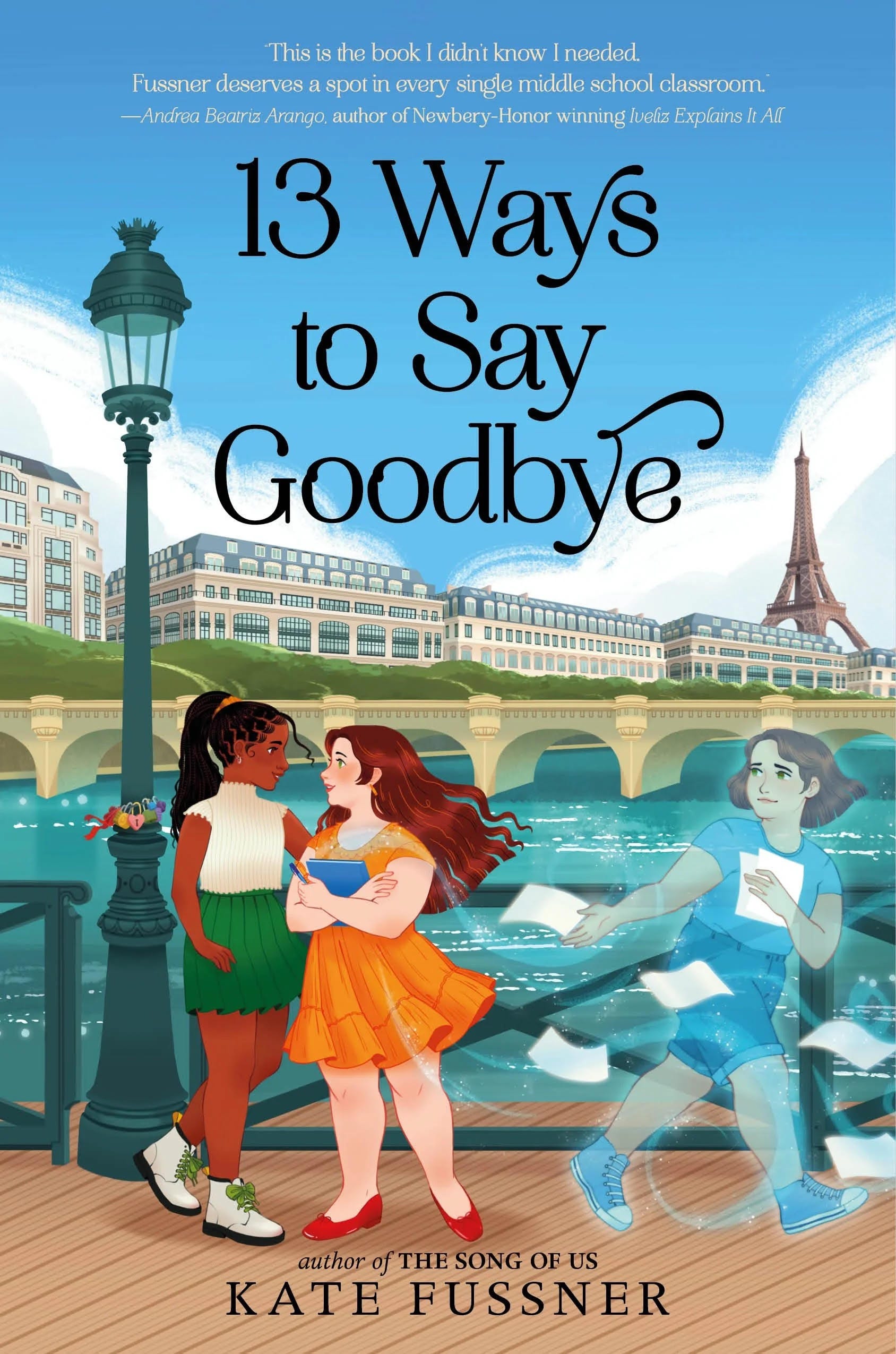
About 13 WAYS TO SAY GOODBYE
A novel-in-verse about life after loss, 13 Ways to Say Goodbye beautifully renders the power of sibling bonds, the depth of grief, and the strength of learning to love again, perfect for fans of Everywhere Blue and The Distance to Home, from the author of The Song of Us.
Nina always followed her older sister, Lily. But just before her thirteenth birthday, Lily died, leaving Nina behind forever.
In the three years since she lost her sister, Nina has completed Lily’s secret Before Birthday lists to continue in her footsteps. But now Nina is catching up. When Nina flies to Paris, France, and completes tasks that Lily never finished, Nina finds herself magically transported inside of her own memories, face-to-face with the ghosts of her past.
With her birthday looming and the last list running out, Nina is torn between visiting her sister in her memories and adventuring in the present, including crushing hard on her art classmate, Sylvie. Should she follow Lily’s instructions or try something new? And what happens when she finishes the list?
About Kate Fussner
Kate Fussner (she/her) is a novelist, teacher, and accidental poet living in Massachusetts with her wife and dramatic dog. She holds her B.A. in English from Vassar College, her M.Ed. from UMass Boston/Boston Teacher Residency, and her M.F.A. in Writing for Young People from Lesley University. Kate spent more than a decade teaching English for grades 6-12 for Boston Public Schools, where she created and implemented choice-based curriculum for her students, helping all students find joy in reading. Her partnership with her school’s teacher-librarian to build a school-wide culture of reading was the focus of several BPS professional developments and the BostonEd Talks in 2019. Her debut novel, The Song of Us (HarperCollins) was named a 2024 Notable Verse Novel by NCTE, longlisted for the MA Book Awards for YA/MG, and named a Best Children’s Book of the Year by Bank Street College of Education. Her second queer middle grade novel-in-verse, 13 Ways to Say Goodbye (HarperCollins), a story of grief, first love, art, Paris, and ghosts, released on March 18, 2025.
If you’d like to anonymously vent about anything author/writing related, write to me at heyjasonjune@gmail.com with the subject: VENTORSHIP. I’ll give you my take in a post, and we’ll crowdsource author opinions in the comments. You’ll remain anonymous, and any haters will be thrown overboard. Ultimately, I think you’re going to be buoyed up by author love and support as we realize we really are all in the same boat 🛳️
No posts
Comments
Nothing yet. Say the first thing.
Sign in to join the conversation.