
The story of Belgian cycling in the golden 1970s is often told through the lens of pure, unadulterated genius—the ruthless dominance of Eddy Merckx, the slick elegance of Roger De Vlaeminck, or the explosive flair of Freddy Maertens. Yet, no rider quite embodied the raw grit, fiery temperament, and heroic work ethic of that era better than Frans Verbeeck. Known affectionately throughout his life as “De Melkboer” (The Milkman), the native of Wilsele passed away on August 21, 2026, at the age of 85, leaving behind a legacy defined by an unmatched appetite for agony and one of the most remarkable second acts in sports history.
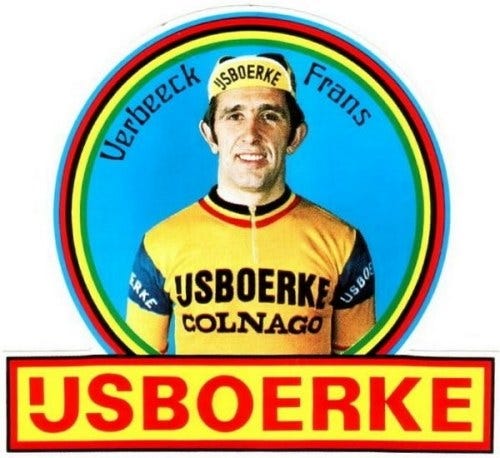
Verbeeck’s career was a Tale of Two Halves. In his initial stint as a professional between 1963 and 1966, he was very much an understated pack rider. Hindered by a modest salary of 5,000 Belgian francs—hardly enough to make ends meet, forcing his wife to support the household—and demoralized by the realization that top-tier success remained out of reach, he hung up his wheels at the age of twenty-five to take over a local milk delivery route. Yet, life in the milk crate proved to be a crucible. Stepping away from the sport brought a stark realization: he had never truly dedicated himself one hundred percent to the craft.
Determined to rewrite his story, Verbeeck launched an improbable comeback in the spring of 1968. Balancing his early morning milk deliveries with grueling training rides, his resurgence was pure blue-collar heroism. Before winning his first Omloop Het Volk in 1970, Verbeeck awoke at five in the morning, packed his milk truck as a form of power-training, completed his rounds by eight, and drove his battered Volkswagen to Ghent—munching on sandwiches while a friend held his coffee cup. Winning that afternoon proved transformative. The former journeyman discovered an obsession with pushing past his physical thresholds; where others saw pain, Verbeeck saw purpose.
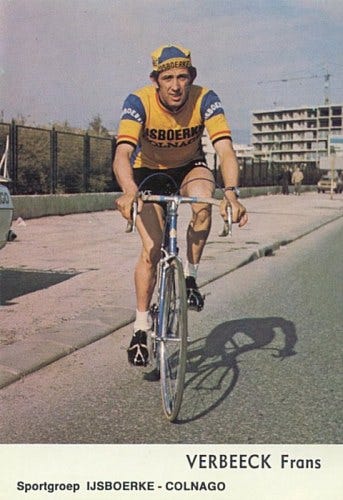
What followed was an extraordinary decade among the elite. Though lacking the innate, effortless class of a natural-born prodigy, Verbeeck compensated with sheer ferocity and an unconditional training regimen. He became the central pillar of teams like Watney and later IJsboerke, routinely racing up to 150 events a season. If he wasn’t lining up in a Grand Tour, he was storming four mid-week kermesses, driven by an almost pathological refusal to hide in the wheels.
His palmarès grew into a staggering testament to consistency and tenacity: triumphs at Omloop Het Volk, the Amstel Gold Race, and the Waalse Pijl, along with a iconic Belgian National Championship title in Soumagne in 1973—a victory achieved after almost abandoning early on due to a foot infection, only to outsprint Merckx himself at the line. Across the Monuments and major classics, Verbeeck achieved an astonishing forty top-five finishes, including nine in 1975 alone.
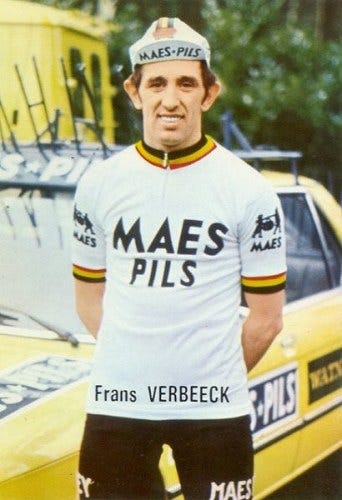
Yet, Verbeeck’s place in cycling folklore was forged just as much by his near-misses and his fiery character. Who could forget the legendary 1975 Ronde van Vlaanderen? On the Oude Kwaremont, 100 kilometers from the finish, Verbeeck doggedly matched a brutal acceleration by Merckx, enduring a harrowing ordeal where he was pushed so far into the red that he could barely hold the wheel. Broken and spent by the finish line, a exhausted Verbeeck delivered one of the most famous quotes in cycling broadcasting history, breathlessly declaring: “He rides five kilometers an hour too fast for us. I don’t know how he does it. I really don’t know.”
That was Verbeeck: honest to a fault, a bundle of raw emotion and vitality. He was a rider who swore, gestured, barked orders at teammates in the heat of battle, and once even snatched a red flag from a race official who had annoyed him and tossed it into a roadside field. He could only truly enjoy a victory if he felt dead to the world upon crossing the line.
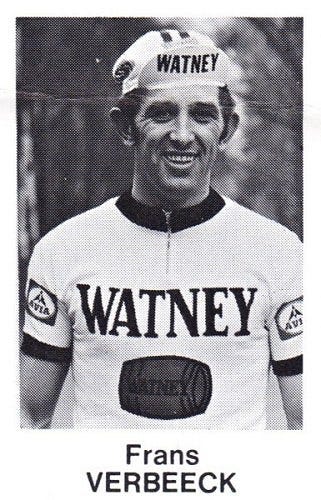
When Verbeeck retired for good in October 1977 after a final victory in Herentals, he transitioned his trademark intensity straight into the business world. Having left school at fifteen, he built a hugely successful sports clothing empire from scratch, working sleepless six-month stretches without a single word of complaint. Frans Verbeeck was a man who knew how to take a punch, thrive under pressure, and elevate everyone around him. In an era dominated by giants, the Milkman stood tall on the front line, proving that sheer force of will can carve out immortality.
In the end, Frans Verbeeck reminded us that while talent gets you to the starting line, it is character—and character alone—that carries you into legend.
Comments
Nothing yet. Say the first thing.
Sign in to join the conversation.