
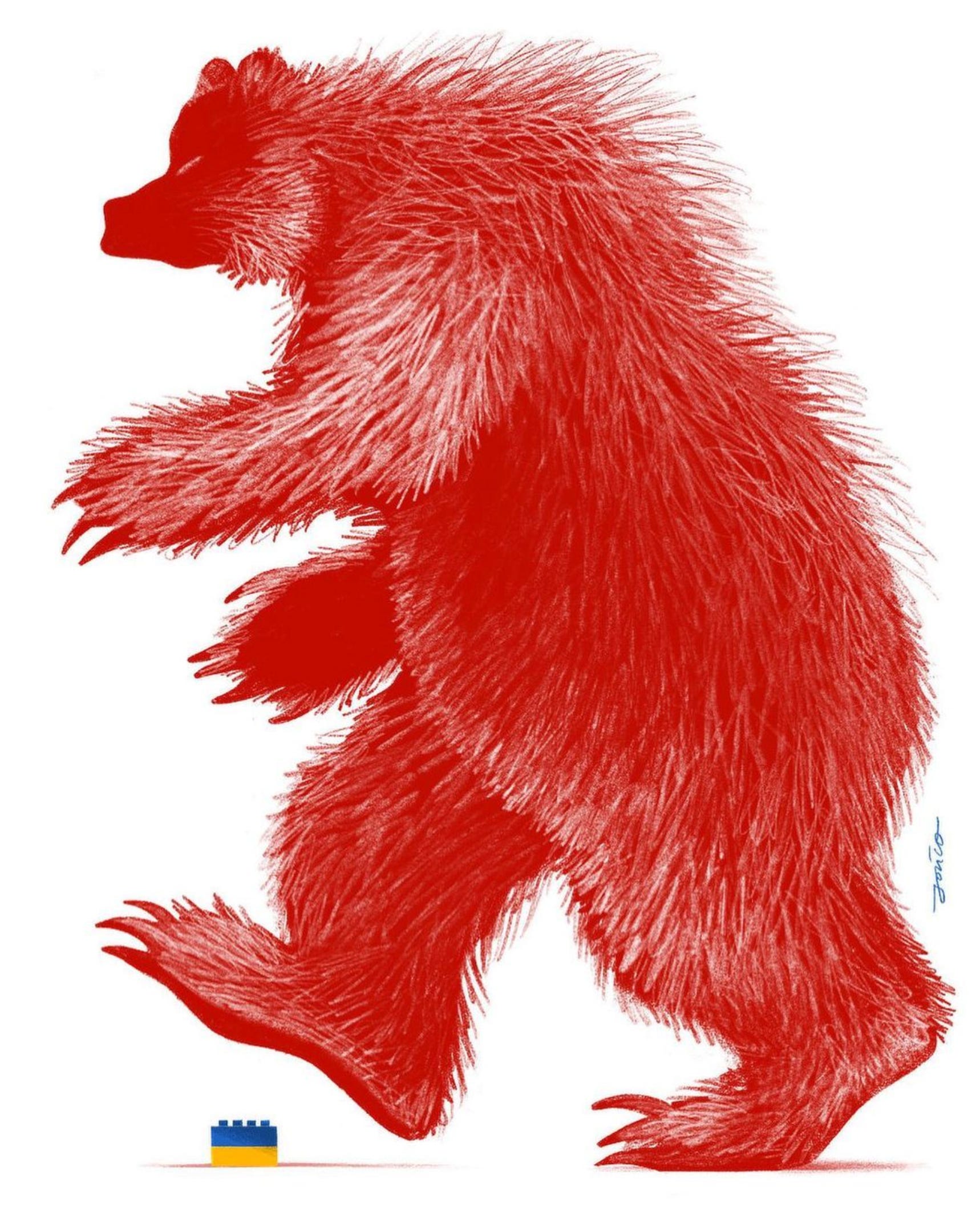
*CW/TW: I talk a lot about the Ukraine war and news photographs from the invasion in this post, but I do not go into any descriptive or triggering details. There are also anti-war protest posters sprinkled through the post by Ukrainian and Polish artists.
In high school (I’m old remember, so this was circa 1998) my classmate Mel and I were talking about the Internet. Probably many of us had computers at home by this point and we definitely had email addresses (hotmail and yahoo of course). I was in love with the Internet. I surfed that web! I clicked on those webrings, I devoured my fave ER fan webpages and everyone’s weird fanfic and my ICQ kept going UH-OH (I was #103388368, I think?).
Mel was an aspiring actor into musical theatre (this was an arts high school) and she confessed to me one day at lunch break that she was afraid of the Internet. Biting into her sandwich she told me she only dared check her email and make a cautious trip to Sondheim.com. I was kinda shocked - ‘Luddite!’ I remember thinking. I mean: the Internet had so much to offer! So many tv show fan pages to look at, people’s weird art sites, music lists, and you were even able to Ask Jeeves. Why wouldn’t you spend all your waking hours in there exploring? People: it was the age of innocence. Internet cafes were becoming a thing. Pagers still existed. Online dating was something you did only if you wanted a guarantee of meeting an axe murderer.
A solid two decades later, how far we’ve fallen. I’m thinking Mel was on to something - can someone please tell her that I too am afraid of the Internet now?
These days I’m finding I’m actually wary of picking up my phone in the morning and having a little scroll through my IG feed and quickly checking the news. Nothing is quite safe.
Take the Russian invasion of the Ukraine. In its fifth week, the mindmelting horrors compound daily. The images of the war mostly pour into my phone (and therefore, my mind’s eye) through jarring interruptions in my Instagram feed. First, a ceramics video. Cool. Two illustration posts. They are both excellent, and I heart them both. Oh look, a bodega cat! Yay, that’s a quality meowzer! And then, abruptly and with no warning: a chilling carousel of war photos from any number of news outlets I follow on IG, pushed up by the algorithm because the posts are getting so much engagement. Seeing these wretched images as I stand in my kitchen with my coffee and my cats, and having just watched a ceramics throwing video while I wait for the kettle to boil for coffee is completely…destabilizing? Gut punching? Not what I was prepared for at 7:42am? Not what I expect out of the seemingly safe and fluffy web-space of my IG feed? This experience is something we’ve all been subject to for a lot of different world events in recent years. My nerves are a bit frayed, as I’m sure yours are.
I have had to mute/unfollow news outlets on Instagram in the last weeks to try and give myself the news diet I know I need at this moment to stay sane. If COVID taught us anything it’s too much existential bad news will wreck you just as fast as the virus will crush your unvaccinated immune system. The tradeoff to my news diet is that it makes me less informed. It’s an uncomfortable feeling because I have always really prided myself on keeping up with the news. I don’t find reading a lot of news to be a good practice for my mental health but until recently I just always wanted to know everything all the time. It mattered, and just a much now suddenly it matters more to me to not know the exact details of everything.
The question I wrestle with when the horrible content just keeps coming is: how granular do you need to get? Is simply knowing the vague outlines, the loose pencil lines of the thing enough? Can I leave the heaviest stuff, the stuff I’m not capable of processing without harming myself, in hazy grey tones and not the sharpest, finest detail? Sharing a message through protest art is a good filter. It helps to not be suddenly confronted with the source, but filtered through another’s visual thoughts.
So I’ve muted the news outlets, I now only get news if I intentionally visit a news site (which I also just don’t anymore for the same reasons!). This also means I don’t see any other news posts about other events. I wish I could just mute posts only about Ukraine, but this is the clumsy instrument we’ve got. OK: I’m in an information void of my own creation, right? Wrong! The people I follow on Instagram also follow news outlets. They share to their IG stories the images, their outrage, their own shock and horror. So what now? Do I mute them too, never to hear from them online again because I forget their account exists after it’s muted? I like these people! Often their posts are exactly what I’m on this stupid IG platform for! Where does this end?
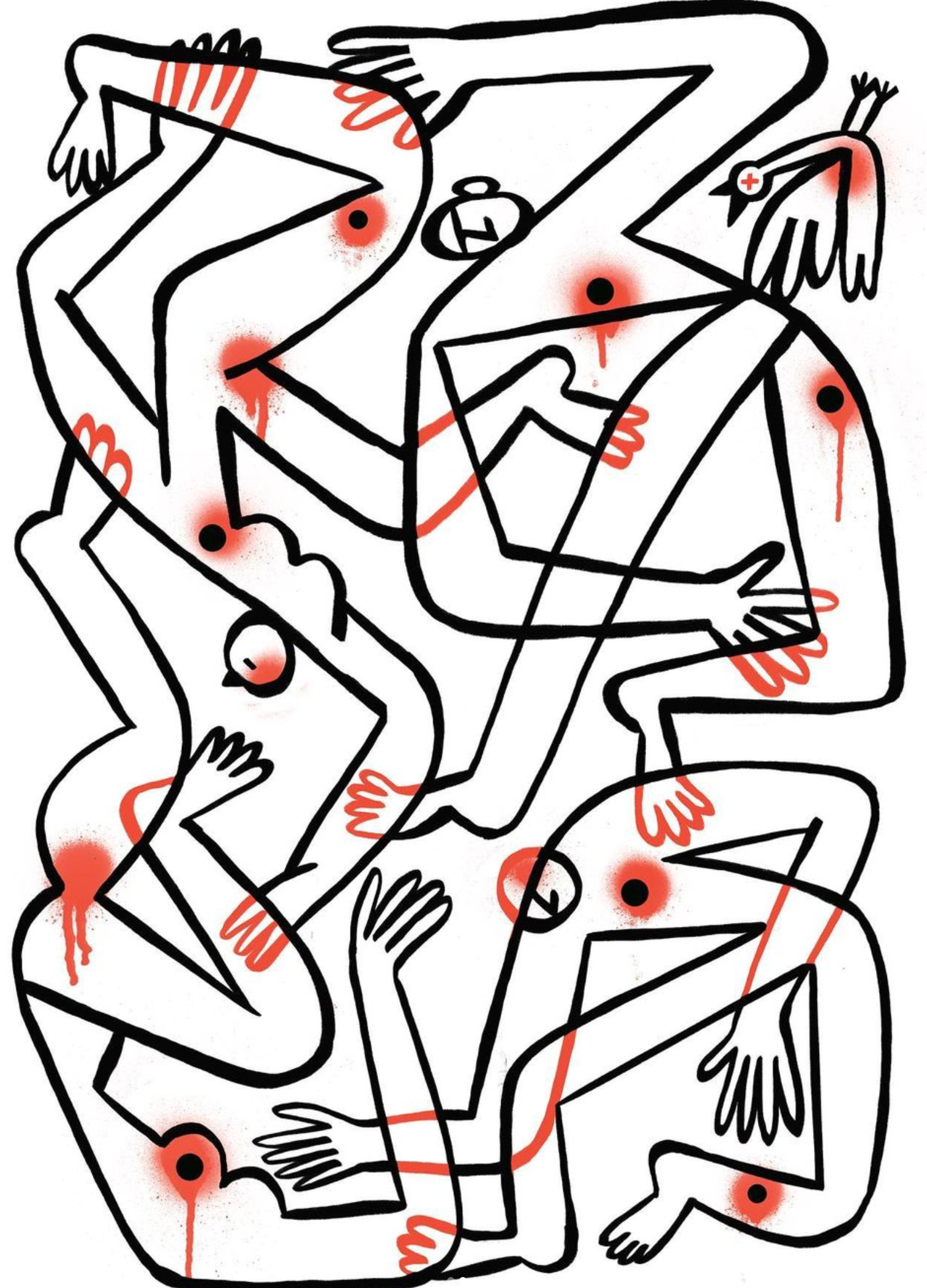
Internet etiquette asks that we post content warnings or trigger warnings in front of scary-as-shit posts. Personally I try to only speak about the Ukrainian invasion in general terms so as not to dump too much onto people when I’m sharing a protest image from a Ukrainian artist. I often don’t show the caption. If it’s terribly graphic I don’t post it at all. But the thing about Instagram is that on top of a pile of ads and huge brands beaming their capitalist flotsam and jetsam at you it’s also a constellation of people’s personal pages and their psychologies too. Everyone has their own little corner and everyone is reacting differently. My city has a huge Ukrainian- Canadian population, and it is inevitable that you will come across someone in your sphere who is deeply and personally affected by this war. My being a helpless bystander halfway across the world, I can’t imagine the personal trauma Ukranians are going through, and many are naturally, understandably playing it out on the Internet. People are beaming their pain out there, and others in their feeds respond to it, subconsciously registering their trauma and sending it down the line.
Secondary traumatization is a thing. It’s important to know that you, layperson in your pajamas drinking coffee in the morning, trying to care and also live your life as best you can, are in control of how much of someone else’s trauma you are able to accept, especially when it’s sprung on you in between cat videos. Mental health workers don’t process trauma 24/7. They get days off, they try to live a joyful life, and they also debrief with other professionals (ie. they see therapists too). There need to be supports in place when when the trauma of others affects you greatly.
There is a line between spreading awareness constructively as a bystander and broadly suffering alongside someone else through the internet. The latter is probably not a great method of solidarity, and it can really fuck you up. So for now, I’m using the mute button and I hope I’ll remember to un-mute these accounts eventually. This isn’t the last conflict we’re going to have beamed directly into our phone-brains. They didn’t teach these strategies in CALM 20 when Mel and I were hanging out in the hallway at lunch, but twenty years later we have got to learn as we go.
*If you can, consider donating to these aid groups in Ukraine, Poland, and in Canada supporting those who have come all the way elsewhere and may never get to go home. These links are directly from the Ukrainian illustrators and artists I posted about above:
Canada-Ukraine Foundation - Canada based
Polska Akcia Humanitarna - Polish Humanitarian Action group
Hospitallers - Volunteer paramedic org in Ukraine
List of grassroots orgs to donate to in Ukraine - the message is, whatever you do don’t donate to the Red Cross, many say the bureaucracy won’t get the aid out in time.
No posts
Comments
Nothing yet. Say the first thing.
Sign in to join the conversation.