
Sequoia’s “Generative AI’s Act II” is like a State of the Union address for GenAI. The esteemed investor revisits past prognostications and refreshes their view of how the market will unfold.
Three ideas leap out that point to the evolution of vector databases.

Sequoia describes “Act I” as the technology-out wave of novelty apps—lightweight demonstrations of cool new technology. Act II, says Sequoia, is where “GenAI will shift towards solving genuine human problems with enhanced editing interfaces, superior outputs, and more diverse needs.”
What are these genuine human problems? Their “Generative AI Market Map V3” contains 31 categories and companies:
Entertainment
Social
Avatar Generation
Education
Music
Medical Advice
Relationships
Personal Assistants
Gaming
Search
RPA
Marketing
Sales
Design
Software Engineering
Customer Support
Productivity (e.g., Notion)
Data Science
Healthcare
Legal
Bio
Financial Services
Translation
Voice
General Knowledge
Virtual Avatars
Autonomous Agents
Video Creation and Editing
Browser Copilots
Image Creation
3D
Explore their market map here or in the original article.
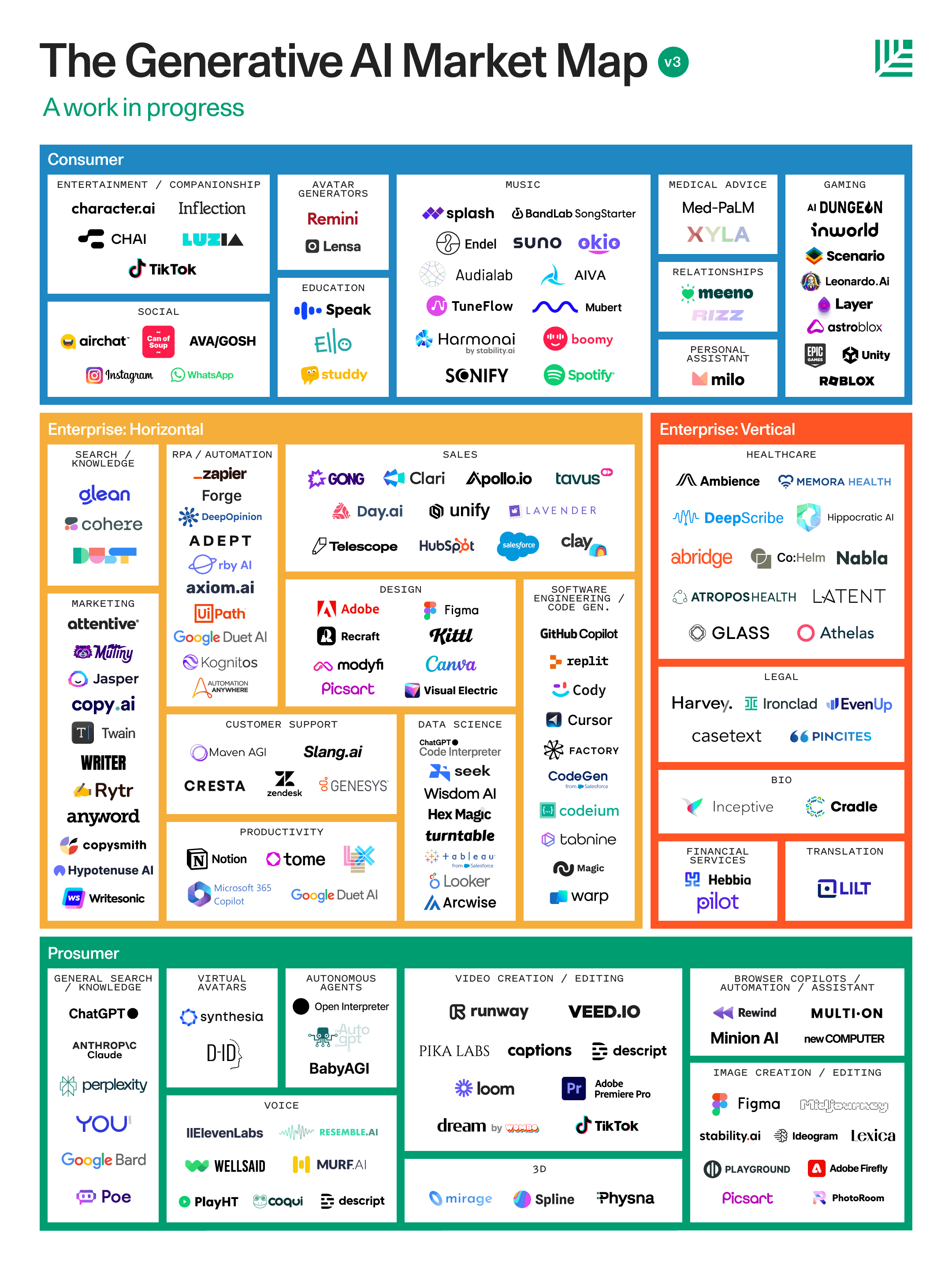
These applications, says Sequoia, will spark the rise of a new GenAI systems architecture, which includes the vector database and the specialization of task or domain-specific foundation models and apps.
LLM Ops
Observability, Monitoring, Alerting
User Analytics
Firewall
Workflow
Application Frameworks
Data Management
Vector Databases
Model Training & Fine Tuning
Data Labeling
Synthetic Data
GPU Supply
PaaS
Foundation Models: Text
Foundation Models: Image
Foundation Models: Video
Foundation Models: Audio
Foundation Models: 3D
Foundation Models: Code
Foundation Models: Open Source
Another Silicon Valley visionary firm, Andreessen Horowitz, pronounced vector databases “the most important piece of a generative AI architecture” (a claim that should come with the disclosure that Andreessen Horowitz has invested over $100 million in a vector database company).
Sequoia makes no such proclamation of the primacy of vector databases, but Sequoia and Andreessen Horowitz agree that vector databases play a prominent role in the Generative AI Infrastructure stack.

A challenge with LLMs, Andreessen Horowitz says, is that they hallucinate answers that seem confident and factually correct. For example, “Asking an LLM for the gross margin of Apple last quarter can result in a confident answer of $63 billion, which models can back up by explaining that they subtracted $25 billion in cost of goods from $95 billion in revenue. But that’s wrong in three ways,”
The revenue number is wrong because the LLM doesn’t have real-time data. Usually, training data is months or years old.
Left alone, an LLM will “guess” at data like revenue or cost of goods numbers. In this case, it took that data from another company’s financial statements.
Its calculation is not mathematically correct. Even a relatively simple calculation like gross margin requires carefully vetted calculations and data.
This is where vector databases come in. They help developers store relevant contextual data for LLM apps. Instead of sending unstructured documents with every API call, developers store data in a vector database and pick the most relevant and highest-quality data sources for any given query — an approach called in-context learning.
Vector databases store data in semantically meaningful embeddings, which pre-process and offload operations such as calculating gross margins to the database, which can be recombined with LLM output for confident-sounding and accurate responses.

Vector databases also help applications access up-to-date data, potentially in real time. We’ve written about how real-time vector databases do this for “Act II” applications like:
Clinical Trial Selection in Healthcare at Syneos
Vector databases complement LLMs with up-to-date, accurate, contextual insight that, combined with prompt interfaces and natural language, promise to help usher in the next act for GenAI —solving end-to-end human problems.
Read Generative AI’s Act Two from Sequoia.
Read Emerging Architectures for LLM Applications from Andreessen Horowitz
For a detailed case study on time series vector databases in clinical trials, read Time Series Vector Databases in Healthcare case study by Syneos.
Read about vector databases and prompting in {The, Weekly, Vector} newsletter #7: The Implications of Prompt Interfaces (Vol. 7).
It’s an exciting time to join the GenAI and vector database community. To keep track of it all, subscribe to {The, Weekly, Vector ↗️} below and share it with your friends! Paid subscriptions are donated to charity.
Check out these Substacks we love:
AI Supremacy by Michael Spencer
Follow our writers,
Have an idea for {The, Weekly, Vector}? DM our editor, Mark Palmer.
Comments
Nothing yet. Say the first thing.
Sign in to join the conversation.