
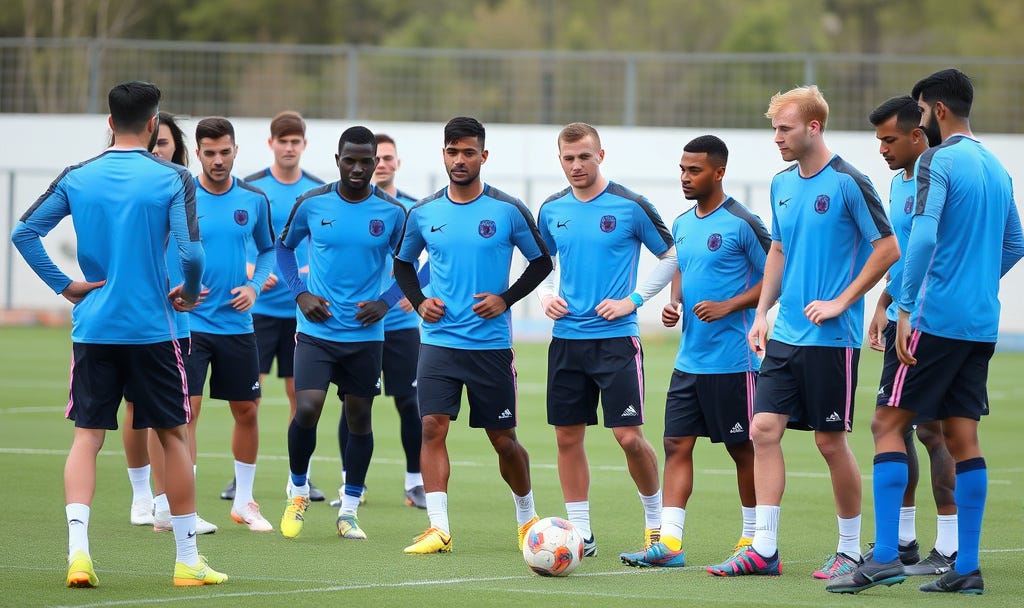
Efficiency in football is not about doing more. It is about doing what matters most at the right time, with the right focus, and with the right constraints.
In modern football environments influenced by clubs such as Manchester City and FC Barcelona, we see highly synchronized, efficient teams that appear to “control” matches. This control is not accidental. It is built on disciplined prioritization: clarity of principles, alignment of training content with game demands, and strategic management of time, energy, and cognitive bandwidth.
As coaches, our challenge is not the lack of tasks. It is the overabundance of them.
Session plans.
Video analysis.
Individual development plans.
Match preparation.
Parent communication.
Administrative responsibilities.
Scouting.
Conditioning integration.
Recovery monitoring.
Tactical periodization.
Without a clear prioritization structure, your environment becomes reactive instead of intentional. And when the coach is reactive, the team becomes inefficient.
This newsletter will examine:
Why prioritization is a competitive advantage
How poor task sequencing undermines performance
A practical framework for prioritizing weekly and seasonal objectives
How prioritization improves tactical clarity and collective coordination
The neuroscience and ecological rationale behind focused task design
A practical decision-making matrix for coaches
How to embed prioritization into your culture
Football is a complex adaptive system. Every action emerges from interaction; player, teammate, opponent, space, time, and task constraint.
Efficiency in this environment means:
Faster perception–action coupling
Reduced cognitive overload
Clear shared affordances
High-quality repetition of relevant behaviors
When coaches attempt to “cover everything,” players often master nothing.
Consider how Pep Guardiola structures his teams. Regardless of opponent, a small number of principles dominate:
Positional superiority
Numerical superiority
Third-man concepts
Controlled rest defense
The training week is built around reinforcing these principles repeatedly, under varying constraints. The focus does not change weekly. The emphasis shifts.
That is prioritization.
Many coaches believe productivity equals progress. It does not.
Common inefficiencies include:
Four tactical themes in one session.
Two physical objectives.
Three coaching interventions per drill.
Outcome: fragmented attention, low retention.
Monday: pressing
Tuesday: possession
Wednesday: transition
Thursday: set pieces
Friday: free play
Players struggle to perceive coherence. There is no stable informational landscape guiding decision-making.
After losing, coaches redesign everything. After winning, they add complexity.
Efficiency collapses when priorities shift impulsively.
To prioritize effectively, you must distinguish between:
Non-negotiables (identity principles)
Game model sub-principles
Opponent-specific adaptations
Individual development needs
Supplementary enhancements
Many coaches invert this hierarchy.
They over-prioritize opponent adjustments and under-prioritize identity.
If you coach a possession-based 4-2-3-1 (which aligns with your preferred methodology), your non-negotiables might include:
Build-up through central progression
Double pivot connectivity
Wide overloads
Immediate counterpress after loss
These should dominate your task design weekly.
Within that identity, one phase may receive increased attention based on recent performance:
Defensive transitions
Final-third combination
Compactness between lines
Adjust pressing triggers or build-up traps, but never at the expense of your identity.
This hierarchy reduces cognitive clutter and clarifies intent.
Efficiency emerges when the microcycle has a clear thread.
Below is a structured model you can apply:
Priority: restore and cognitively reinforce identity.
Video: 2–3 key identity moments
Low-intensity rondos emphasizing principles
Priority: one primary phase of play.
Example: Breaking low blocks.
All tasks must reflect that theme:
6v4 overload build-up
8v6 positional games
10v10 constrained to central access
Priority: same theme under fatigue.
Add:
Reduced space
Time constraints
Transition triggers
Priority: clarity and tempo.
Short-duration, high-intensity games
Set-piece rehearsal
Priority: simplicity and rhythm.
No new information. Reinforce.
This reduces randomness and enhances efficiency.
From an ecological dynamics perspective, learning emerges from representative task design.
The concept of representative learning design (associated with scholars such as Keith Davids) emphasizes that tasks must preserve perception-action couplings found in competition.
If you attempt to prioritize too many elements simultaneously:
Informational variables multiply
Attention becomes diluted
Affordance detection weakens
Efficiency improves when:
Tasks highlight key informational constraints
Repetition stabilizes pattern recognition
Players detect consistent environmental cues
Prioritization simplifies the affordance landscape.
Before adding any task or theme to your week, ask:
If not, remove or postpone.
If it happened once, observe. If it is systemic, prioritize.
If not representative, redesign.
If yes, simplify.
You can categorize tasks into:
Essential
Important but deferrable
Optional
Distracting
Elite environments ruthlessly eliminate the distracting.
Efficiency in team behavior depends on shared mental models.
If Monday emphasizes wide overloads and Tuesday emphasizes central combination without connection, players experience fragmentation.
However, if every task reinforces:
Inside-out build-up
Third-man runs
Double pivot rotation
Then pattern recognition accelerates.
This is how synchronized teams operate.
Observe Liverpool F.C. under Jürgen Klopp. Transition moments are prioritized relentlessly. Every session contains cues for immediate counter-pressing.
That consistency builds efficiency.
Task prioritization is not only tactical. It is physiological.
Coaches must prioritize:
High-intensity exposures
Recovery windows
Sleep education
Nutritional alignment
If everything is “high intensity,” nothing is optimal.
Strategic stress placement improves output.
For youth players (particularly 15–19), this is critical. Hormonal stress, academic demands, and growth spurts require disciplined scheduling.
One of the most difficult prioritization challenges is balancing individual growth with collective identity.
If your No.10 struggles with scanning, that is important.
But if your team consistently fails in defensive transitions, that takes precedence.
Efficient coaches:
Address individual needs inside collective tasks
Avoid isolating technical work detached from context
Embed corrective constraints into game-based design
Example:
Add scanning triggers into positional games rather than isolated drills.
This respects time and increases transfer.
Working memory capacity is limited.
When players are exposed to excessive coaching cues:
Decision latency increases
Automaticity decreases
Anxiety rises
Clear prioritization:
Reduces extraneous load
Enhances intrinsic load alignment
Supports long-term retention
This is why elite coaches limit touchline instructions to 1–2 cues.
Clarity beats volume.
Never emphasize more than three key principles per week.
After training, evaluate:
What was the central objective?
Did every activity reinforce it?
Did I over-coach?
Before finalizing your weekly plan, remove 20% of content.
Efficiency often increases.
Assistant coaches must understand priorities.
Mixed messages destroy clarity.
Teams reflect coaching behavior.
If you prioritize punctuality, discipline, and tactical detail consistently, players internalize structure.
If you frequently shift emphasis emotionally, players mirror instability.
Prioritization is leadership.
It communicates:
What matters
What is optional
What defines us
Across a season:
Preseason: identity establishment
Early season: stabilization
Mid-season: refinement
End season: adaptability
You cannot develop every tactical principle simultaneously.
Strategic phasing enhances depth.
Players articulate principles clearly
Fewer but more precise coaching interventions
Faster decision-making under pressure
Reduced tactical confusion
Stronger intra-team coordination
Efficiency becomes visible.

The temptation to add is constant.
Add drills. Add strategies. Add detail. Add complexity.
But mastery comes from disciplined subtraction.
Ask yourself weekly:
What truly moves our game model forward?
What is noise?
What can wait?
Your team’s efficiency depends less on how much you know and more on how well you filter.
Clarity creates speed.
Speed creates advantage.
Advantage creates performance.
In an era where information is abundant, prioritization is power.
Thank you for reading Game Changer. Elevate your coaching with our eBooks full of innovative strategies and practical tips. Click below to explore more and start your journey to smarter coaching!
Click HERE to access Game Changer Ebooks


No posts
Comments
Nothing yet. Say the first thing.
Sign in to join the conversation.