
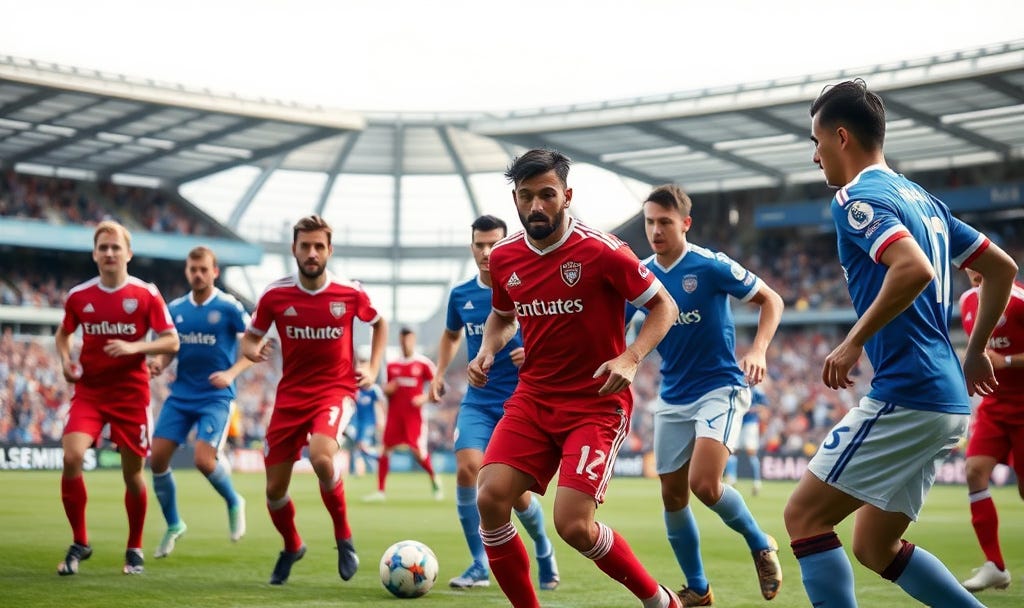
One of the greatest challenges in coaching is understanding why players sometimes make excellent decisions one moment and poor decisions the next, even when their technical ability appears identical. A player who effortlessly breaks a defensive line in one game may repeatedly lose possession in another. A defender who consistently intercepts passes against one opponent may struggle against another with similar technical quality.
Traditional coaching often attributes these differences to concentration, confidence, intelligence, or technical execution. While these factors certainly play a role, modern research in ecological dynamics suggests another explanation:
Players perform according to the information available to them.
The game itself constantly provides information. Every movement of a teammate, every adjustment by an opponent, every bounce of the ball, and every available space becomes information that players perceive before acting.
These are known as informational constraints.
Rather than viewing decision-making as something occurring solely inside the player’s brain, ecological dynamics proposes that decision-making emerges from the continuous interaction between the player and the environment.
The player’s movement is therefore inseparable from what they perceive.
This relationship is known as Perception–Action Coupling.
Understanding this principle has the potential to transform how coaches design practices and develop intelligent footballers.
Informational constraints are the pieces of information within the environment that influence a player’s decisions and movement.
Unlike coach instructions or tactical diagrams, informational constraints exist naturally during play.
Examples include:
Position of teammates
Position of opponents
Ball speed
Ball trajectory
Body orientation
Space availability
Distance between players
Direction of movement
Time pressure
Scoreline
Speed of the attack
Players never make decisions in isolation.
Every action is a response to information.
The better players become at identifying relevant information, the better their decisions become.
Ecological Dynamics proposes that players do not first think and then act.
Instead,
They perceive while acting.
Action changes perception.
Perception changes action.
This continuous interaction occurs hundreds of times during every minute of a football match.
For example,
A midfielder receives the ball.
Before the first touch he notices:
a pressing opponent,
a teammate making a forward run,
another defender stepping out,
available space behind the midfield line.
His decision emerges from all of this information simultaneously.
He is not calculating every possibility.
He is coupling his movement to the information available.
Perception–Action Coupling is the continuous relationship between what players see and how they move.
Neither perception nor movement happens independently.
They influence one another continuously.
Imagine a winger receiving the ball. As he dribbles,
The defender adjusts.
The attacker then changes speed.
The defender changes angle.
The attacker cuts inside.
The defender recovers.
This is one uninterrupted cycle.
Information changes movement.
Movement creates new information.
This continues until the play finishes.
Elite players maintain this coupling continuously.
Less experienced players often disconnect perception from action by deciding too early or too late.
Many coaching sessions unintentionally teach players to memorize solutions.
Examples include:
“Always pass wide.”
“Always overlap.”
“Always press immediately.”
“Always play two-touch.”
Football simply does not work that way.
Every situation is unique. Although patterns exist, no two situations contain identical informational constraints.
Therefore, players should not memorize solutions.
They should learn to detect information.
One of the most important concepts within ecological dynamics is the idea of affordances.
Affordances are opportunities for action that emerge from the interaction between the player and the environment.
The environment constantly offers possibilities.
The player decides which possibilities are available.
For example:
A gap between two defenders may invite:
a through pass,
a dribble,
a supporting run,
or no action at all.
The affordance depends upon:
the player’s speed,
technical ability,
confidence,
angle,
timing,
and perception.
Two players may observe the same situation.
One recognizes a passing lane.
The other does not.
The affordance existed for both.
Only one detected it.
Elite players are exceptional because they detect affordances earlier than others.
This allows:
quicker decisions
better timing
more efficient movement
greater creativity
Decision-making therefore becomes less about choosing from stored memories and more about identifying opportunities as they emerge.
This explains why world-class players often appear to have “more time.”
They do not.
They simply recognize affordances sooner.
Unlike static practice drills, football never stops changing.
Every second:
players move,
space changes,
angles change,
pressure changes,
passing lanes appear,
passing lanes disappear.
Players must continually update their perception.
This is why training with cones alone cannot fully prepare players for competition.
Cones never change. Opponents do.
One fascinating area of research examines how defenders intercept passes.
Traditional coaching often says:
“Read the pass.”
Modern research provides a more detailed explanation.
Successful defenders continuously couple their movement to several information sources simultaneously.
These include:
passer’s body orientation
foot position
angle of approach
speed of the passer
distance from receiver
receiver’s movement
ball trajectory
available passing lane
Rather than reacting after the pass, elite defenders begin moving before the ball leaves the passer’s foot.
Why?
Because they are detecting information before the pass occurs.
Once the ball has been struck, another informational constraint becomes critical:
the ball’s flight.
Elite defenders continuously adjust:
running angle
speed
body orientation
interception point
They are not simply chasing the ball.
They are matching their movement to its changing trajectory.
This continuous adjustment is another example of Perception–Action Coupling.
The ball moves.
The defender moves.
The changing relationship between both determines successful interception.
Many coaches describe certain players as possessing:
“Excellent anticipation.”
However, anticipation is not magic.
It is information.
Experienced players become highly sensitive to subtle cues including:
shoulder position
eye gaze
hip orientation
stride length
supporting foot
receiver movement
attacking patterns
These cues provide advance information.
The earlier players detect these cues, the earlier they can act.
Experienced players possess richer informational experiences.
They have encountered thousands of similar situations.
This does not mean they memorize solutions.
Instead:
they become better at identifying relevant information quickly.
Their attention becomes more selective.
They ignore irrelevant information while focusing on critical cues.
Poor informational processing often produces:
late decisions
poor positioning
inaccurate passing
defensive errors
slow transitions
ineffective pressing
unnecessary touches
Conversely, excellent informational awareness leads to:
faster play
improved scanning
better timing
earlier support
quicker transitions
improved creativity
greater tactical intelligence
Perhaps the biggest implication for coaches is this:
Players cannot improve decision-making without experiencing realistic information.
Decision-making should not be coached by telling players what to do.
Instead, coaches should manipulate environments that allow players to discover better solutions.
Training should resemble competition.
The informational constraints present during games should also exist during practice.
This principle is known as Representative Learning Design.
Examples include:
Instead of:
Passing around cones
Use:
Passive defenders becoming active defenders.
Instead of:
Predetermined passing patterns
Use:
Opponents creating genuine pressure.
Instead of:
Static receiving exercises
Use:
Players moving into space while scanning.
Representative learning preserves the information that players use during matches.
Coaches can deliberately manipulate constraints to encourage particular behaviours.
Examples include:
Encourages:
quicker scanning
faster decisions
improved first touch
Encourages:
longer passing
switching play
penetration
Creates:
confidence
possession retention
passing opportunities
Develops:
pressing
compactness
anticipation
communication
Improve:
transitions
forward passing
defensive recovery
Encourage:
rapid perception
faster execution
reduced hesitation
Scanning is one of the most important perceptual behaviours.
Elite players constantly collect information before receiving possession.
Coaches should reward:
checking shoulders
body orientation
receiving on the half-turn
awareness before first touch
Rather than asking,
“Why did you lose the ball?”
Ask,
“What information did you have before receiving?”
The second question develops perception.
One of the greatest dangers is excessive instruction.
Constantly telling players where to pass prevents them from learning how to detect affordances independently.
Instead, allow players opportunities to explore.
Use guided questioning.
Examples include:
“What did you notice?”
“What options became available?”
“When did the passing lane open?”
“What made you decide to dribble?”
These questions encourage players to reflect on information rather than memorized tactics.
Small-sided games naturally increase informational richness.
Players experience:
more decisions
more transitions
greater pressure
more touches
increased scanning
This makes them ideal environments for developing perception-action coupling.
Repeating identical drills creates stable movement but poor adaptability.
Instead, vary:
player numbers
field dimensions
starting positions
scoring methods
transition rules
directional targets
Variation forces players to continuously recalibrate their perception.
Every practice should ask one simple question:
“What information do players need to perceive during the game?”
Once identified, design activities that preserve those informational constraints.
Avoid removing:
defenders
pressure
timing
movement
uncertainty
These are exactly the elements players rely upon during competition.
Play 5v5 plus neutral players.
Award extra points for passes that split defenders.
Players begin recognizing affordances rather than simply completing passes.
Set up attackers attempting penetrating passes.
Defenders earn points through interceptions rather than tackles.
This develops sensitivity to passing cues and ball trajectory.
Immediately after possession changes, teams have five seconds to score.
Players become highly attentive to rapidly changing informational constraints.
Allow play to continue.
Avoid stopping every mistake.
Observe whether players self-correct.
Learning often occurs through repeated interaction with information.
Football is becoming increasingly fast.
Technical ability alone is no longer sufficient.
The players who succeed are those capable of:
identifying information earlier,
detecting affordances faster,
coupling perception and movement more effectively,
adapting continuously to changing environments.
This represents a shift from coaching movements to coaching interactions.
Rather than producing players who simply execute rehearsed techniques, coaches should strive to develop adaptable footballers who can perceive, decide, and act effectively under the constantly changing informational demands of the game.
Every pass, tackle, interception, movement, and goal begins not with the foot, but with the eyes and the brain working together through the environment.
Informational constraints shape every decision players make. Their ability to detect affordances determines the opportunities they recognise, while perception–action coupling allows them to transform those opportunities into effective actions. Whether a defender intercepts a pass by reading the passer’s body shape and adjusting to the ball’s trajectory, or an attacker exploits a fleeting gap between defenders, success depends on the continuous interaction between perception and movement.
For coaches, this understanding carries a profound responsibility. If training environments fail to provide the same informational richness found in competition, players cannot develop the perceptual skills required for match performance. Practices should therefore challenge players to scan, adapt, solve problems, and discover solutions rather than simply reproduce predetermined patterns.
Ultimately, the goal of coaching is not to create players who know what to do in rehearsed situations, it is to develop players who can recognise what the game is asking of them in every unique moment. By designing representative learning environments that preserve the informational constraints of the game, coaches cultivate footballers who are not only technically capable but also perceptive, adaptable, and intelligent. These are the players who consistently make better decisions under pressure and who elevate the collective performance of their teams when it matters most.
Thank you for reading Game Changer. Elevate your coaching with our eBooks full of innovative strategies and practical tips. Click below to explore more and start your journey to smarter coaching
Click HERE to access Game Changer eBooks

No posts
Comments
Nothing yet. Say the first thing.
Sign in to join the conversation.