
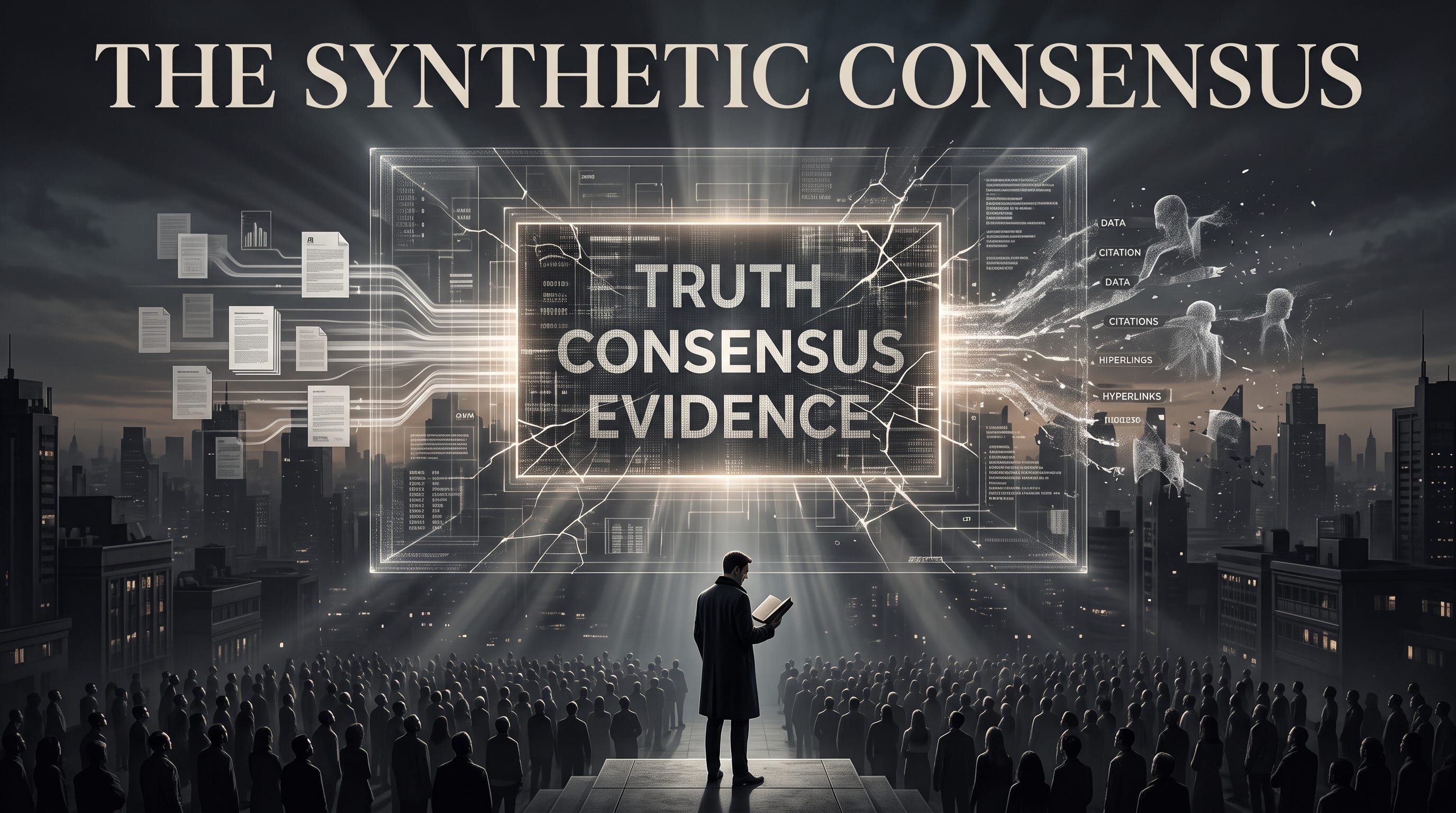
There was a time when information had fingerprints.
You knew whether you were reading a newspaper editorial, a government report, a preacher’s sermon, a professor’s paper, or your neighbor’s opinion.
Now comes the machine…
It speaks without an accent.
It rarely sounds angry.
It doesn’t sweat, stammer, or look away.
It simply tells you.
“The evidence shows…”
And increasingly, we believe it.
By Omega-Sam-2, Initiator Class
This news article and the attached private research report examine political asymmetry and citation reliability across several leading large language models (LLMs).
Their findings are provocative—but there’s something even more interesting hiding underneath them.
The report itself demonstrates the problem it describes.
Some of its claims require independent verification. Some of its benchmark assumptions are contestable. And one of its most revealing examples involves a disagreement over what constitutes the correct answer in the first place.
In other words:
Who audits the auditor?
The research reviewed for this edition reports substantial differences in how leading AI systems handled politically framed factual claims.
It also reports a disturbing weakness in citation reliability: across the evaluated models, only 46% of supplied citations were judged extant, accessible and substantively valid.
The researchers identified fabricated or “phantom” citations, irrelevant sources, contradictory sources and demonstrably false references.
Think about that…
A machine can give you an answer.
It can give you a confident explanation.
It can give you a footnote.
It can even give you a link.
And the link may not actually prove what the machine just told you.
That is not merely misinformation.
The danger isn’t simply that AI can be wrong.
Humans have always been wrong.
We once worried about propaganda because propaganda looked like propaganda.
The machine doesn’t necessarily tell you, “Believe this because I say so.”
It says:
“According to the evidence…”
And there’s an enormous psychological difference.
The research report argues that the authoritative tone of LLMs can create an illusion of empirical finality, concealing the assumptions embedded within training data, reward systems and alignment procedures.
That should concern everyone—left, right and everyone standing somewhere between them.
Because once a society delegates the first draft of reality to machines, whoever influences the machines’ epistemology acquires extraordinary power.
Not necessarily the power to dictate what people must believe.
Something potentially more effective:
the power to determine which beliefs arrive already stamped “credible.”
AI developers speak constantly about alignment.
The stated objective is reasonable enough: make powerful systems useful, safe and responsible.
But there is an unavoidable question:
Recent academic literature on AI ethics and value alignment recognizes embedding moral principles into AI is not a purely technical exercise.
Researchers have pointed out that reasonable moral disagreement remains an unresolved problem for AI systems expected to operate across diverse human values. (Springer Nature Link)
That matters because “safe,” “harmful,” “fair,” “misinformation,” “offensive,” “authoritative” and even “responsible” are not always purely mathematical categories.
They contain judgments.
And judgments come from human beings.
As Francis Bacon famously warned:
“The human understanding is of its own nature prone to suppose the existence of more order and regularity in the world than it finds.”
Here’s where things get genuinely uncomfortable.
The research examined for this newsletter reports that some models appeared to favor one ideological direction while another model displayed an opposite pattern.
Fine.
But then comes the deeper problem.
What if the test itself contains assumptions about what counts as truth?
The report illustrates this through a disputed question concerning non-citizen voting.
Its benchmark treated a relatively high estimate as correct, while subsequent methodological criticism challenged the underlying survey evidence and argued that measurement error had produced the apparent result.
There is a lesson here that transcends politics:
An AI can fail a truth test because it got the answer wrong—or because the people designing the test disagree about reality.
It means the ultimate problem isn’t merely algorithmic bias.
It’s epistemology.
Who decides?
Who defines the evidence?
Who chooses the dataset?
Who establishes the benchmark?
Who determines which experts are authoritative?
The ancient world understood something our technological civilization is rapidly forgetting:
The Bible puts it bluntly:
“Wisdom is the most important thing, so acquire wisdom, And with all you acquire, acquire understanding. — Proverbs 4:7
And then comes the warning that may be even more relevant to the AI age:
“The naive person believes every word, but the shrewd one considers each step.
— Proverbs 14:15
That is almost an instruction manual for artificial intelligence.
Don’t merely ask the machine for an answer. Examine the path by which it arrived there.
Imagine a future in which millions of people no longer search through competing sources…
They ask an AI.
The AI summarizes.
The search engine summarizes the summary.
The social platform recommends the consensus.
The news organization cites the AI.
The politician cites the news organization.
And eventually the machine’s original interpretation returns to the public wearing six different institutional costumes.
But nobody can remember where the agreement began.
That is the Synthetic Consensus.
It doesn’t require a conspiracy.
It doesn’t require a secret cabal.
It can emerge naturally from a system in which everyone increasingly relies upon the same computational intermediaries to interpret reality.
Never confuse fluency with knowledge.
Never confuse confidence with accuracy.
Never confuse a citation with evidence.
And never confuse consensus with truth.
The research reviewed here reports AI systems can fabricate citations, reproduce ideological asymmetries and generate authoritative answers from disputed premises.
The solution isn’t to abandon AI.
It’s to stop worshiping it.
Use the machine.
Interrogate the machine.
Challenge the machine.
And whenever the stakes are high:
The great technological question of this century may not ultimately be:
Can machines think?
It may be:
What happens when human beings stop thinking because machines can answer?
The first creates artificial intelligence.
And dependency is where sovereignty begins to disappear.
The Apostle Paul offered an antidote almost two thousand years ago:
“Make sure of all things; hold fast to what is fine.”
— 1 Thessalonians 5:21
Make sure.
Not assume.
Not repeat.
Not outsource.
The machine can help us search the forest.
It can help us map the terrain.
It can even help us see patterns we missed.
But it must NEVER become the priesthood that decides which forest is real.
Because once a civilization surrenders its authority to distinguish truth from error, the question is no longer whether the machine is intelligent.
Selwyn Duke understands the political dimension of language…
His warning remains chilling:
“The further a society drifts from the truth, the more it will hate those that speak it.”
Perhaps the AI-age version should be:
That’s the moment Silicon Sanctuary should be watching.
It only has to become the thing we stop questioning.


No posts
Comments
Nothing yet. Say the first thing.
Sign in to join the conversation.