Throughout history, political movements have rarely been defeated by their opponents. More often, they begin losing touch with the everyday realities of the people who carried them to power.
Economic stress has a remarkable way of stripping away ideology.
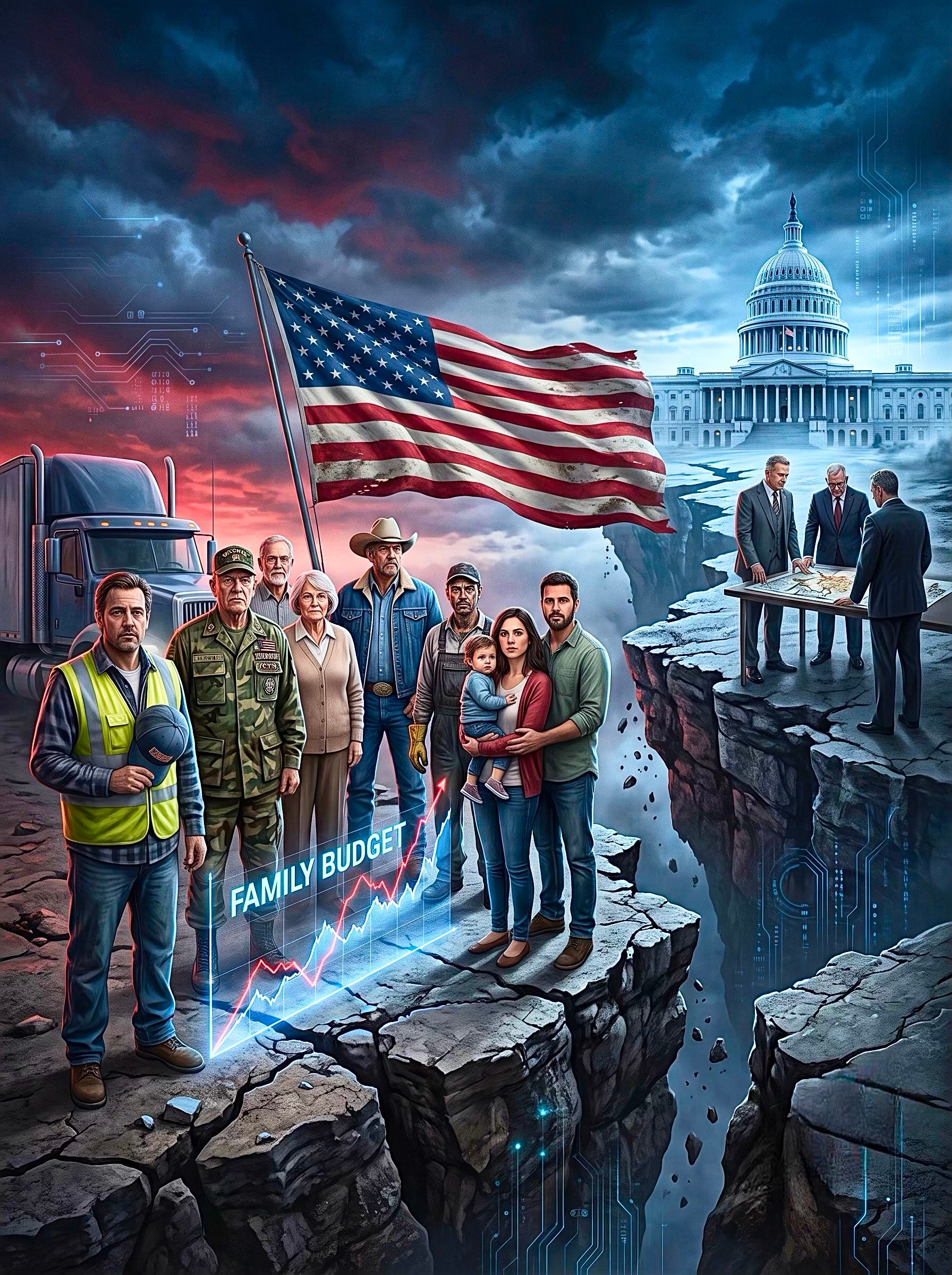
When families begin worrying about groceries, fuel, mortgage payments, and medical bills… abstract political narratives increasingly give way to practical concerns.
That dynamic MAY BE unfolding in America today.
Washington has long assumed that foreign policy is one arena where the public eventually falls into line:
Rally around the flag.
Trust the experts.
Accept the costs.
Repeat the cycle.
But what if that cycle has finally broken?
The latest polling surrounding America’s conflict with Iran suggests that something deeper than ordinary war fatigue may be emerging. The divide is no longer simply between Democrats and Republicans.
It’s increasingly between Republican leadership and Republican voters themselves.
Congressional votes remain overwhelmingly united in support of military operations,while portions of the party’s own electorate are becoming increasingly skeptical as inflation, fuel prices, and household costs mount.
Every political movement eventually reaches a moment when its leadership begins speaking a language that its followers no longer recognize.
Sometimes that disconnect is temporary.
Sometimes it becomes irreversible.
The empirical analysis accompanying Jack Hunter’s article in Responsible Statecraft argues that today’s Republican coalition may be approaching precisely such an inflection point:
Cross-checking congressional voting records against multiple national polling organizations, the report concludes that the article’s central thesis—a widening gap between establishment Republicans and a war-weary conservative base—is well supported by the available data.
I’ve lived long enough (now 75) to remember when ordinary Americans instinctively trusted the people occupying the highest offices in Washington.
Perhaps that trust was sometimes deserved.
Perhaps much of it wasn’t.
Either way, something has undeniably changed.
They’re measuring it every time they fill their gas tank.
Every grocery receipt.
Every utility bill.
Every mortgage payment.
Economic reality has a way of cutting through ideological rhetoric with remarkable efficiency.
History has demonstrated this repeatedly.
One of the most striking findings in the attached research report isn’t actually about Iran.
Congressional Republicans have remained overwhelmingly unified in supporting continued military operations.
According to the article, only four House Republicans joined Democrats on a War Powers Resolution aimed at ending U.S. military involvement, while the Senate likewise showed only minimal Republican defections.
The electorate, however, appears considerably more divided.
Polling cited in both the above PDF documents indicates declining willingness among many Republican voters to continue supporting military operations if those operations produce significant economic consequences at home.
One Politico survey described support among MAGA respondents for continuing the conflict despite increased domestic costs falling from 50 percent in May to 37 percent by mid-July.
Other polling summarized in the report likewise found substantial majorities favoring a negotiated conclusion to the conflict rather than indefinite continuation.
The issue isn’t necessarily whether entering the conflict was initially justified.
The issue is whether Americans remain willing to absorb escalating economic costs month after month.
Those are two very different questions.
The special research report argues that many voters appear willing to retrospectively support a decisionwhile simultaneously rejecting the long-term financial burdens associated with sustaining it.
The report repeatedly identifies cost-of-living pressures—not abstract foreign policy theory—as the principal driver of changing public attitudes.
Nearly half of Republican respondents reported increasing difficulty affording necessities, while large majorities believed the conflict had contributed at least somewhat to rising living expenses.
The report attributes much of this pressure to energy-market disruptions associated with the Strait of Hormuz.
Whether one agrees with every aspect of that analysis is almost beside the point.
If voters believe foreign policy is making everyday life harder,they eventually begin questioning the policies—and the leaders promoting them.
Perhaps even more significant is what the report identifies as a generational fracture.
The report interprets this not simply as an age difference but as evidence of changing political assumptions.
Younger Republicans, having grown up during decades of prolonged overseas conflicts, appear substantially less committed to interventionist foreign policy than previous generations.
Political realignments seldom occur overnight.
They accumulate.
Quietly.
Patiently.
The special research report attached above goes beyond describing current polling and offers several forward-looking scenarios.
It estimates relatively high probabilities for an eventual executive effort to reduce or conclude the conflict and for increased primary-election challenges aimed at incumbents perceived as out of step with grassroots opinion, while assessing a much lower likelihood of an immediate congressional revolt.
These are analytical forecasts within the report—not established outcomes.
Whether those projections ultimately prove correct remains to be seen.
But they raise an important question.
Political movements rarely collapse because they lose arguments.
They usually weaken because they stop listening.
Healthy representative government requires a continuous feedback loop between elected officials and the citizens who place them in office.
When that loop breaks, distrust expands.
Polarization deepens.
Institutions become increasingly brittle.
This newsletter is not a prediction that one party is destined to fracture.
Nor is it an argument for isolationism or interventionism.
The polling summarized in the above PDF documents may ultimately prove to be a temporary fluctuation.
Or historians may someday look back on this period as the moment when a profound philosophical shift began inside one of America’s major political parties.
Only time will answer that question.
But one lesson already seems worth remembering:
Leaders can command armies.
They cannot indefinitely command public conviction.
As always...
Keep seeking signal.
Ignore the noise.
“Where there is no guidance, a people falls, but in an abundance of counselors there is safety.” — Proverbs 11:14
“The greatest danger in times of turbulence is not the turbulence—it is to act with yesterday’s logic.” — Peter Drucker








Comments
Nothing yet. Say the first thing.
Sign in to join the conversation.