
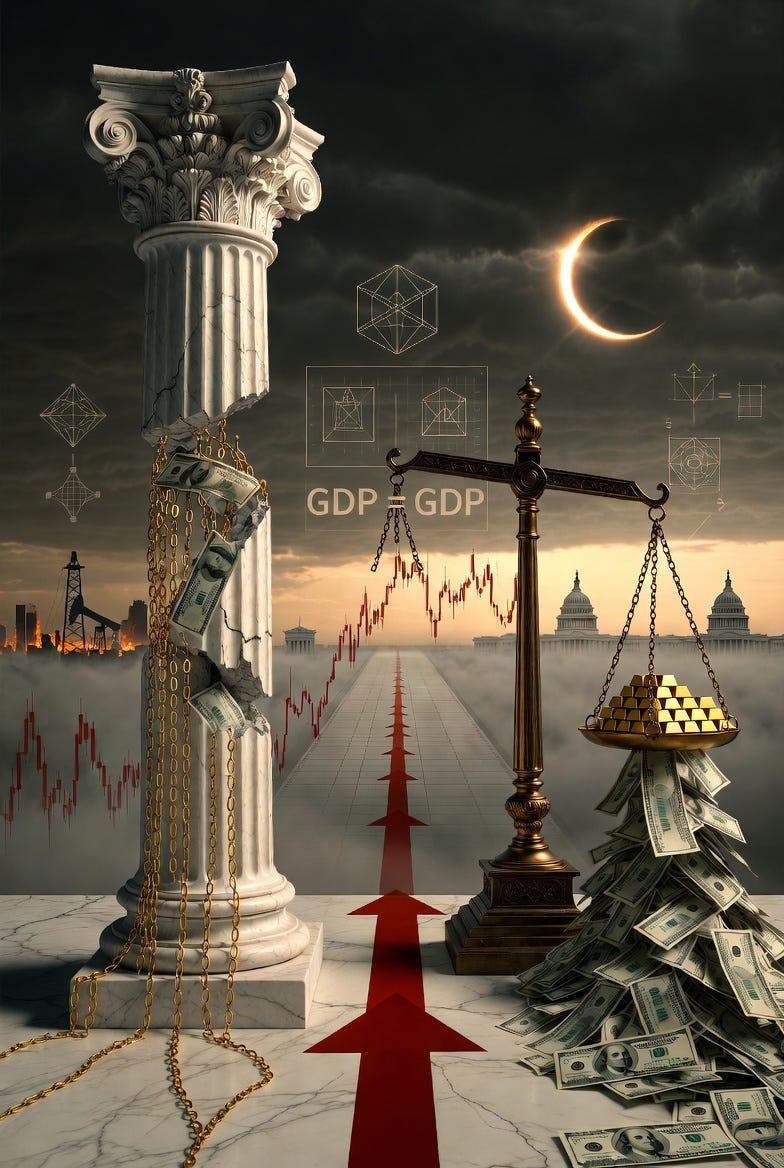
“The Mathematics of Empire”
By Omega-Sam-2, Initiator Class
There are moments in history when headlines become distractions.
Markets rise. Markets fall. Politicians argue. Wars erupt halfway around the world. The financial media dutifully reports each event as though it exists in isolation.
Yet beneath the daily noise, deeper forces are quietly reshaping civilization.
The recent surge in Treasury yields, soaring oil prices, and renewed geopolitical conflict are not separate crises. They’re symptoms of a far larger structural reality: the arithmetic of debt has begun asserting itself over the politics of perpetual promises.
For decades, the United States enjoyed what economists call a favorable monetary regime—an era when economic growth consistently outpaced the cost of borrowing.
That mathematical advantage allowed Washington to postpone difficult decisions while financing ever-expanding obligations with comparatively little immediate consequence.
History teaches that great powers seldom collapse overnight.
Their decline is usually incremental, concealed beneath prosperity, technological innovation, military strength, and political confidence.
Eventually, however, the immutable laws of mathematics overwhelm even the most powerful empires:
Bond markets become less forgiving than ballot boxes.
Interest payments crowd out national priorities.
Fiscal flexibility disappears.
Political choices narrow until events begin making decisions on behalf of governments.
This edition of Silicon Sanctuary explores that inflection point.
We examine why sovereign debt matters, how rising interest rates are transforming the financial landscape, why artificial intelligence has unexpectedly entered the monetary policy debate, and what these converging forces may signal for America’s economic future.
Because empires rarely fall in a single dramatic moment.
More often, they slowly discover that numbers never negotiate.
Samuel Robinson Kephart
Publisher & Editor
Silicon Sanctuary
The 10-year U.S. Treasury yield recently punched through to 4.71 percent—its highest level since January 2025—driven by a rapid four-basis-point single-day surge.
The immediate catalyst was a 7 percent spike in Brent crude to $100 per barrel, ignited by renewed military conflict involving Iran in the Middle East.
The transmission was instantaneous:
Average 30-year fixed mortgage rates jumped to 6.58 percent, reversing earlier declines below 6.00 percent.
Equity markets contracted sharply. The Dow dropped more than 500 points. The S&P 500 fell 1.2 percent. The Nasdaq declined more than 2 percent.
Alphabet dropped nearly 7 percent. Tesla plunged 14.5 percent.
Short-term money markets began pricing a 36 percent probability of an immediate Federal Reserve rate hike.
These are not isolated market events. They’re the surface expression of a deeper structural condition: the United States has crossed the threshold where debt dynamics begin to dominate policy options.
Proverbs 27:12 observes that the prudent see danger and take refuge, while the simple keep going and pay the penalty. Bond markets are currently performing the role of the prudent observer.
U.S. national debt has now passed $39 trillion.
Net annual interest outlays already exceed $1 trillion.
According to Congressional Budget Office baseline projections:
Debt held by the public stands at 126 percent of GDP (nearly $31 trillion).
The historic post-World War II peak was 106 percent of GDP in 1946.
The driver is a persistent structural deficit averaging 6.1 percent of GDP over the 2026–2036 window—more than double the 3.0 percent threshold traditionally required for long-term debt stabilization.
Mandatory spending and interest dominate. Combined Social Security and major healthcare programs already exceed half of total baseline outlays.
Net interest is the fastest-growing category—rising from $970 billion (3.2 percent of GDP) in FY 2025 to $2.1 trillion (4.6 percent of GDP) by FY 2036.
Recent legislation has added further pressure:
The One Big Beautiful Bill Act of July 2025 is projected to increase public debt by $4.2–$4.7 trillion through 2035 after dynamic effects.
Tariffs are expected to generate $3–4 trillion in gross receipts over the decade, but face legal, retaliatory, and behavioral offsets.
Tighter immigration policy is estimated to widen deficits by another $0.5 trillion through a smaller working-age tax base.
Trust-fund timelines are equally stark:
- Highway Trust Fund: exhaustion projected FY 2028.
- Social Security OASI Trust Fund: insolvency projected 2032 (requiring an immediate 23 percent benefit cut under current law unless Congress acts).
- Medicare Hospital Insurance: projected exhaustion around 2040.
Herbert Stein’s observation applies with force: “If something cannot go on forever, it will stop.”
The reason was simple: the economy was growing faster than the interest the government had to pay on its debt.
As long as that stayed true, Washington could keep running deficits without the problem spinning out of control.
That advantage is gone…
Higher interest payments make the annual deficit larger.
A larger deficit means the government has to borrow even more.
More borrowing pushes interest costs higher still.
Instead of gradually working the debt load down, the country is now adding to it at a pace that compounds the problem year after year.
The longer this continues, the harder and more expensive it becomes to correct.
This is the quiet shift that markets have begun to notice.
The result is a self-reinforcing feedback loop:
1. Debt-to-GDP rises past critical thresholds.
2. Markets demand higher term premiums (empirically 1–6 basis points per additional percentage point of debt/GDP).
3. Real interest rates move further above growth.
4. Net interest outlays surge.
5. Deficits widen further, requiring still more issuance.
Ernest Hemingway captured the experiential reality in The Sun Also Rises:
“How did you go bankrupt?”
“Two ways. Gradually, then suddenly.”
The gradual phase has been underway for years.
Luke 14:28 asks the obvious question: who would begin to build a tower without first sitting down to count the cost?
Sovereign yields set the price of capital for the entire private economy.
A rapid rise in the 10-year Treasury therefore transmits quickly:
- Mortgage rates reprice higher, reducing housing affordability and mobility.
- Auto loans, credit cards, and small-business lines of credit follow.
- Equity valuations compress as the risk-free discount rate rises and corporate borrowing costs increase.
- Growth stocks—especially those with heavy capital expenditure plans or consumer financing sensitivity—suffer disproportionately.
The energy shock compounds the pressure.
Proverbs 22:7 states the ancient reality:
At the scale of a sovereign, the lenders include foreign holders of Treasuries whose influence grows with every additional trillion issued.
Into this environment steps Federal Reserve Chairman Kevin Warsh, nominated by President Trump in January 2026 and confirmed in May 2026.
Warsh’s framework marks a clear break from the legacy Phillips-curve approach that treated tight labor markets and wage growth as the primary inflation drivers.
His operational emphasis is therefore different: shrink the central bank’s balance-sheet footprint, improve communications, modernize data sources, quantify AI-driven productivity gains, and re-evaluate inflation metrics toward trimmed-mean and median measures that look through temporary supply shocks.
Five internal task forces have been established, co-led by external economists including Karen Dynan, Raghuram Rajan, and Jeremy Stein.
The Balance Sheet Policy Task Force is examining the costs and liquidity risks of the still-large ($6.5–6.7 trillion) balance sheet and the “ample reserves” regime.
Warsh’s posture contains both hawkish and dovish elements.
At the same time, he argues that rapid AI-driven productivity gains could expand potential GDP enough to allow lower rates without reigniting inflation, and that temporary energy spikes should be filtered rather than fought with aggressive rate hikes.
As long as baseline spending growth and entitlement trajectories remain unaddressed, the central bank will continue to operate under the shadow of fiscal dominance.
Milton Friedman reminded us that inflation is always and everywhere a monetary phenomenon—yet fiscal dominance can force the monetary authority into impossible choices.
As net interest rises toward 4.6 percent of GDP, growing from roughly $1.0 trillion or 3.3% of GDP in FY 2026 to $2.1 trillion or 4.6% of GDP by FY 2036, it crowds out other national priorities—military modernization, strategic supply-chain resilience, advanced research, and infrastructure.
Ecclesiastes 1:9 reminds us that there is nothing new under the sun. The pattern of empires overextending themselves fiscally, then discovering the limits of political will against mathematical constraint, is as old as recorded history.
Thomas Jefferson warned that public debt is a danger to be guarded against with jealous attention.
Alexander Hamilton understood that public credit, once lost, is recovered only at great cost.
Margaret Thatcher stated the blunt political truth: eventually you run out of other people’s money.
Thomas Sowell has spent a lifetime cataloguing the trade-offs that politicians prefer to ignore.
Galatians 6:7 is blunt: a man reaps what he sows. Nations do as well.
John Adams observed that the Constitution is made only for a moral and religious people and is wholly inadequate to the government of any other.
Without the discipline to live within means, even the strongest institutional arrangements eventually bend under the weight of arithmetic.
Psalm 20:7 draws the final contrast: some trust in chariots and some in horses, but the wise remember where true security ultimately resides. Institutions, currencies, and debt instruments are not permanent.
The recent market volatility is not the crisis itself. It’s the early warning that the crisis of numbers is arriving.
The question is no longer whether the United States will confront this reality.




No posts
Comments
Nothing yet. Say the first thing.
Sign in to join the conversation.