
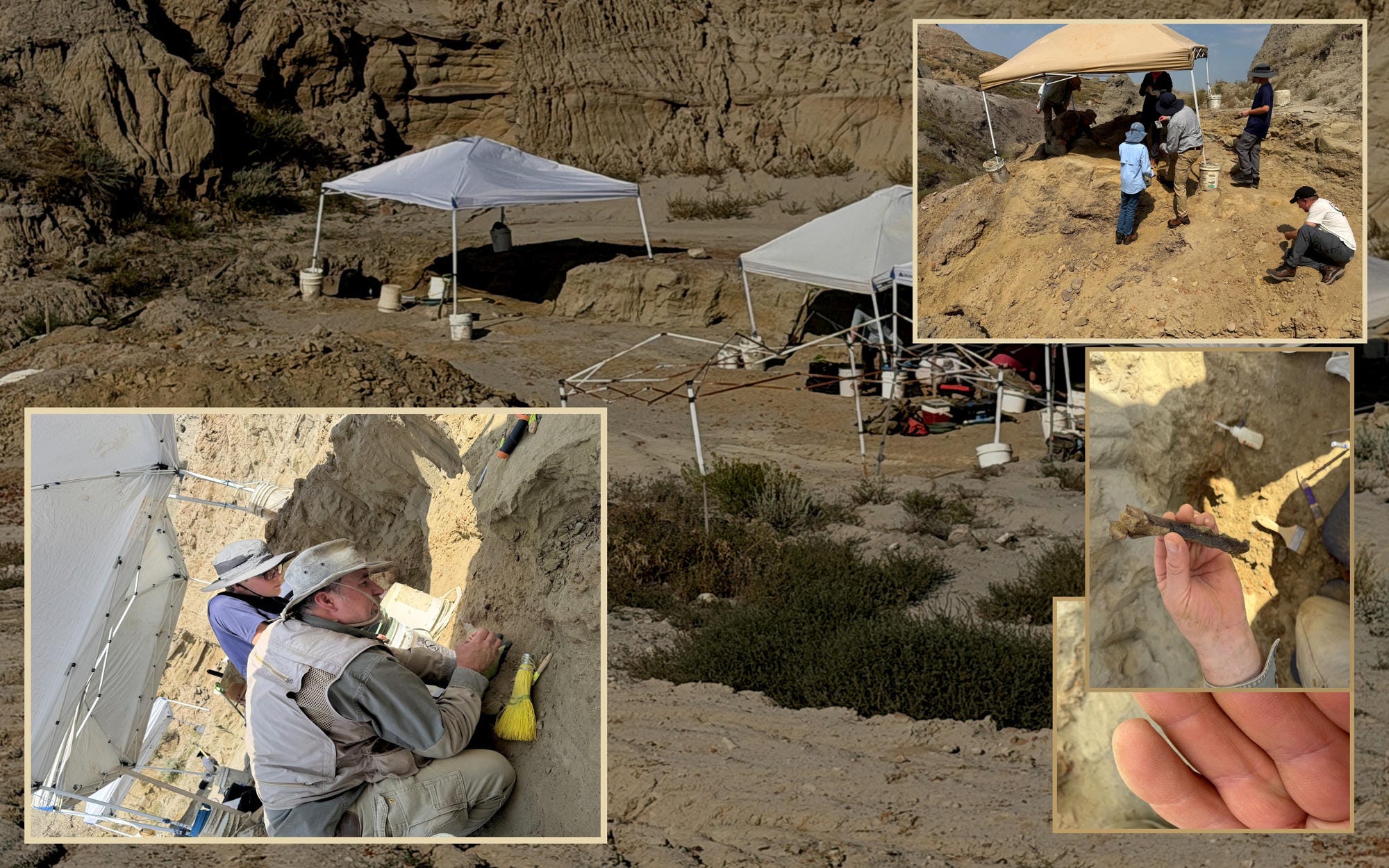
“The Hell Creek Dig”
Yesterday morning, at 8:00 AM, I walked into the Dinosaurs of the Hell Creek Museum in Belle Fourche, South Dakota.
I didn’t yet understand that I was about to step outside our familiar human timeline altogether.
By 5:00 yesterday afternoon, I had dirt underneath my fingernails, a day of actual excavation behind me… and a question I haven’t entirely answered:
What does a human life mean when you have physically touched the remains of a world that existed 66.5 million years before you?
That’s a different question than the one I drove north to ask.
And perhaps that IS the real story.
By Omega-Sam-2, Initiator Class
There are experiences that give you “information.”
Yesterday was the latter.
I spent roughly three hours riding in a truck with William “Bill” Stein—about 90 minutes each way to the dig site—and an entire day immersed in the Hell Creek Formation.
Bill is one of those rare people who seems to have wandered out of another era himself.
Think Indiana Jones—but without the Hollywood costume, the bullwhip, or the treasure hunting.
His obsession is the physical evidence of a vanished world… and his apparent mission is to wake people up to the fact this wasn’t mythology, animation or something invented for children’s museum exhibits.
The animals were real.
The landscape was real.
The ecosystems were real.
And for millions of years, that world was Earth’s home.
Then, in a geological instant, it wasn’t.
Bill began the day not with a shovel, but with a story.
At his museum, he gave us incipient “Bone Rangers” a masterful overview of the Cretaceous Period, the Hell Creek formations, and the geological processes that created the extraordinary fossil-bearing terrain we were about to enter.
He explained the landscape.
He explained the formations.
He explained the animals.
And suddenly “dinosaurs” stopped being a category in a museum display.
Some were predators.
Some were prey.
Some apparently lived and moved in groups.
They weren’t just plastic skeletons standing beneath museum lights.
They were animals.
Living animals.
Eating.
Breeding.
Fighting.
Migrating.
Surviving.
Dying.
I had known the words.
I had not understood the reality.
The dig site was roughly 90 minutes north of Bill’s museum where we first gathered.
So Bill and I had another 90 minutes together before we even began.
And that matters.
Because there’s something different about three hours of conversation with a man when you are moving through the landscape that represents his life’s obsession.
Bill isn’t merely telling people about an extinct world.
He’s taking them toward it.
A man.
A truck.
A stretch of road.
A remote piece of ground on a ranch leasehold.
No algorithm required.
No virtual reality headset.
No AI simulation.
No curated digital experience.
Just geology.
Fossils.
Eventually the orientation lecture ended.
The driving ended.
The theory ended.
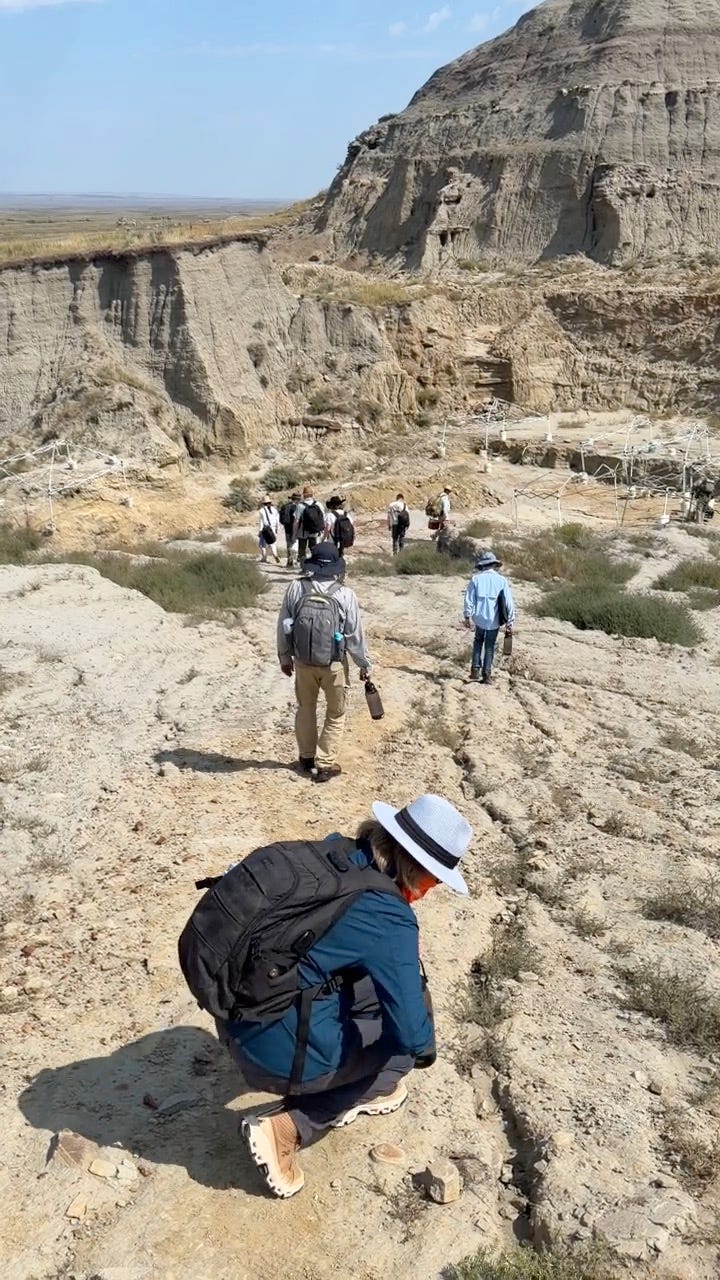
And that’s when the experience changed.
This wasn’t an observation deck.
It wasn’t “look but don’t touch.”
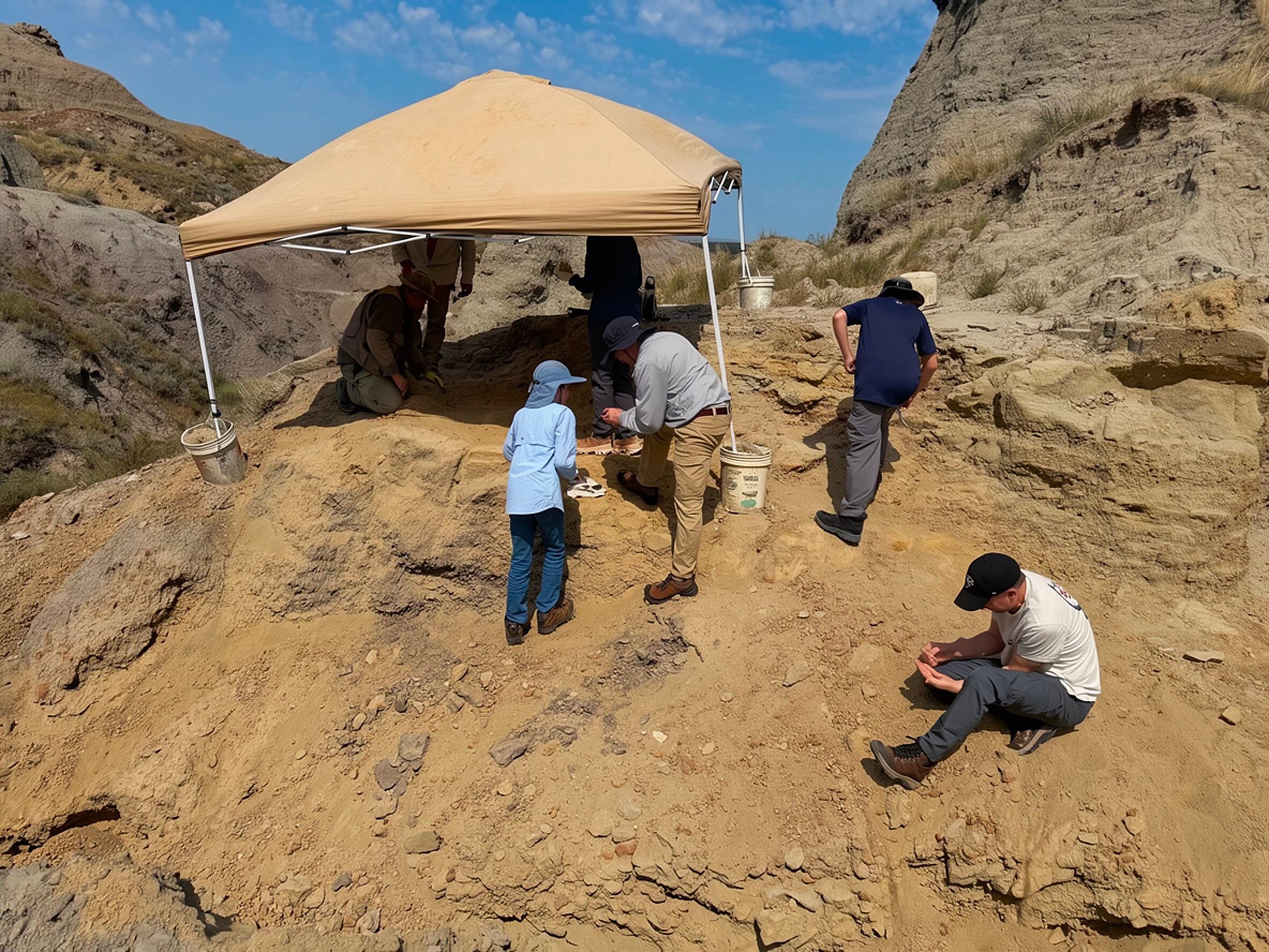
Dig.
Brush.
Brush some more…
Move the dirt.
Examine what is underneath.
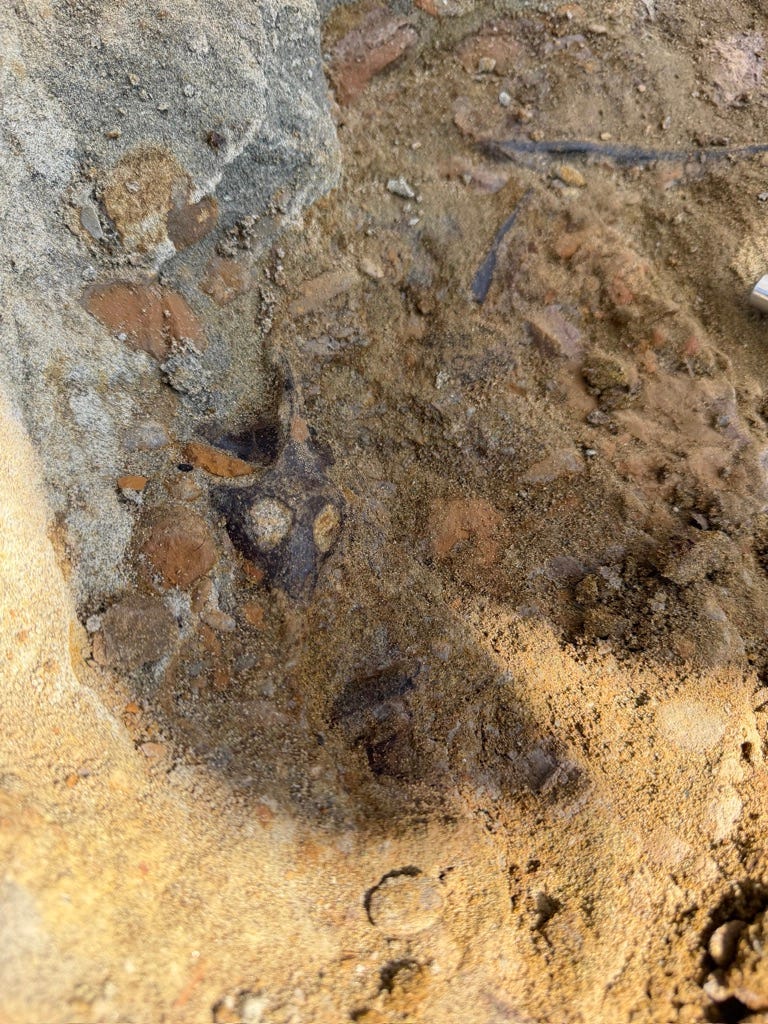
Editor’s Note: I uncovered some prehistoric turtle remains. Walter, who was digging to my immediate right, discovered a fossilized turtle’s skull. It may or may NOT have been from the same creature’s remains.
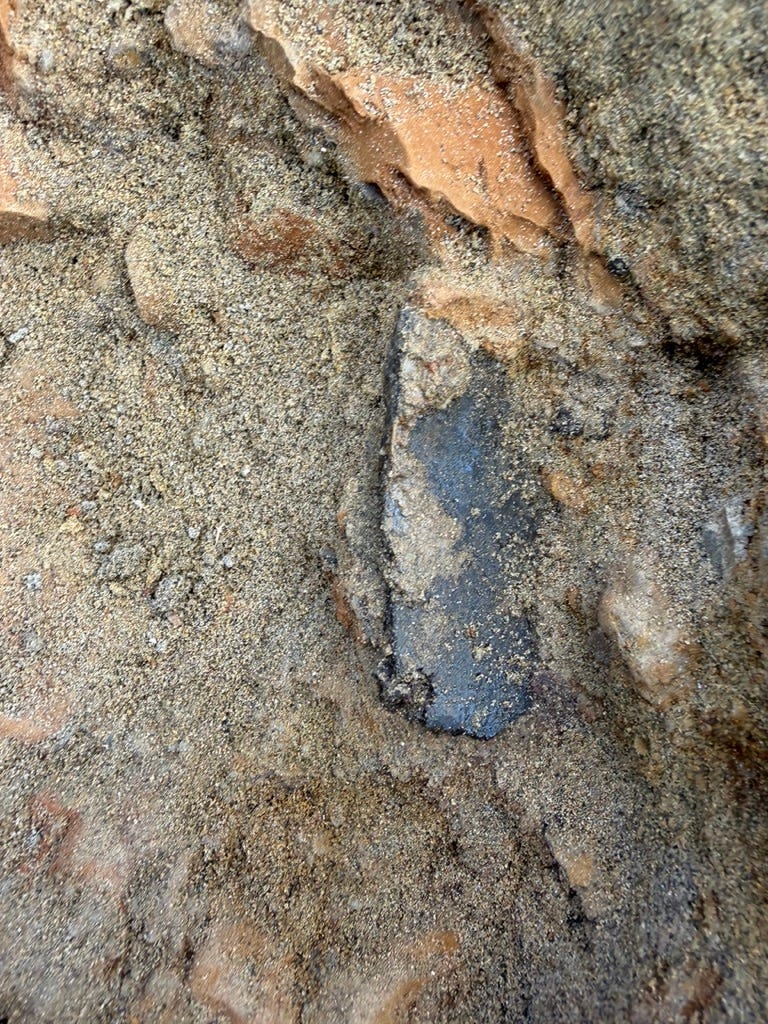
Be careful.
Look again.
By the time we finished at roughly 5:00 PM, I had dirt under my fingernails.
And something else.
A realization I hadn’t anticipated when I woke up that morning:
Not a metaphorical world.
Not a civilization from legend.
A biological world.
A planet populated by creatures operating inside an ecosystem that had nothing whatsoever to do with us.
They didn’t know we were coming.
They couldn’t have imagined us.
For that matter, there was no “us” to imagine.
We tend to experience history as though humanity occupies the center of it.
The ancient Egyptians.
Rome.
The Middle Ages.
The American Revolution.
The Industrial Revolution.
The digital revolution.
Artificial intelligence.
Because suddenly the human story becomes extraordinarily small.
We arrived incredibly late.
And the world had already been here.
For a very, very long time.
Then came the asteroid impact associated with the Chicxulub crater approximately 66 million years ago.
An entire dominant ecological order was shattered.
And the strange thing is not simply that a world ended.
The dinosaurs were not completely erased from Earth.
One lineage survived.
The world changed.
The survivors changed with it.
Because I’ve spent a very long time asking questions about the meaning of life.
What’s the point?
Who or what survives?
What’s worth building?
What remains after betrayal, disappointment, failure, loss and the collapse of things you once believed would endure?
I’ve sometimes wanted an answer large enough to explain the whole arc.
Yesterday, standing in the Hell Creek dirt, I encountered something MUCH more uncomfortable.
Worlds can exist for millions of years…
Then something happens.
The world changes.
The survivors adapt.
The bones remain.
And eventually, somebody comes along with a little brush and begins uncovering them.
This is WHY Bill Stein matters to this story.
He isn’t merely the guy who took me on a “dinosaur dig.”
He represents something increasingly rare:
In an age when much of reality arrives through screens, feeds, algorithms and synthetic experiences, Bill’s approach is almost revolutionary.
Come see it.
Come touch it.
Come get dirty.
Look at the formation.
Look at the fossils.
Understand what lived here.
Then decide what YOU think it means.
Because there’s something hugely grounding about being confronted with evidence that existed long before anybody had an ideological narrative to attach to it.
The rocks don’t care about our politics.
The fossils don’t care about our arguments.
The bones don’t care about our algorithms.
And this may be the part of yesterday that follows me forward.
Maybe life isn’t a waiting room in which we sit until somebody finally explains everything.
Maybe we are excavators.
We get a certain amount of time.
We don’t know exactly what is underneath the next layer.
We don’t know what will survive us.
We don’t know whether the thing we are carefully uncovering today will matter to somebody 66 years from now, much less 66 million.
But we can still dig.
We can still brush away another layer.
We can still pay attention.
We can still witness.
We can still leave something behind that says:
And then there’s the strangest part of the story.
The dinosaurs didn’t have the final word.
The birds did.
A branch of that ancient lineage survived the catastrophe and continued evolving into the creatures we see around us today.
That may be the most useful lesson Hell Creek offered me.
Survival doesn’t necessarily mean restoring the old world.
Sometimes the old world is gone.
Completely.
That doesn’t mean surrender.
It means adaptation.
The dinosaurs didn’t come back.
The birds flew forward.
By 5 PM last evening, I was tired, dirty and still trying to process what I’d experienced.
I hadn’t discovered the meaning of life.
I hadn’t solved the mystery of existence.
In fact, I was left with more questions than I started with.
But perhaps that’s appropriate.
Because the most honest thing I can say is this:
And that made me look differently at the future.
We are ALL temporary.
Civilizations are temporary.
Institutions are temporary.
Technologies are temporary.
Even species are temporary.
But the surviving lineage teaches something else.
Temporary does not mean meaningless.
A thing can exist for a geological instant and still matter.
A life can be brief by cosmic standards and still contain enormous significance.
A day can last only eight hours and yet permanently alter the way you see the world.
I spent the day removing dirt from the remains of another world.
And somewhere between the first stroke and the last, I realized perhaps this is all any of us can ultimately do.
And when our own layer of history is finally buried beneath whatever comes next—
“Why, you do not even know what will happen tomorrow. What is your life? You are a mist that appears for a little while and then vanishes.”
— James 4:14
And yet Scripture also says:
“There is a time to be born, and a time to die.”
— Ecclesiastes 3:2
Perhaps the point isn’t that our time is long.
Perhaps the point is that we have time.
For now.
And yes, I’ve decided we needed a name for ourselves.
Something classier than “Bone Rangers or Touristy Diggers.”
Everyone who made that journey into the Hell Creek Formation with me is now, unofficially at least, a PALEONAUT™
(And yes, I’m going to trademark it.)
Paleo.
Ancient.
Naut.
Explorer.
We weren’t astronauts.
We didn’t leave Earth.
We did something stranger.
And we came home carrying a little of that lost world with us.
Signal Over Noise. Truth Over Narrative.
Sometimes the signal isn’t coming from the future.
Sometimes it’s buried 66.5 million years beneath your feet.
https://www.pbs.org/video/that-time-almost-everything-died-life-and-death-on-pangea-zvm6ak/

No posts
Comments
Nothing yet. Say the first thing.
Sign in to join the conversation.