
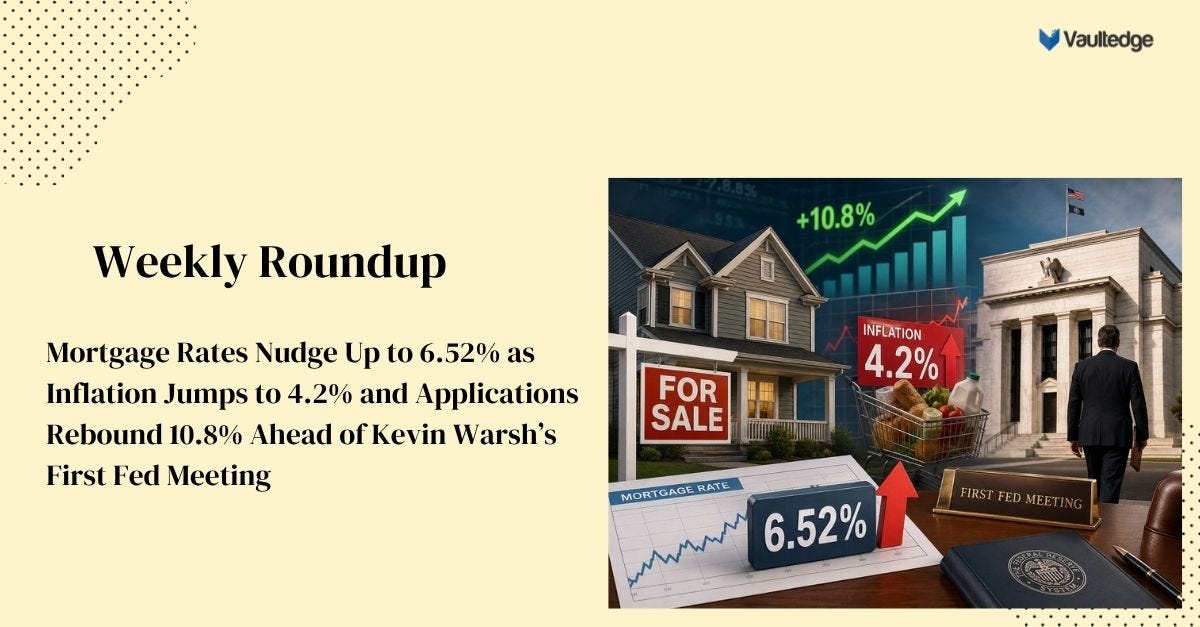
What’s Included:
30‑year and 15‑year mortgage rate snapshot as of June 11
May CPI at 4.2% year‑over‑year, highest in three years, driven largely by energy
MBA applications up 10.8% in the week ending June 5 after a 2.5% drop
How markets are positioning for Kevin Warsh’s first FOMC as Fed Chair
Playbook for lenders and servicers in a 6.4–6.7% rate world
Here’s a complete low‑down 👇
Mortgage rates moved modestly higher this week, chipping away at last week’s brief relief rally. Freddie Mac’s Primary Mortgage Market Survey and FRED’s MORTGAGE30US series both show the 30‑year fixed‑rate mortgage averaging 6.52% as of June 11, 2026, up from 6.48% the prior week, while the 15‑year fixed climbed to 5.84% from 5.79%.
Barchart’s summary notes that a year ago the 30‑year FRM averaged 6.84%, putting today’s level about 32 basis points lower year‑on‑year. For a standard $400,000 loan, the move from 6.48% to 6.52% adds roughly $10–12 to the monthly principal‑and‑interest payment, small in absolute terms but another reminder that we are oscillating around a plateau, not trending back to pandemic lows.
For lock desks and secondary teams, the trade remains about fine‑tuning execution inside a 6.4-6.7% corridor, with week‑to‑week moves driven by energy prices, 10‑year yields and data surprises rather than by any imminent Fed pivot.
Read more:
The U.S. Consumer Price Index rose 4.2% year‑over‑year in May 2026, the fastest pace in three years, as energy prices spiked on the Iran conflict. The BLS report showed headline CPI up 0.5% month‑on‑month after a 0.6% rise in April, while core CPI (excluding food and energy) increased 0.2% on the month and 2.9% on the year.
Reuters described the print as “consumer inflation vaulting above 4% as Iran war boosts energy costs”, highlighting that the energy index jumped 3.9% in May and 23.5% over the year, accounting for more than 60% of the monthly CPI gain. CNN called it the highest annual inflation rate in three years, stressing that the three‑month run‑up in headline CPI is the steepest since mid‑2022.
For the Fed, this virtually locks in a “higher for longer” stance: headline inflation is well above the 2% target, and even though core is more contained, the risk of energy‑driven shocks bleeding into expectations is non‑trivial. For mortgage markets, it means the odds of any 2026 rate cuts are close to zero, and markets must also contemplate a small but rising risk of an eventual hike if energy prices fail to subside.
Read more:
After three straight weekly drops, mortgage demand finally bounced. MBA’s Weekly Mortgage Applications Survey shows total applications rising 10.8% in the week ending June 5, 2026, compared with a 2.5% decline the previous week.
FloorDaily’s summary notes that the Market Composite Index increased 10.8% on a seasonally adjusted basis and 21% unadjusted, with the Refinance Index up 15% week‑over‑week and 20% above the same week a year ago. The seasonally adjusted Purchase Index rose 7%, up 4% year‑over‑year, indicating that both refi and purchase borrowers jumped on perceived short windows before rates drift higher.
CNBC framed the move as “weekly mortgage demand surges nearly 11% higher, despite volatile interest rates”, pointing out that average 30‑year conforming rates in MBA’s own survey actually ticked up from 6.57% to 6.60% during the week, but shifts in points and local pricing still created “pockets of opportunity” originators could sell into. Trading Economics emphasises that this is the largest weekly increase since late February, and that it ends a three‑week streak of declines.
For lenders, this is less the start of a new up‑cycle and more evidence that demand in a 6.5% world is tactical, borrowers come off the sidelines in bursts when local prices, concessions and products line up, not because of a structural shift in rates.
Read more:
All of this, mid‑6s mortgage rates, 4.2% headline inflation and choppy but opportunistic demand—feeds into one focal point: Kevin Warsh’s first FOMC meeting as Fed Chair on June 16–17. While markets widely expect the policy rate to be left unchanged, the real story will be in the Summary of Economic Projections and Warsh’s guidance on inflation, energy shocks and balance‑sheet policy.
As highlighted in recent coverage, Warsh has signalled a reform‑oriented, balance‑sheet‑focused approach, with Yahoo Finance warning that his plans for more aggressive quantitative tightening “could quietly push borrowing costs higher,” even if the Fed eventually trims the policy rate. Against a backdrop of 4.2% headline CPI and still‑solid labour markets, the bar for any discussion of cuts is extremely high; the more realistic question is whether the dot plot for 2027 shifts higher, locking in elevated term premiums for longer.
For mortgage desks, this meeting is less about hoping for immediate relief and more about mapping the new reaction function, how this Fed trades off headline vs core inflation, what it views as a neutral long‑term rate, and how steeply it is willing to let the yield curve rise as it shrinks its portfolio.
Read more:
Putting the week together, the near‑term picture is clear: mortgage rates around 6.5%, headline inflation near 4%, core just under 3%, and demand that arrives in tactical bursts when conditions align. Zillow’s latest housing forecast still pegs 2026 existing‑home sales at about 3.73 million (up only 0.5% from 2025) and home values up a marginal 0.3% by December 2026, implying a long, shallow plateau rather than a boom or bust.
In that world, the winners will be lenders and servicers who:
Treat 6.4-6.7% as the base case for 2026, not a temporary spike.
Design products for payment‑sensitive buyers, transparent ARMs, buydowns and income‑linked structures where compliant.
Automate aggressively across underwriting, verification and servicing to keep cost‑to‑originate aligned with lower, volatile volumes.
Use data and AI to surface “pockets of opportunity” in both new‑business and retention, cash‑out refis for low‑LTV borrowers, HELOCs, and targeted recapture and recapture‑plus offers.
Keep capital‑markets and risk teams tightly aligned around the Fed’s evolving stance under Warsh.
Read more:
That’s a wrap on this week’s Mortgage Market Update.
From 30‑year mortgage rates nudging back up to 6.52% while still sitting slightly below year‑ago levels, to headline CPI jumping to 4.2%, its highest in three years, on an Iran‑driven energy shock, to MBA applications rebounding 10.8% after three weeks of declines as borrowers chase narrow affordability windows, and finally to markets positioning for Kevin Warsh’s June 16-17 FOMC debut with no cuts on the table, this edition captures a U.S. housing market that is stable but finely balanced.
In 2026, the path to winning in mortgages isn’t about betting on a big pivot from the Fed; it’s about building a franchise that can thrive in a long mid‑6s plateau, hyper‑efficient operations, sharp pricing, and the agility to capture demand whenever those fleeting “pockets of opportunity” appear.
No posts
Comments
Nothing yet. Say the first thing.
Sign in to join the conversation.