
What’s Included:
30‑year and 15‑year mortgage rate snapshot as of July 2
MBA mortgage applications for the week ending June 26
June 2026 jobs report and what it signals about the economy
New‑ and existing‑home sales, prices and inventory heading into H2 2026
Playbook for lenders and servicers in a mid‑6s, slow‑growth environment
Here’s a complete low‑down 👇
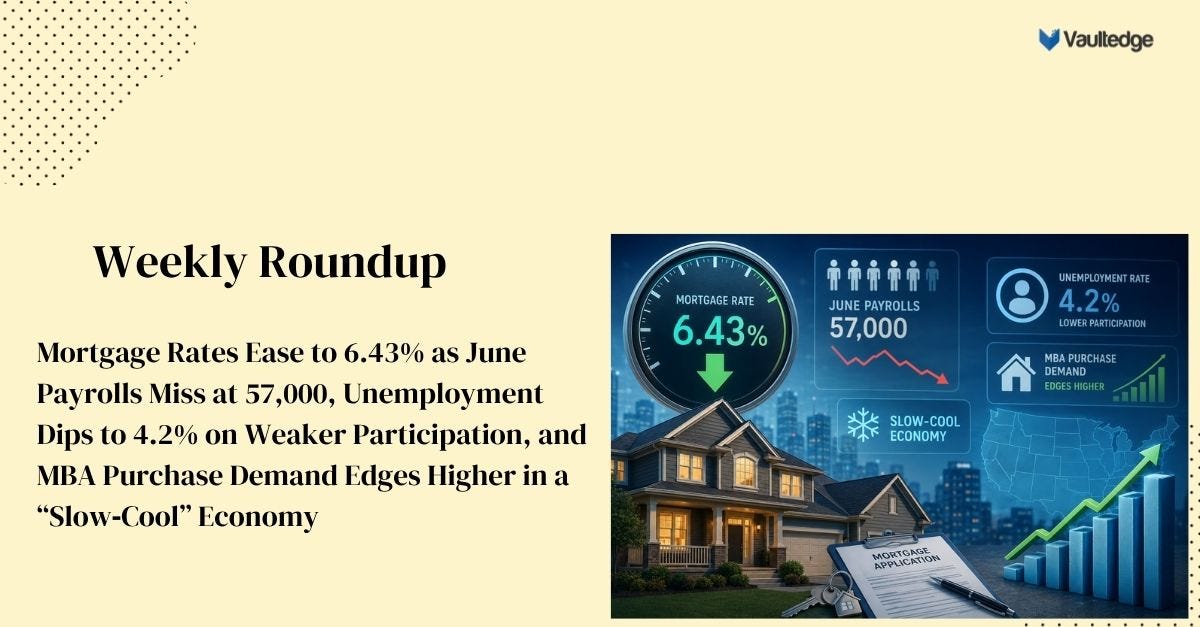
Freddie Mac’s July 2 Primary Mortgage Market Survey shows the 30‑year fixed‑rate mortgage averaging 6.43%, down from 6.49% a week earlier and roughly 20-25 basis points lower than a year ago, marking a seven‑week low. The 15‑year fixed averaged 5.79%, down from 5.84% the previous week, while the 5/1 ARM held in the mid‑5s range.
Freddie’s commentary notes that rates have “drifted lower on softer economic data”, with purchase demand “edging higher compared with last year’s depressed levels” but still far from pre‑pandemic norms. Independent trackers such as Mortgage News Daily show similar levels, with the best‑execution rate for top‑tier 30‑year conforming loans in the 6.4-6.5% band and meaningfully higher quotes for cash‑out or lower‑FICO borrowers.
For a $400,000 loan, this week’s move from 6.49% to 6.43% reduces principal‑and‑interest payments by roughly $15-20 per month, marginal in isolation but potentially enough to move fence‑sitters in combination with price cuts or seller concessions.
Read more:
MBA’s latest Weekly Mortgage Applications Survey (week ending June 26) shows overall application volume essentially flat, up just 0.04% on the Market Composite Index, but with a 1% rise in purchase activity offset by a 1% drop in refis. Chicago Agent Magazine notes that the seasonally adjusted Purchase Index is now modestly above its year‑ago level, while the Refinance Index remains higher than in 2025 but well below historical boom cycles.
On the rate side, MBA’s own survey found the average contract rate for 30‑year fixed‑rate mortgages with conforming balances easing to 6.57% from 6.59%, and FHA 30‑year rates dipping to 6.00% from 6.02%. The share of ARM loans fell below 8% of total applications, the lowest since January, as a relatively flat yield curve and elevated short‑term rates make fixed‑rate products more compelling.
The net message: demand isn’t surging, but it is no longer deteriorating. Purchase volume is slowly improving as buyers adjust to mid‑6s rates, while refinance activity is confined to niche pockets (equity‑rich borrowers, cash‑out needs, and a small cohort exiting older, higher‑rate loans).
Read more:
The June 2026 employment report injected a clear dose of caution into the macro narrative. Reuters reports that nonfarm payrolls increased by just 57,000, barely half the roughly 110,000 jobs economists had expected and the weakest monthly gain since early 2024. In addition, April and May payrolls were revised down by a combined 74,000, revealing a more persistent slowdown than earlier data suggested.
The unemployment rate slipped to 4.2% from 4.3%, but this was driven by a drop in the labour‑force participation rate to 61.5%, a five‑year low, as an estimated hundreds of thousands of workers left the labour force. Eastern Herald and First Trust highlight that average hourly earnings rose 0.3% month‑on‑month and 3.5% year‑on‑year, which is below the roughly 4.2% inflation rate, marking the third consecutive month of real wage erosion.
For the Fed and markets, this “bad‑ish growth, still‑high inflation” mix argues for a slower hiking bias but not an imminent easing cycle, especially under Kevin Warsh’s hawkish framework. For mortgage lenders, it reinforces the base case of mid‑6s mortgage rates in a slowing but not collapsing economy, with borrowers increasingly sensitive to both monthly payments and job security.
Read more:
US job growth slows sharply in June; labour force participation rate at 5‑year low
US Added Just 57,000 Jobs in June as Wage Growth Trails Inflation
On the supply side, the latest New Residential Sales release shows that new single‑family home sales fell to a 580,000 SAAR in May 2026, down 7.3% from April’s 626,000 and 6.8% below May 2025’s 622,000. Inventory of new homes rose to 496,000 units, representing 10.3 months of supply at the current sales pace, up from 9.3 months a month earlier. The median sales price was $424,900, with the average at $540,600, both roughly flat to modestly up year‑over‑year.
In contrast, the existing‑home market looks slightly healthier. NAR’s May 2026 Existing-Home Sales Housing Snapshot reports 4.17 million annualised sales, a 3.2% increase from April, with a median price of $429,300 (up 1.3% YoY) and 4.5 months of inventory. First‑time buyers made up 35% of all transactions, the highest share since June 2020, while about 25% of homes still sold above list price, although bidding‑war intensity and contingency waivers have eased compared with 2022-23.
RE/MAX’s May 2026 National Housing Report adds that across 51 metros, closed home sales were up 7.9% from April but slightly below last year, with overall inventory up 8.4% month‑on‑month and 2.0% year‑on‑year, and the median price at $450,000, up 1.4% from May 2025. All in, the housing market is best described as “slow but functioning”: higher inventory, stable to gently rising prices, and enough turnover to sustain purchase originations at today’s rates.
Read more:
Putting the week together, 30‑year mortgage rates at 6.43%, applications flat with a modest tilt to purchases, a jobs report that shows just 57,000 payroll gains and weaker participation, and a housing market characterised by high new‑home inventory and slowly improving existing‑home sales, the second half of 2026 looks like a mid‑6s, slow‑growth regime rather than a pivot year.
In that context, lenders and servicers that win will:
Anchor pricing and hedging around a 6.3-6.7% base case, with scenario‑planning for modest moves in either direction, not a crash lower.
Double‑down on purchase business in segments with improving inventory (new‑construction partners, move‑up buyers, first‑time buyers empowered by slightly softer competition).
Treat refi as a precision instrument, targeted cash-out and term‑change opportunities among equity‑rich borrowers, rather than a volume engine.
Use automation and AI not just for underwriting but for lead‑scoring, retention and servicing, so that every earned lead and relationship generates maximum lifetime value.
Keep macro and risk teams glued to labour-market and inflation data, which will drive the Warsh Fed’s next moves and, through term premiums, the long end of the curve.
In 2026, the edge in mortgages is less about calling the Fed and more about running a lean, data-driven franchise that can profit in a long plateau, turning small rate moves and local housing shifts into durable share gains.
No posts
Comments
Nothing yet. Say the first thing.
Sign in to join the conversation.