

Hey, welcome to the last VWV Bulletin of the school year! This week, we’re covering the latest news and moves in VC and tech. Best of luck on finals, and VWV wishes you an amazing summer break! 🕺
📌 For this semester, keep up with our content if you’re interested in:
Demystifying & breaking into VC
Finding opportunities in the start-up world
Keeping up with VC investment news at Brown & beyond (pro tip: this is essential to breaking in and finding opportunities)
Enjoy the Bulletin!
Tim Cook announced Monday that he is stepping down as Apple’s CEO after nearly 15 years, with John Ternus, currently SVP of hardware engineering, taking over on September 1. Cook will move to be the executive chairman of the board.
Cook took over from Steve Jobs in 2011, inheriting a company already at the center of consumer technology. When Cook took over, Apple was valued at just under $350 billion. Now, it is a $4 trillion company. That is an operations story, and Cook was, above everything else, an operator.
The critique of the Cook era has always been that Apple stopped inventing and started refining. The iPhone, Mac, and iPad are all Jobs-era ideas that Cook’s Apple iterated on rather than replaced. The Vision Pro, the one genuinely new category bet of his tenure, failed to resonate with consumers who didn’t want to spend several thousand dollars on it. Apple Intelligence, launched in 2024, has also underwhelmed consumers. The revamped AI-powered Siri that Apple promised in 2024 has yet to prove its innovation.
But the critique misses what Cook actually built. Apple’s services business generated $109 billion in revenue in fiscal year 2025. It’s important to note that they were not a business that was known to exist when Cook took over. Apple Pay, Apple TV, Apple Music, and iCloud are not hardware products. They are the infrastructure of a platform company, and Cook built them quietly while everyone was waiting for the next iPhone moment.
Ternus is a 25-year Apple veteran and an engineer by background. His first major test arrives almost immediately: Apple’s fall iPhone event, which is unlikely to change its post-Labor Day timing, will be his first stage moment as CEO. He is taking over the head role in a company that is dominant in hardware, behind in AI, under regulatory pressure in the US and EU, and navigating a manufacturing shift away from China. Whether Ternus can fill Cook’s shoes, while also pushing Apple back toward genuine innovation, is the open question.
Cook’s legacy is one of the stranger ones in business history: a man who spent 15 years in the shadow of a myth and still managed to build one of the most valuable companies ever to exist.
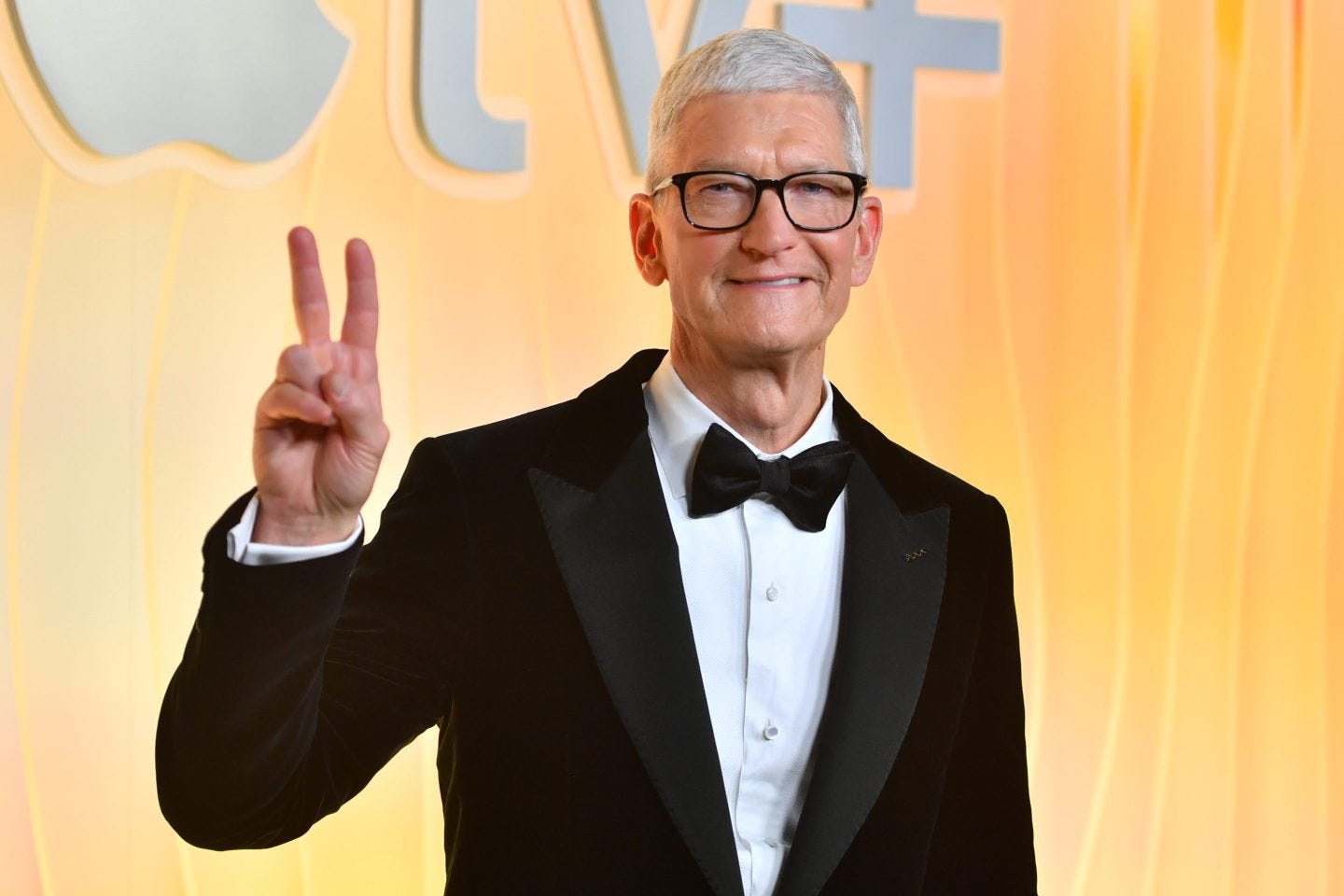
The AI infrastructure race got a significant moment this week. Amazon and Anthropic deepened their collaboration, with Amazon committing to invest $5 billion in Anthropic today and up to an additional $20 billion in the future, tied to certain commercial milestones, bringing Amazon’s total investment in the company to $13 billion.
The more interesting number, though, is on Anthropic’s side of the ledger. Anthropic is committing more than $100 billion over the next ten years to AWS technologies, securing up to 5 gigawatts of new capacity to train and run Claude. That is a supplier relationship dressed up as a partnership. Amazon gets a decade of locked-in cloud revenue; Anthropic gets the compute it desperately needs.
And Anthropic does desperately need it. Over 100,000 customers run Claude models on AWS, and the company has been struggling to keep up. The WSJ reported that the computing crunch has led to outages, throttling, and slower performance, with some customers switching to competing models out of frustration. Anthropic’s run-rate revenue has now surpassed $30 billion, up from approximately $9 billion at the end of 2025, growth that creates its own problems when your infrastructure cannot match demand.
The commitment spans Trainium2 through Trainium4 chips, with the option to purchase future generations of Amazon’s custom silicon as they become available. The Trainium line is Amazon’s answer to Nvidia, a bet that proprietary chips optimized for AI workloads can undercut on price while matching performance. Anthropic being the primary customer for those chips through the next decade gives Amazon a real-world training ground for the technology.
What makes this deal structurally notable is the timing. Anthropic is reportedly being valued at $800 billion or more in discussions with VCs. An IPO is likely coming. Before that happens, locking in infrastructure at scale and the credibility that comes with a $25 billion Amazon commitment matter. The deal is both a balance sheet move and a signal.
The AI infrastructure layer is consolidating fast. The companies that win may not be the ones with the best models, but the ones that secure the compute to run them.
Jersey Mike’s confidentially filed for an IPO this week, targeting a valuation of around $12 billion and looking to raise over $1 billion. This filing is roughly 16 months after Blackstone acquired a majority stake in the business at an $8 billion valuation, a quick turnaround that reflects the brand’s growth and Blackstone’s scalability skills.
Jersey Mike’s crossed $3 billion in system sales in 2023 and finished 2025 at $4.2 billion. Average unit volumes sit at $1.37 million across 3,227 locations, making it the second-largest sub chain in the United States behind Subway. The initial franchise cost runs between $436,000 and $1.16 million, and the brand added 238 locations last year alone.
Charlie Morrison, the former Wingstop CEO who guided that brand through its own IPO in 2015, was brought in to run Jersey Mike’s after the Blackstone deal. That hire was a signal. Wingstop went public at a modest valuation and has since become one of the better-performing QSR stocks of the past decade. The bet here seems to be that Jersey Mike’s can follow a similar arc: a focused concept with strong unit economics, room to scale, and a culture that holds as the footprint grows.
The timing is interesting. Several restaurant franchisors have recently gone private, such as Denny’s and European Wax Center, while FAT Brands was delisted after filing for bankruptcy. Jersey Mike’s would be the first restaurant chain to go public since Black Rock Coffee Bar’s debut last September. Whether the broader market has appetite for a new restaurant IPO, in an environment where Planet Fitness is down 32% year to date and Jack in the Box is down 31%, is a legitimate question.
What Blackstone is selling is not just a sandwich chain. It is a brand with a clear identity, a founder mythology, and a unit-level model that works. Whether the public markets agree on the $12 billion number is what the next few months will determine.
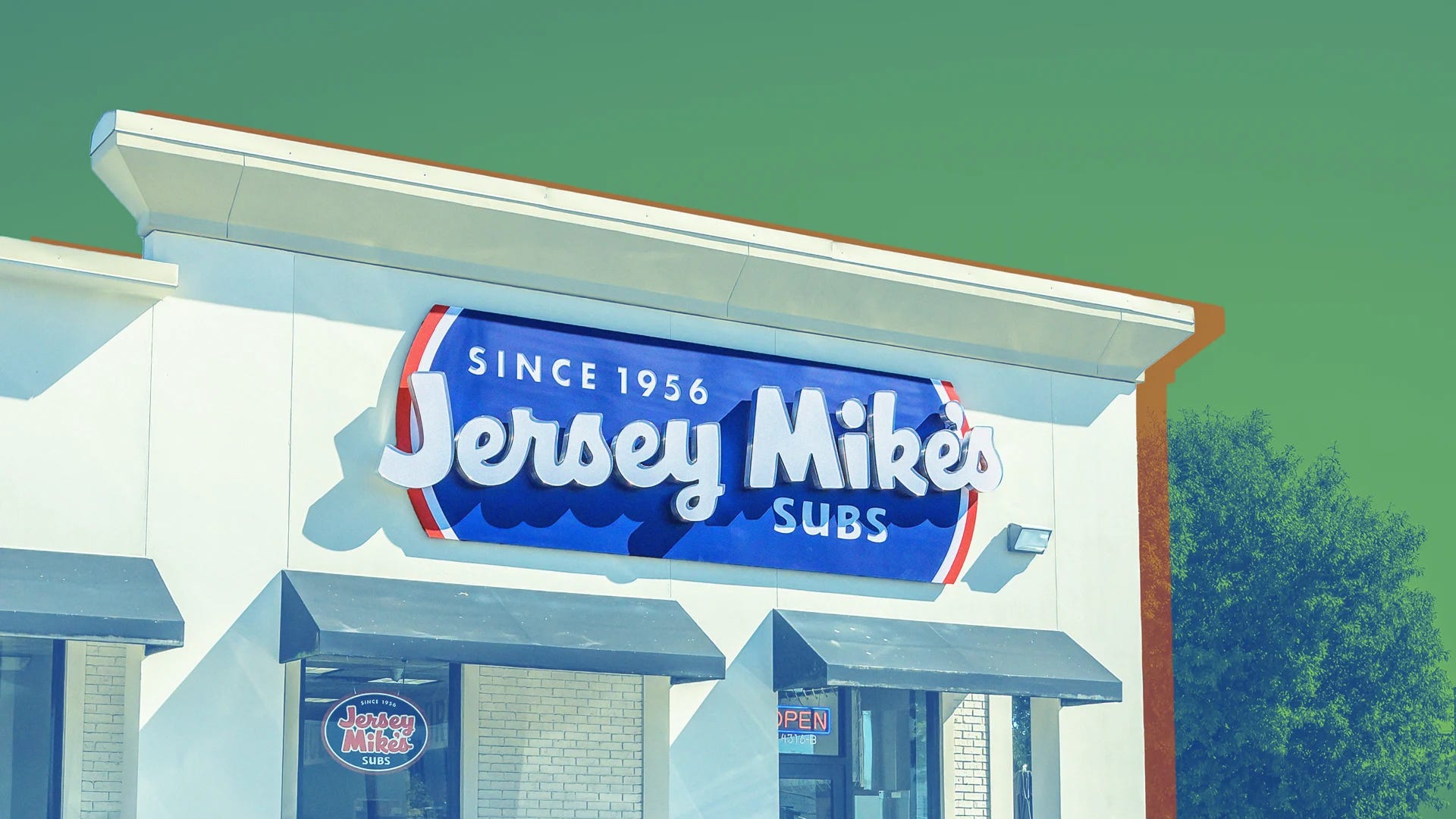
Tony’s Chocolonely is a Dutch chocolate company that was founded in 2005. The name represents the business’ story: a single journalist, Teun van de Graaf, an entrepreneur who set out to prove that a business selling 100% slave-free chocolate was possible.
The chocolate industry has a well-documented labor problem. Cocoa supply chains in West Africa, where most of the world’s cocoa comes from, have historically relied on child and forced labor. Most big chocolate companies acknowledge this. Most have not fixed it. Tony’s decided that was the product. Not the chocolate itself, the mission.
Everything about Tony’s is built around that premise. The unequal chunk sizes on every bar are a deliberate reference to inequality in the supply chain. The loud, primary-color packaging looks like something designed to be picked up and asked about. The company publishes a yearly “Choco-meter” that tracks its own progress toward slave-free sourcing and openly admits when it falls short. It is a strange thing to see in F&B: a brand that treats transparency as a core feature rather than a PR strategy.
The model has attracted serious capital. Tony’s raised funding that valued it in the hundreds of millions, and in 2023, the company reported revenues of around €130 million. It has expanded into the U.S., where it positioned itself at the premium end of a market that was already moving toward ethical consumption. The bet is that enough consumers will pay more for chocolate that comes with an auditable supply chain.
Whether the mission scales is the real question. Tony’s model depends on paying above-market prices directly to farmer cooperatives, which works at their current size but gets harder as volume grows and sourcing complexity increases. The company knows this. They’ve started an industry coalition, the Tony’s Open Chain, inviting other brands to source through their supply chain model, turning a competitive advantage into an industry standard, or at least trying to.
Tony’s is not the most technically innovative product in food. The chocolate is good, not transcendent. What’s interesting is the experiment: can a consumer brand use its supply chain as its primary differentiator, and can that actually move an industry? The answer is still being written.
We love our website, and want to make sure it is accurate and up-to-date. Please let us know through this form if you are a part of the VWV team (Investment Committee, Advisors, Alumni) and have changes you wish to make to your personal profile.
That’s it for this week, feel free to email me eason_zhang@brown.edu with any thoughts or inquiries! 💌
Follow us:
Instagram: @vanwickleventures
Twitter: @VanWickleV
No posts
Comments
Nothing yet. Say the first thing.
Sign in to join the conversation.