

Hey, welcome back to the VWV Bulletin! We hope you had a restful winter break and have had a great start to the new semester! This week, we’re covering the latest news and moves in VC and tech. Let’s get into it! 🕺
📌 For this semester, keep up with our content if you’re interested in:
Demystifying & breaking into VC
Finding opportunities in the start-up world
Keeping up with VC investment news at Brown & beyond (pro tip: this is essential to breaking in and finding opportunities)
Enjoy the Bulletin!
Say you’re a business and, like every other business that has ever existed, you need some money. How do you get it? Well, for the greater part of economies (and, like, all of time), you could go borrow. These days, you can go to a bank, they give you money, and they syndicate that risk across a ton of institutional lenders, and then those loans trade on some leveraged loan market. Or, if you have the means, you can go straight to the market and sell some bonds. People still do this a lot, and Alphabet does it with a fun little twist.
But there is a third player which has managed to gain some popularity. Back when things went south in 2008, the government introduced some new rules, and banks got a bit more selective with who they gave money to. Thankfully, people like being owed money, and we have private markets to replace them—hence, private credit. The idea is simple:
Raise money into a fund from pensions, endowments, insurance companies, the usual
Lend that money directly to a company with privately negotiated terms
Make money on a credit spread + fees
You can of course get fancier with different terms and fee structures (in fact, that is kind of the point), but those building blocks are always the same. Now, you might ask, if this system is efficient and companies seem to like it, who needs these bank loans? Well, turns out being private can come with a few pressing issues:
At its peak, Zips Car Wash operated in 270 locations and generated hundreds of millions of dollars in revenue. It had completed dozens of expansionary acquisitions and operated in an industry that was viewed as recession-resilient as a national car wash provider with recurring membership revenue. Unfortunately, its business model was not recession-resilient, and it filed for Chapter 11 bankruptcy February 5th, 2025. Still, things happen and companies can go bankrupt. Zips, though, was a bit special. When it went bankrupt it had $654 million in debt, all of which was held by secured private lenders.
So, if you’re an LP and you want to participate in the credit spread upside those Zips’ loans have, you can do so by providing your capital to the funds which made them. Of course, the amount of returns you receive relative to how much capital you provide defines the price! If you buy into a fund pricing its loans at 90c on the dollar, you expect those loans to be pretty secured and pretty covered. However, if you’re paying for loans in Zips, who had been in distress for months, took on ~$80 million in bridge financing, and worked to extend several maturities, you would probably expect to pay less. Unfortunately, you would be wrong.
The point is, if you’re a private credit fund Capital Southwest, HPS Investment Partners, and PennantPark, you can price your fund at your discretion. It’s not “traded” on a market like its alternatives, and thus there is no efficient market theory to price in risk. To decrease the value of loans is synonymous with decreasing confidence in the asset backing them, which is bad for business. But then, it’s also bad for investors, who might say, “hey, these guys know what they’re doing and this seems like a great way to make some money and minimize some risk.”

It seems these days everyone agrees that Cybersecurity is important. And, since everyone else is moving to the cloud, that means cloud security is also pretty important. We saw Google buy Wiz for $32B, Palo Alto Networks buy CyberArk for $28.7, and ServiceNow buy pretty much everything else. And this is great for the parties involved—if a company is selling and another company is buying, money is being made and boardrooms are happy (probably). Of course, it is not great for the parties not involved. There are less targets to be bought and less buyers to be sold to. This is fine if time goes on, the landscape stays the same, and you can eventually get acquired. Alas, this is technology, and nothing stays the same.
Yesterday, Tenable, SailPoint, Okta, SentinelOne, Fortinet, and Palo Alto Networks stock dipped. The belief is that investors, in typical investor-fashion, were spooked by this announcement by Anthropic. Basically, Anthropic says that Claude can scan codebases for vulnerabilities, “reason” about them (as opposed to pattern matching), and propose fixes. Really, it just sounds like a run-of-the-mill SaaS addition, and, as it stands now, that’s precisely what it is. We have seen this type of market reaction in the past (Alphabet dropped 8% when Microsoft announced OpenAI x Azure, Chegg fell 40% when it cited ChatGPT as a competitor, Adobe sold off when DALL-E gained traction, etc.), which has sometimes been correct and sometimes not.
Still, the reaction is humoring an interesting possibility which would be important for cybersecurity (and cloud security specifically). Right now, a CNAPP (cloud-native application protection platform) like Orca or Wiz, works like:
Connect via APIs to cloud platform (AWS / Azure / GCP)
Pull IAM/PAM privileges, configurations, data (who can access what)
Run various checks/tests
Build a graph of potential attacks
Show it to a team of smart developers
Fix the problem
Repeat
What is probably possible (but not currently implemented) with Claude and co. is the removal of step 3. Instead of having a dynamic library of tests/rules -> responses to run on a platform, Claude can reason to create its own, meaning it can recognize new risks and propose its own solutions.
Of course, Orca, Wiz, and the million other cloud-security platforms, both public and private, have been ceaselessly embedding AI into their platform in-house and via acquisition. But the risk is not their service being unable to keep up—rather, it is their service being commoditized, and the UI they use to attract developers being irrelevant. If Claude can make its own proposals, what is the point of paying for an entirely different service where the only value add is a reproducible dashboard? The question left, then, is whether AI will encroach dangerously on existing cybersecurity companies, or if there will be another, extravagant thing that happens instead (probably the latter!).
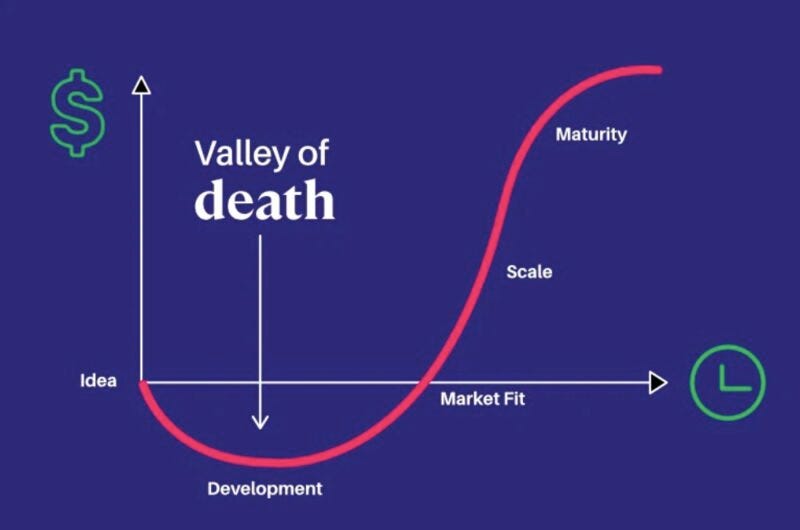
Business can be tricky, and getting money can be even trickier. And, when you’re just starting out, this is all the more true. If you’re an early-stage founder, you can hop on a call with investors or angels and dazzle them with a pitch deck and its endless promises of grandeur and market disruption. If you’re a growth stage company, you can do the same thing, but with more numbers. But there is a gap in-between those two which folks call the “valley of death.”
Basically, if you’re not one of the bajillion SaaS startups, you need to scale with some physical product. Maybe you need materials for production, machines, etc.. Whatever the case, what you really need is capital. The problem is that venture-like terms will be highly dilutive if they are established so early in a company’s lifecycle, and you’d be hard pressed to find a lender willing to use hopes and dreams as sufficient collateral for the millions of dollars required. How do you solve that problem? Josh Felser had a cool idea:
“Material Scale is betting on startups with commercial-ready products that are ready to scale if a customer can purchase in bulk. Buyers will commit enough funds to cover the cost of the material at market price. Material Scale will fund the difference through a combination of loans and warrants in the startup.”
The idea is:
If some company gets a buyer, the company needs to produce the goods its client buys
The fund provides capital to the startup to fulfill that order at market price
The startup then owes that money back over time
There is clearly a ton of room for other terms to be introduced. Felsher proposed Warrant kickers in tandem with the financing which enables equity upside in, say, a few years if things are going well. The idea is still in the early stages and will begin with a pool of about $11 million (presumably big enough for 1-2 investments at scale), but, who knows, it might take off. Ralph Lauren thinks it has potential, so there must be something there.
It is worth noting that this still comes with the same risks as any other form of financing. If demand is not what the company expects it to be, the investment is poor. If the company is unable to sustain its order volume, the investment is poor. If macroeconomic conditions are not in favor, etc. etc., the investment is poor. And, to the dilution argument, there is not technically a guarantee that this is any less dilutive—if the warrant kicker is renegotiated or bolstered then the company may end up just as diluted as it would have with, say, a SAFE note from traditional financing.
In any case, it’s always good to see some new fund mechanics being developed, especially when they aim to solve more broad problems in the industry. Best of luck to Felser and the team as they use this idea to finance climate tech!
We love our website, and want to make sure it is accurate and up-to-date. Please let us know through this form if you are a part of the VWV team (Investment Committee, Advisors, Alumni) and have changes you wish to make to your personal profile.
That’s it for this week, feel free to email me jack_j_connolly@brown.edu with any thoughts or inquiries! 💌
Follow us:
Instagram: @vanwickleventures
Twitter: @VanWickleV
No posts
Comments
Nothing yet. Say the first thing.
Sign in to join the conversation.