
Below are the English lyrics to David Bowie’s Italian-language recording, “Ragazzo Solo, Ragazza Sola” (“Lonely Boy, Lonely Girl”), set to the music of “Space Oddity,” with Italian lyrics by Mogol. The song appears in Bernardo Bertolucci’s last film, Me and You (Io e te, 2012); its scene and music are revisited in Luca Guadagnino’s Joie de vivre (2026), his seven-hour documentary about Bertolucci, premiering out of competition at the 83rd Venice International Film Festival.
If you can play the song while reading the post, that’s ideal — it’s how I wrote it.
My mind took off
One thought only
I walk while the city sleeps
Her eyes in the night
White lights in the night
A voice that speaks to me—who could it be?
Tell me, lonely boy, where are you going?
Why so much pain?
You have undoubtedly lost a great love,
But the city is full of love.
No, lonely girl, no, no, no—
This time you are wrong.
I did not just lose a great love:
Last night, I lost everything with her.
With her.
The colors of life,
Of blue skies—
I will never find someone like her again.
Now, lonely boy, where will you go?
The night is a vast sea.
If you need my hand to swim—
Thanks, but tonight I would like to die.
Because, you know, in my eyes
There is an angel, an angel
Who no longer flies.
Who no longer flies.
Who no longer flies.
There she is:
The colors of life,
Of blue skies.
I will never find someone like her again.
Watching an advance copy of Luca Guadagnino’s Joie de vivre has been a master class in Bertolucci, modern cinema, and film criticism. Yet I woke up with Bowie’s Italian recording in my head. I love to sing; and have songs regularly playing on repeat. But this one made me hear “Space Oddity” anew: not simply as a vision of cosmic isolation, but as a story of lost love, forbidden love, impossible love. Major Tom is not only stranded above Earth; he is cut off from intimacy, from responsibility, and from the living world below.
It becomes a song about the tragedy of so many men—and of the patriarchal stories they have made: the fantasy of transcendence, domination, and escape, rather than the harder work of coming back down to earth. Of joining nature and humanity as they are, not treating them as objects to conquer, possess, or control. That same logic underlies the structures that regulate gender and place women and people of color beneath others in invented hierarchies. There is nothing natural, inevitable, or acceptable about making anyone less than.
Maybe that’s why the song’s idea of distance led me to think about going abroad. There is the distance imagined as escape—the fantasy of leaving one world behind, of mastering another from above—and there is the distance that asks something more difficult of us: humility, attention, and a willingness to be changed by what we learn. The place where patriarchal men fail us and themselves again and again. Come back to earth and be human!
Italy has long been the American fantasy of going abroad: beautiful, culturally familiar, historically saturated, and made linguistically approachable through art, food, cinema, and a language relatively close to English. It is now the leading destination for U.S. students studying abroad for academic credit. China was something else for me. I was among the very few American students who began studying in Beijing in the early 1990s. I was the oddity in space.
China was not simply more geographically distant. It was harder to enter, harder to read, and further from the assumptions I had inherited. Its language, history, scale, and social codes promised not comfort, but disorientation—and demanded a profound commitment. Like Bertolucci confronting China in The Last Emperor, I was drawn by the scale of what I did not yet understand.
When I arrive in Italy to film at the beginning of the festival, I will be there with Vital Voices, while Ted will serve on the international jury for the “Luigi De Laurentiis” Venice Award for a Debut Film—Lion of the Future. At the same time, the Venice Biennale’s 61st International Art Exhibition, In Minor Keys, will be unfolding across the Giardini, the Arsenale, and the city. They are distinct events, but both belong to La Biennale di Venezia; together, during Venice’s September festival period, they make the city an extraordinary convergence of cinema and contemporary art—unlike anything in the United States.
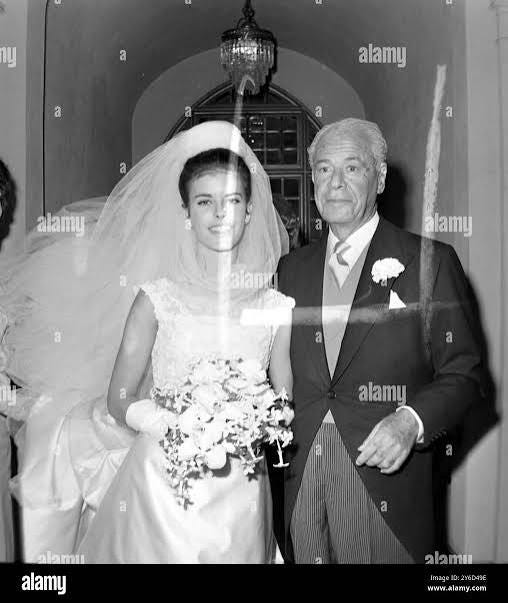
My mother will be with us, too. She has always loved Italy because she studied in Florence while her father, Walter, was working on Cleopatra in Rome in 1961. The troubled production began at Pinewood in England in September 1960, then resumed at Cinecittà after the original shoot was abandoned. Starring Elizabeth Taylor and Richard Burton, the film was Walter’s last. It premiered in June 1963, when my mother turned 20. She and my father announced their engagement that May and married on August 21, 1963.
I am especially looking forward to speaking with Luca, not only because he’s a friend whose films I love (the ones I’ve seen), but also because our film histories have already intersected in a way that feels meaningful to me. His Suspiria (one of the many bold films Ted made happen at Amazon) is a radical reimagining of Dario Argento’s 1977 film, in which my grandmother, Joan Bennett, made her final screen appearance as Madame Blanc, the formidable director of the dance academy. Luca and Tilda Swinton did not simply repeat the role in the 2018 film; they transformed it, moving the story into divided Berlin and making Madame Blanc more interior and morally conflicted.
Luca’s filmography is remarkable for how restlessly it moves across forms, periods, countries, and registers of desire: from the early The Protagonists and Melissa P. to I Am Love, A Bigger Splash, and Call Me By Your Name; through the horror of Suspiria, the erotic competition of Challengers, and the searching literary adaptation Queer. Again and again, his work returns to bodies, landscapes, appetite, memory, class, and the ways people construct—or fail to construct—a life with one another.
And now, in Joie de vivre, he turns his formidable curiosity toward Bernardo Bertolucci: another Italian director of sensuality, political history, travel, art, and impossible longing. I first encountered Luca’s Suspiria as someone watching my grandmother’s cinematic afterlife become something new. I am eager to ask him what it means to inherit a filmmaker’s work—not as a museum piece, but as a living provocation.
Stay tuned for our vHopeful Conversation, coming soon….xo
Comments
Nothing yet. Say the first thing.
Sign in to join the conversation.