
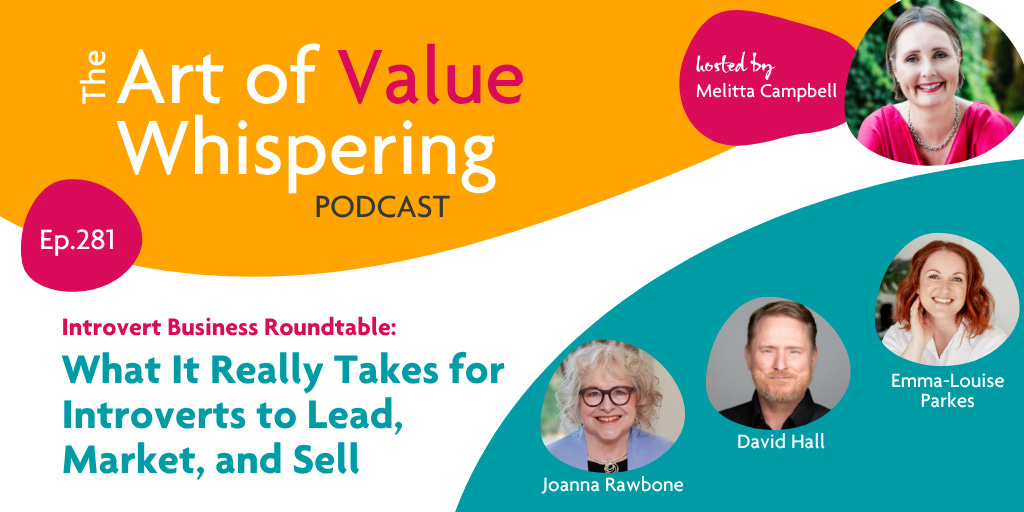
The following article is based on a panel discussion between four introverted podcast hosts:
Melitta Campbell (me): host of ‘The Art of Value Whispering’ podcast
Joanna Rawbone: host of ‘The Flourishing Introvert Talks’ podcast
David Hall: host of the ‘Quiet and Strong’ podcast
Emma-Louise Parkes: host of the ‘Ambitious Introvert’ podcast
You can listen to the full discussion here:
0:00
-55:46
Have you ever been in a meeting and had a genuinely good idea — one you were still turning over, still sharpening — only for the conversation to move on before you were ready to speak?
Or perhaps been told you seem shy or unimpressed (I get that a LOT), when really you were just thinking?
When this happens, it can be easy to think that there is something wrong with you. That the way you show up is somehow not loud enough.
Or at least that’s how I used to feel.
And seeing just how often the term ‘introvert’ is taken to mean ‘quiet, shy, reserved or unconfident’ I decided to set the record straight - with the help of some friends.
I invited three of my fellow introverted podcast hosts for a candid roundtable discussion on what it really means to be and thrive as an introvert.
Together, we pulled apart the myths, highlighted the real strengths, and built a practical toolkit from our combined personal experience.
What follows is everything we wish someone had told us earlier.
Let’s start with the good stuff. Because when introverts list their strengths, they tend to underestimate them, qualify them, or leave them off the list entirely.
So here they are, named clearly.
“We think before we speak. We tend to have a ‘Think, Say, Think’ communication process. And I have found this to be a very good thing. It saves a lot of unnecessary conflict and minimises misunderstandings.”
— Joanna Rawbone
David described it even more directly: introverts think and then speak, while extroverts speak in order to think.
Neither approach is wrong — they are simply different processes.
But when you do not understand your own process, it can feel like a deficiency.
David shared the moment this clicked for him:
“One of my big epiphanies came while I was being certified to give the Myers-Briggs personality assessments. The facilitator explained that introverts think and then speak, and extroverts speak in order to think. And I’m like, oh, okay. That makes sense to me.”
— David Hall
Once you understand that you are not slow or hesitant everything shifts.
Your considered response is not a delay. It is processing and preparation. And that’s simply how introverts are wired. And it’s a method that often allows us to spot the gaps or opportunities other might have overlooked.
Emma Louise named something that often gets overlooked in conversations about introvert strengths: emotional intelligence.
The ability to feel the energy in a room, to read subtext, to hold nuance and to make people feel genuinely safe.
“I know that for myself and my clients, the feedback they get a lot is: “I felt so comfortable with you”, or “I felt safe with you”, or “This felt like a very safe space” or “That was such a nurturing conversation”.
And I think emotional intelligence is something we’re gonna see — well, we’re already starting to see — more companies looking for now, particularly with the rise of AI.
They’re looking for the skills that run alongside that. And to me, I just think introverts just embody that naturally.”
— Emma Louise Parkes
In a world increasingly shaped by automation, the capacity to truly connect with other humans is not soft or secondary.
It is the differentiator.
In our discussion I shared something from my own experience that I had never quite articulated this clearly before: that I became known for my extensive network not by being the loudest or most outgoing person in the room, but simply by listening.
When people told me what they did, what they needed, what mattered to them — I listened and absorbed. Then, I could connect the dots and help them see value in their experiences and personality that they hadn’t recognised before.
This skill was deeply appreciated by my new friends, and enabled us to build a meaningful relationship over time. It also meant I could connect people with just the person they needed at any time, because I understood my network on another level.
That is not an extrovert skill.
That is an introvert superpower.
An important thing I wanted to explore, were the myths about introversion that are harmful and need to be challenged or changed.
We asked each other: what is the one misconception you are most tired of encountering?
We each had different answers, but they all pointed in the same direction.
Joanna told a story that I suspect many of you will recognise.
She was a delegate on a training course — already a trainer herself — and the facilitator asked her a question. She paused to think, and before she could answer, the facilitator moved on to someone else.
At the end of the day, the feedback she received?
“They gave me this feedback that I was a low responder who lacked confidence. And for me, that’s one of the biggest misunderstandings — that when we are taking time to think clearly, we don’t have an answer, or we are on the fence somehow, or we’re struggling, rather than acknowledging the fact that we are thinking about our answer.”
— Joanna Rawbone
And from that, she drew a conclusion that feels important enough to repeat in full:
“Therefore, when it comes to the way we lead, we lead by listening. We are leader material. We are just not those fellas out front. We’re the quiet leaders who listen and take people with us for the right reasons.”
— Joanna Rawbone
David has heard this one so many times he has dedicated two podcast episodes to the issue.
Often, people say to him: “I need alone time, but I can’t be an introvert because I like people”.
“We all like people. Only a very, very, very small percentage of the population don’t like people — maybe 1%. We like people. We just might need people in different doses. Or we might want people in different settings.”
— David Hall
The difference is not whether you enjoy human connection. It is how you sustain your energy around it.
Introverts often thrive in one-on-one conversations or smaller groups. Large, high-stimulation environments are not where we do our best work, at least not for a sustained period of time — and that is fine.
It does not mean we are antisocial. It means we know our conditions.
One of the richest parts of our conversation was simply noticing how differently introversion shows up for each of us.
Joanna describes herself as an ‘open introvert’ — she is not shy, happily talks to strangers in queues, and can access extroverted traits. Though her battery depletes in large groups.
Emma Louise, meanwhile, is energised by groups but overstimulated by the environment — the noise, heat, overlapping conversations all layer up and drain her.
David is highly analytical and approaches empathy more logically, through imagination rather than feeling.
And I have a tendency to be shy, particularly if I haven’t consciously planned for a particular environment or situation (see my post on my VICTORY Formula for more on that).
However, in my corporate career and in many of my entrepreneurial groups, I have a reputation for being quietly reflective and have a knack for seeing what others have missed, which led to colleagues (often far more senior than me) specifically seeking out my perspectives.
The point is not to fit yourself into a single description of what an introvert is.
Instead, understand your own version, it’s quiet strengths and the boundaries you need in order to feel at ease and perform at your best.
Joanna put it simply: if your business does not rely on public speaking, do not give yourself a hard time about it right now. Focus on what you actually need. The other things can come later — or not at all.
“Not all weaknesses are equal. Some of them are allowable weaknesses.”
- Joanna Rawbone
We each contributed something practical to the conversation to help our fellow introverts. This was not generic advice, but things that have actually made a difference in how we run our businesses and protect our energy.
Joanna Rawbone: Boundaries — and believing you deserve them
These boundaries are not rigid rules set in advance, but something you discover through lived experience. When something feels wrong, that is where the boundary is. And when they show up, note them and adapt the way you approach that aspect of your business or life in the future. Step-by-step you’ll set yourself up for greater success.
David Hall: Play to your strengths
Identify what you genuinely do best and do more of that. Delegate the rest as soon as you are able. Analytical? Lead with that. Deep thinker? Build that in.
Emma Louise Parkes: Physical boundaries — especially around tech
Emma Louise as removed all work apps from her phone. Her laptop stays in the office. And she is firm on her ‘no working from bed’ rule. This clear delineation between on and off helps her to manage her energy and perform at her best.
Melitta Campbell: Permission to do it your way
Test what works best for you. Push the edge of your comfort zone a little, then learn from what works. There are many things I’ve tried that I didn’t think I’d enjoy or be good at - like networking and public speaking, that turned out to be real strengths. While other things left me feeling drained. I’ve noticed that the word “could” is often a gentle warning sign that something just wasn’t designed me or my personality.
Throughout our conversation, there were a few points the others made that I hadn’t heard or appreciated before. And these have really stayed with me.
On boundaries, Joanna shared:
“The people who object most to your new boundaries are those who benefited most from you having none.”
— Joanna Rawbone
On confidence, David pointed out:
“Sometimes it’s not the activity we are not good at or confident about. It’s the particular people situation that surround it.”
— David Hall
And Emma Louise made the case for energy as the foundation of everything:
“I want to operate in an energy first way. So I don’t want to get to the end of the day, the end of the week and be depleted because I didn’t recharge at the start. I want to make sure that whatever I’m heading into, I know that my energy’s protected around that, and that there’s gonna be an ‘off’ at the end of the day.”
— Emma Louise Parkes
If there was one thread running through everything we discussed, it was this: self-awareness is the foundation. Not self-improvement in the sense of fixing what is broken.
Self-awareness in the sense of genuinely understanding how you work, what you need, and where your strengths already live.
“Strip away this stereotypical introversion, these different traits — because it’s all on a spectrum. We’re all different... Come back to the common factor, and it’s our energy. The way we use, drain, recharge our energy. If we can strip away the personality traits and actually just focus on — ‘right, where am I energised and where am I not spending enough time getting energised and what’s draining me?’ — then the rest becomes a lot more manageable.”
— Emma Louise Parks
And David added the reminder that your path to success may simply look different from someone else’s — and that is not a problem to solve.
“I can be a great leader, I can be a great public speaker, but my path to success may look different from my extroverted friend, and that’s okay. Don’t compare yourself to others, but compare yourself to how can you be your best.”
— David Hall
Joanna closed with something that applies to every introvert who has ever held back out of a fear of getting it wrong:
“Nothing is forever. Everything’s an experiment, and we just need to remember to learn from each step. Very little is fatal. Some things you might be embarrassed about, but hell — isn’t that life actually.”
— Joanna Rawbone
And as for me…
“You do not have to shout louder. You just need to resonate deeper. And the way you are already wired? That is exactly what makes that possible.”
— Melitta Campbell
What would you add to our Introverts Toolkit?
And what quiet strengths have you come to appreciate over the years?
I’d love to hear your thoughts on introversion - please do share these in the comments.
And for more content like this, be sure to subscribe to ‘Smarter Marketing for Introverts’, here’s a handy button to make that easy ; )
Comments
Nothing yet. Say the first thing.
Sign in to join the conversation.