
$1M x 15% ÷ 12 months = $12,500/month
Part of the reason why I’m writing this post is because I think most investors don’t have a North Star when it comes to investing. Naturally, they reach for maximum growth, which is only human but lacks true direction. And that lack of direction results in a lack of conviction when it comes to allocating capital.
This article is intended to provide some meaning when investing in public markets — a meaningful objective, even if you’re not extremely wealthy. For most of us, that means retirement and a nest egg to support financial freedom. I’m here to provide more granularity to that goal.
Suppose you manage to save $1 million by your retirement. Most FIRE doctrine will tell you that’s not enough, and that you need up to $4M saved before you can achieve financial freedom. That advice is based on the assumption that you’d earn a risk-free 4% yield on your retirement savings, which amounts to $13,333 per month in yield. For a lot of people, that represents a comfortable amount to live off of and retire on.
But what if you could earn a 15% yield instead of 4%? Then you’d only need $1M of capital in order to earn $12,500 per month in yield, which would garner you an arguably similar lifestyle as the aforementioned $13,333. If I were a wealth manager, this is what I’d personally advise my fiduciaries to aim for — to save up $1M by retirement and aim for a 15% yield, which is a much more realistic goal than earning 4% on $4M of savings (for most people).
Of course, that assumes you can earn a 15% yield to begin with. The good news is that it’s highly possible to do so by your retirement. Here’s how.
Assume that you only invest in companies at 15x PE or below. Right off the bat, that implies a minimum 6.66% earnings yield. Your task is now to grow that yield to 15% by retirement. Let’s say you have 20 years left before retirement. What would the annual CAGR requirement be to grow that 6.66% yield into a 15% yield within 20 years?
Firstly, it should be acknowledged that you’re not investing all your capital upfront in one lump sum. Rather, you’d be investing evenly across those 20 years, likely in equal sums per year. So it makes sense that those sums invested at the outset would have more time to grow than sums invested later.
For instance, sums invested in year 1 would have 20 years to grow. Sums invested in year 2 would only have 19 years to grow… and so and so forth, until year 20. Thus, all sums invested across the 20 year time horizon would need to grow until on average they earn a blended yield of 15% by year 20. Assuming you only invested at 15x PE or below (6.66% earnings yield), what CAGR would you require to achieve a blended 15% yield by year 20?
The chart below should illustrate things a little better:
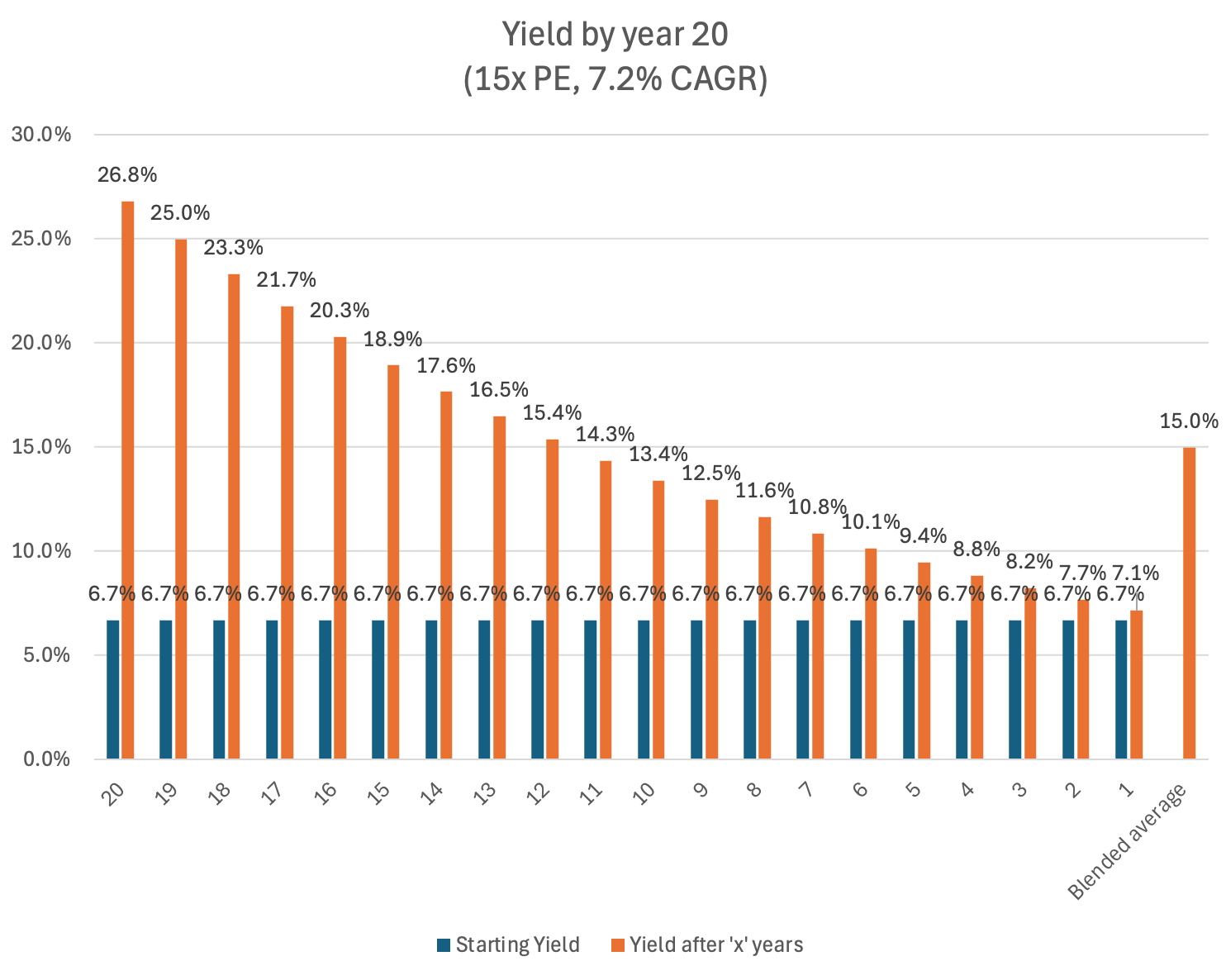
As we can see, only 7.2% CAGR is required to achieve such a blended yield of 15%. At 7.2% CAGR, sums invested at 15x PE (6.7% starting yield) would grow to yield 26.8% by year 20 (6.7% x 1.072^20). Likewise, sums invested at year 10 would yield 13.4% by year 20 (6.7% x 1.072^10). Thus, the blended average yield across the entire 20 years would be an average yield of 15%. It is this 15% yield which would be applied to your nest egg of $1M by retirement at the end of year 20, in order to earn the aforementioned monthly yield of $12,500.
That’s not too shabby, isn’t it? For most investors, 7.2% CAGR is considered nigh achievable, at slightly less than half of the gold standard of 15% CAGR. As long as you don’t pay too much upfront, you can afford to take it easy and look for investments which only grew by 7.2% CAGR.
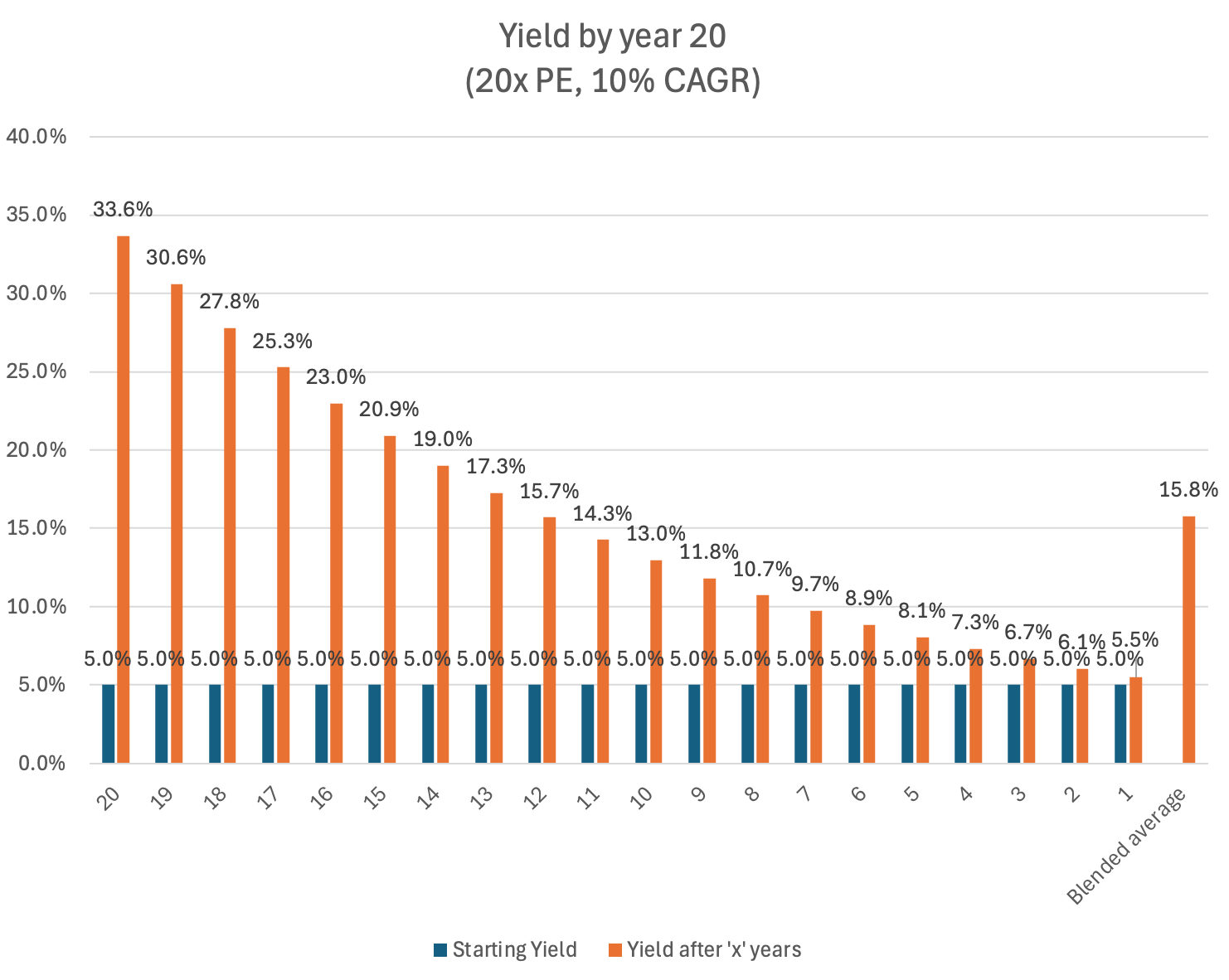
Now let’s switch things up a little. What if you invested in stocks below 20x PE instead, but aimed to achieve 10% earnings CAGR (totally doable)? You’d still be able to achieve a blended average yield of 15% by your retirement. This demonstrates how there is actually some margin of safety in the formula above, where you can afford to invest in slightly higher growth stocks at slightly higher PE ratios. More importantly, doing so doesn’t detract from achieving your retirement goals, while adding some zest and perhaps some additional yield to the process.
That’s all you need to retire comfortably. Invest at a 6.66% earnings yield (15x PE), and aim for 7.2% earnings growth. If you can save up $1M by the time you retire, that’s all you need to earn $12,500 in monthly yield, which should be enough to put you on the path to FIRE.
That’s what I’m here to tell you. You don’t need obscene NVDA level growth to achieve your financial goals. If you invest wisely and don’t pay too much upfront, all you need to achieve is 7.2% CAGR in order to retire early. That is something almost anyone can do, provided they put in the work to analyze publicly-listed companies.
Of course, that also assumes that you can save up $1M in 20 years. If you work backwards, that’s about $4,166 in monthly savings. For most households on a dual income, that’s more than doable even after expenses.
This also provides some context regarding investment risk. In this case, risk would refer to the possibility of not reaching your retirement goals. If so, then one shouldn’t take more risk than necessary in order to grow your investments by 7.2% CAGR. It may not sound exciting, but maintaining the yardstick of 7.2% growth against a reasonable price paid (15x PE) would serve as a compass towards all your investment decisions. Buffett reportedly only paid 7x EV/EBIT for the majority of his investments, so doing this would be on-brand with being a value investor.
Of course, this principle can also apply to those who have already achieved financial independence, and are looking to grow their wealth beyond it. If so, I’d advice you to figure out what your financial end goals look like and work backwards in a similar fashion to determine what your required CAGR would be. The point of all this is to find a balance between yield, growth and risk, and to not upset that balance in search for higher growth than necessary (e.g. 15% CAGR). Figure out what works for you, then invest accordingly. Stay safe investing!
Comments
Nothing yet. Say the first thing.
Sign in to join the conversation.