
I’ve followed Terry Smith closely for five years. Every letter. Every AGM.
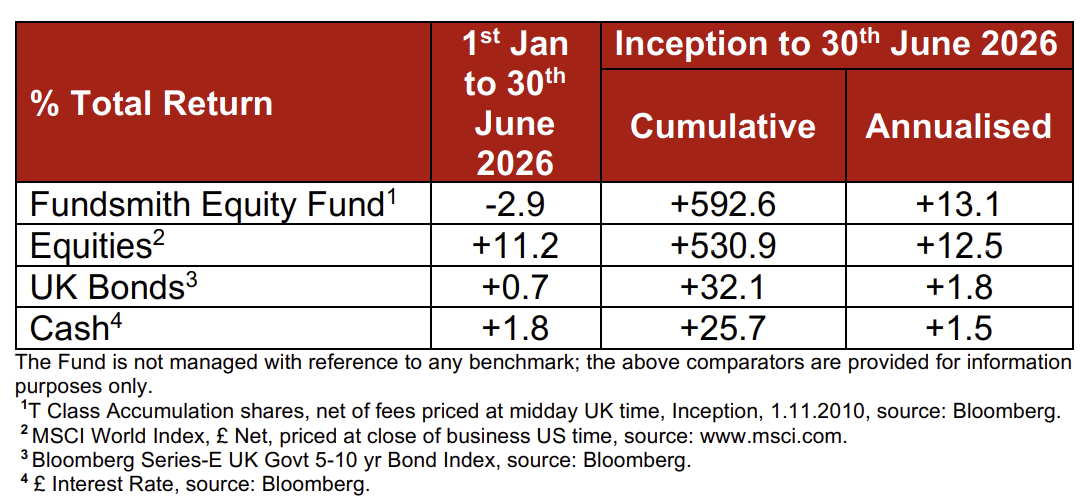
For most of those five years, the fund has trailed the index. This half, it fell 2.9% while the MSCI World rose 11.2%. Fourteen points behind in six months.
I don’t write that to pile on. I write it because I think it explains everything else in this letter. Feel free to read his letter here.
The mantra was three lines
Buy good companies. Not overpay. Do nothing.
He restates all three. Then he says the third leg “probably needs the most change.”
Portfolio turnover hit 51.8% in the first half. For a fund built on sitting still, that’s not a footnote. That’s a different fund.
Every letter he’s written for years carried the same warnings. Stay disciplined. Don’t chase AI. Momentum ends badly. “Trees do not grow to the sky.” He repeats all of it here, at length, and then does something quite different from what it implies.
“You should therefore expect that we will be more active in future.”
The line that actually matters
Smith says he will be much less willing to buy quality companies when they hit a glitch.
That move was his whole edge. Buffett bought Amex in the salad oil scandal. Smith bought Microsoft at the end of Ballmer. Good business, temporary panic, patient money. It worked because you could wait.
Now he calls it catching “the proverbial falling knife.” His words: “All we are getting is cut fingers.”
He’s honest about why Buffett could do it and he can’t. Buffett ran a closed fund he controlled. Fundsmith runs open-ended funds, and investors have been redeeming. Smith names the risk directly: “the market can remain illogical longer than we can remain in business.”
Read that sentence again. That is not a man optimising returns. That is a man in survival mode.
He needs the fund to still exist when he’s proved right. Which is why he keeps invoking the Indy 500 maxim, “In order to finish first, you must first finish.” Finishing, right now, means not bleeding assets for another three years.
Two names I own
I hold Novo Nordisk and LVMH. He sold both.
On Novo, one sentence. It “parlayed a market leading position in the biggest drug discovery in decades into an investment disaster.” That’s the entire write-up. No hedging.
On LVMH: China won’t recover until the property market does, and “family succession plans are also an increasing concern.”
Uncomfortable reading when you own both. And I can’t pretend he’s wrong on the facts. Novo fumbled a GLP-1 lead it once owned outright. LVMH’s China problem is structural, not a bad quarter. Both have performed poorly. Both hit real hiccups.
The question isn’t whether he’s describing something true. He is. The question is whether the right response to a true problem is to sell into it, or to be the buyer while everyone else does. That was the old Terry Smith’s answer. It isn’t this one’s.
Look at the rest of the exit list and a pattern shows up. Coloplast: organic growth slipped from 8% to 6%, plus acquisition screw-ups. Mettler-Toledo: 1% underlying growth doesn’t justify a premium multiple. Atlas Copco: anaemic growth, sub-3% FCF yield after the shares ran. Zoetis: management can’t respond to generics or even explain themselves.
Read together, these are sales of businesses whose fundamental momentum stalled. Not businesses that stopped being good.
What he bought instead
Here’s where I think there’s a real thesis, not just a flinch.
GE Vernova. Legrand. Nextpower. Three industrials, none of them an AI stock in the way Nvidia is. Turbines and grid equipment. Electrical sockets and data centre busways. Solar tracking systems.
His GE Vernova write-up gives it away. Order backlog of $163bn, four times 2025 revenues. Equipment generating roughly a third of the world’s electricity. Growth tied to grid upgrades and behind-the-meter power at AI data centres.
He’s not picking the AI winner. He’s betting that power is the layer that gets paid regardless of who wins.
People describe Nvidia as sitting at the base of the AI stack, the picks and shovels of the boom. Smith has gone a layer below even that. Below the chips. Below the compute. Down to the electrons that have to exist before any of it runs.
Add TSMC at 90% of advanced node manufacturing. Add Mastercard, on the reasoning that payments grow whatever happens with AI. Add Uber, Netflix, AppLovin, TJX. It’s a portfolio built to be exposed to the boom’s plumbing while claiming no view on the boom itself.
The fundamentals still screen well. ROCE 31%. Gross margin 62%. Cash conversion 92%. FCF yield 4.3%, against an S&P 500 he estimates has fallen below 2% as the megacaps pour cash into the arms race.
So he hasn’t abandoned the framework. He’s pointed it somewhere new.
Is it discipline, or is it drift
Both readings survive the letter.
He admits selling at a loss. He admits rebuying names he could have had cheaper. He still insists “we have no desire to hug the index.” These are not the words of a man hiding a style change.
And yet. “The environment changed so I had to change” is the first sentence of every strategy drift that ever happened. True right up until it becomes the excuse.
There’s a line from the Batman films I keep circling back to. You either die a hero, or you live long enough to see yourself become the villain.
I don’t mean that as an attack. I mean it as description. Smith spent fifteen years being the disciplined one, the man who sat still while everyone else chased the story, warning about bubbles and momentum and trees not growing to the sky. That was the hero arc. Then he sat in that chair through five years of the market rewarding exactly what he warned against, with redemptions leaving every month.
Live long enough in that seat and eventually you do the thing you spent a career telling people not to do.
Whether that’s wisdom or capitulation, I’ll let you decide. I’ll say only that it is sad to watch. Terry Smith taught a generation of us how to think about quality. Seeing him write that he’ll now take more account of momentum, in the same letter where he explains why momentum is dangerous, is not a triumph for anyone.
Before I get too comfortable
I should say the obvious thing. My own year has been poor. Behind the index, not close.
No sugarcoating it. I manage my own money. There’s no market environment to blame, no redemption pressure, no board. The only person I’m accountable to is me, and I’m the easiest person in the world to lie to.
Which makes writing about Terry Smith’s underperformance a delicate business. He at least has an excuse. I don’t.
And there’s a stranger thing underneath all of it. Buying the index is the single easiest way to beat most investors, including most professionals. Everyone knows this. Smith spends four pages of this letter documenting it, and the awkward part is that his own numbers make the case against him.
And yet here we all are. Him with a fund. Me with a spreadsheet. Both of us writing long explanations of why our decisions were reasonable.
Someone once said that investing is an arrogant act. You are declaring, with money, that the collective judgment of everyone else pricing this security is wrong and yours is right. That’s the trade. Every single time.
Most days I think that’s exactly correct, and I do it anyway.
What I’m actually taking from it
Your strategy works until it doesn’t. Then you find out what you’re made of.
The part that stays with me isn’t Fundsmith’s turnover number. It’s the reminder that a manager with an outstanding fifteen-year record, enormous conviction, and a philosophy he’s articulated more clearly than almost anyone alive, can still be moved by other people’s money leaving.
Sources: Dataroma
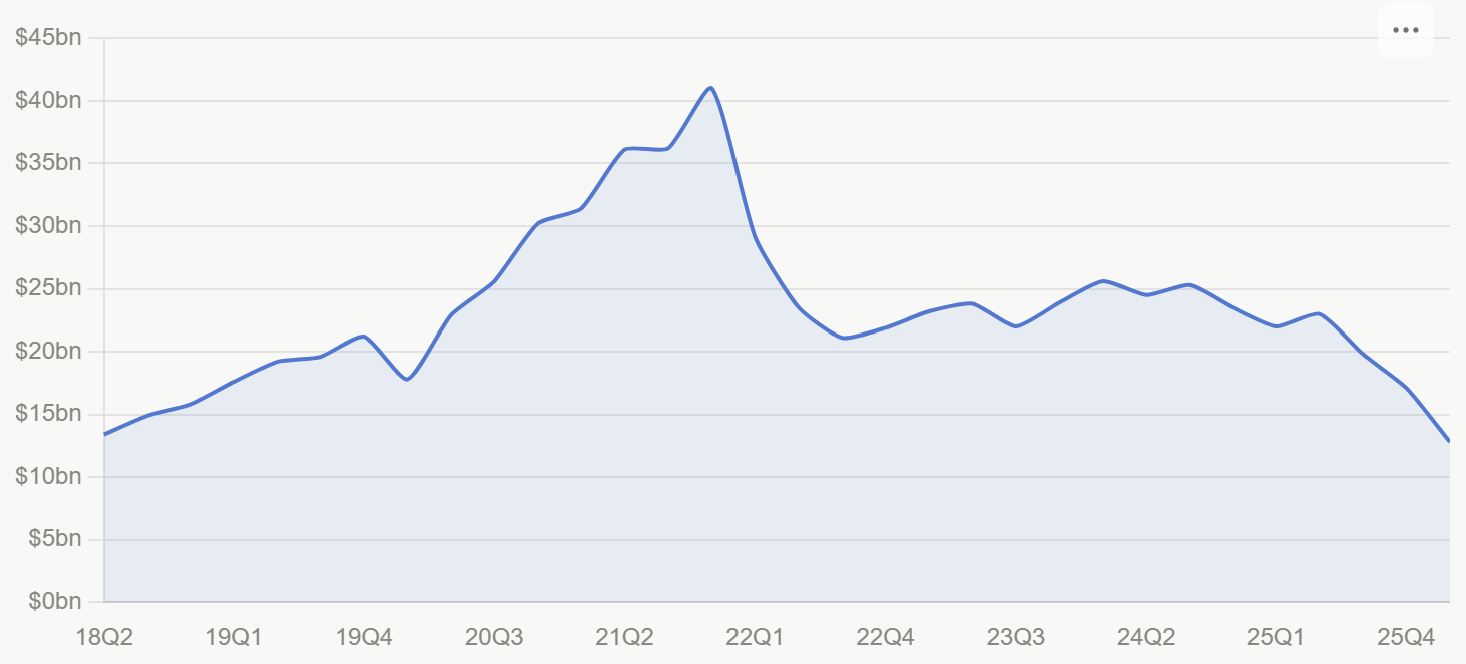
He’s not weak. He’s structurally exposed. Open-ended funds mean flows vote on your timeline. His funds peaked at over $40bil and it has since reduced to less than $15bil. Tough time ahead.
I don’t have that constraint. Neither do you. Nobody redeems from a retail investor. No board asks why we’re behind the index at the half. That is the single largest structural advantage we have, and most of us throw it away by watching prices instead of businesses.
We can hold what we believe. That’s the whole edge.
But there’s a warning stapled to that edge, and I learned it the hard way. Holding what you believe only works if the belief is yours. I’ve owned positions where the conviction was borrowed. A manager I admired liked the name.
The thesis sounded right. I told myself I’d done the work. Then it broke, and I found I had no independent reason to hold, because the reasoning was never mine to begin with. You sell at the bottom every time. Rented conviction always gets repossessed exactly when you need it.
So Smith selling Novo and LVMH doesn’t move me. It’s information about how a very good investor reads two businesses I own. I’ve read his reasons closely. I think his facts are largely right. What I do about it is my problem, not his.
If I’m wrong on these names, I want to be wrong for reasons I can say out loud.
And if I’m right, I want that to be mine too. That’s the other half nobody talks about. Borrowed conviction that happens to work out teaches you nothing. You get the money and none of the lesson, and you walk away slightly more confident in a process you never actually ran. The next position is where you pay for it.
Being right on your own reasoning is the only thing that compounds twice. Once in the account. Once in what you know.
That’s what I’m taking from this letter. Not that Smith is right or wrong. Just that watching someone this good work through the hardest stretch of his career, in public, with his name on every line, teaches more than criticising him ever could.
Learn from him. Learn from all of them. But take only the parts that fit your own situation, your own capital, your own temperament. The rest belongs to someone else’s constraints.
Comments
Nothing yet. Say the first thing.
Sign in to join the conversation.