
Today, I’m pleased to present an interview with Katy Mahon, author of Cry. I’ve been really looking forward to sharing this – it’s among the best conversations to ever appear on these pages; utterly fascinating and frank.
First though, a small admin note. I conducted this interview in April, and have woken up almost every day since then intending to put it on this blog – only to be thwarted by my current circumstances. Almost everything is exhausting me at the moment, but writing, editing, and formatting blog posts seems to be a particular drain. (After writing to you about my health and Anne’s longlisting in June, I was wiped out for the next 36 hours.)
I started this Substack as a personal blog first and a company megaphone second; hence the title for the past three years, By the Book: Jamie McGarry at Valley Press. It wasn’t a bad idea – readers generally prefer people to companies – but that concept is now actively getting in the way of what should be an amazing opportunity for our books and authors to reach their audience. (That, plus my perfectionism and stubbornness – historically such great allies!)
So as of today, the title is simply Valley Press: By the Book, and I am giving my colleague Lindsey free reign to post here on VP’s behalf, in my stead. Be kind to her! And don’t worry, I’m not disappearing or retiring – yet – this is just a tweak to keep things moving forward. No need to shed any tears. Speaking of which...
Katy Mahon’s second pamphlet, Cry, was “soft launched” late last year, and arrived in bookshops a few weeks ago. In its 42 pages, she writes about the smudged, blurry territory between motherhood and creativity – and the struggle to keep hold of your self whilst negotiating these states.
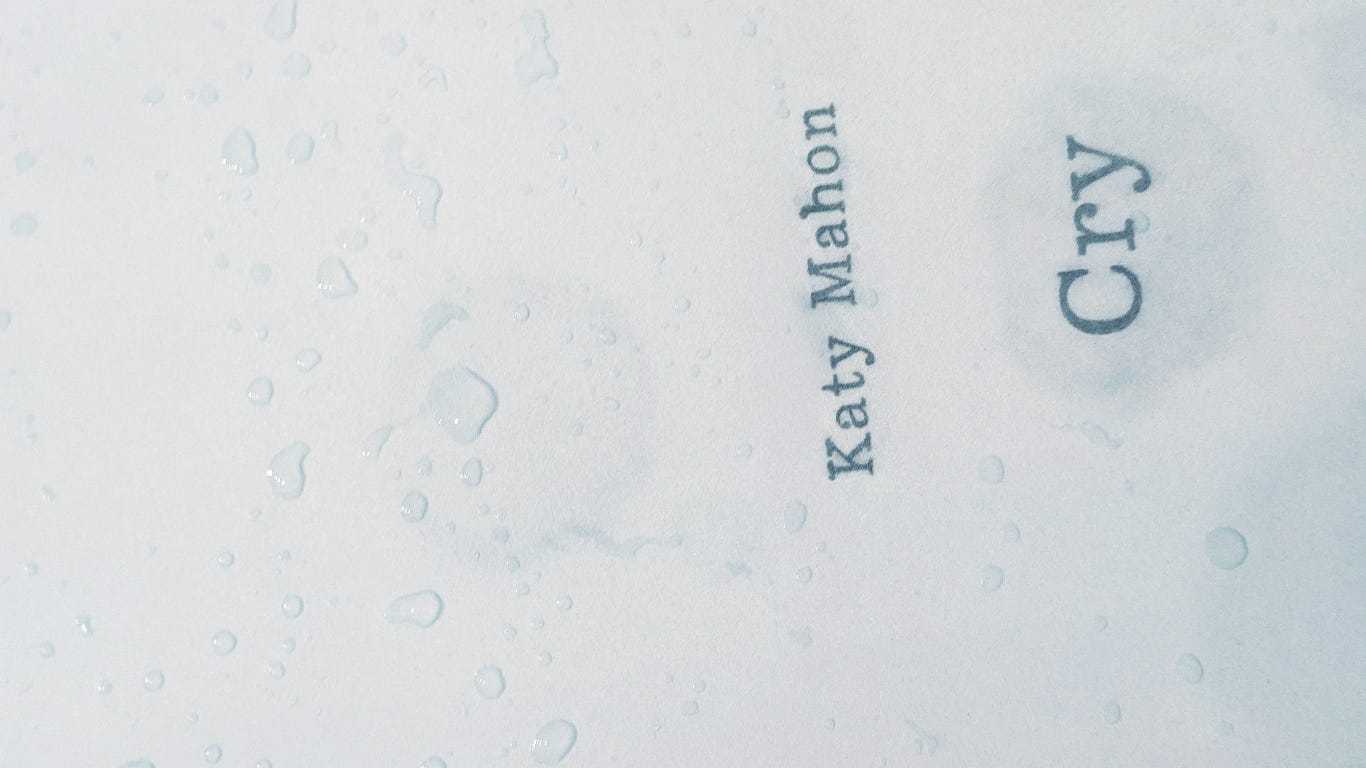
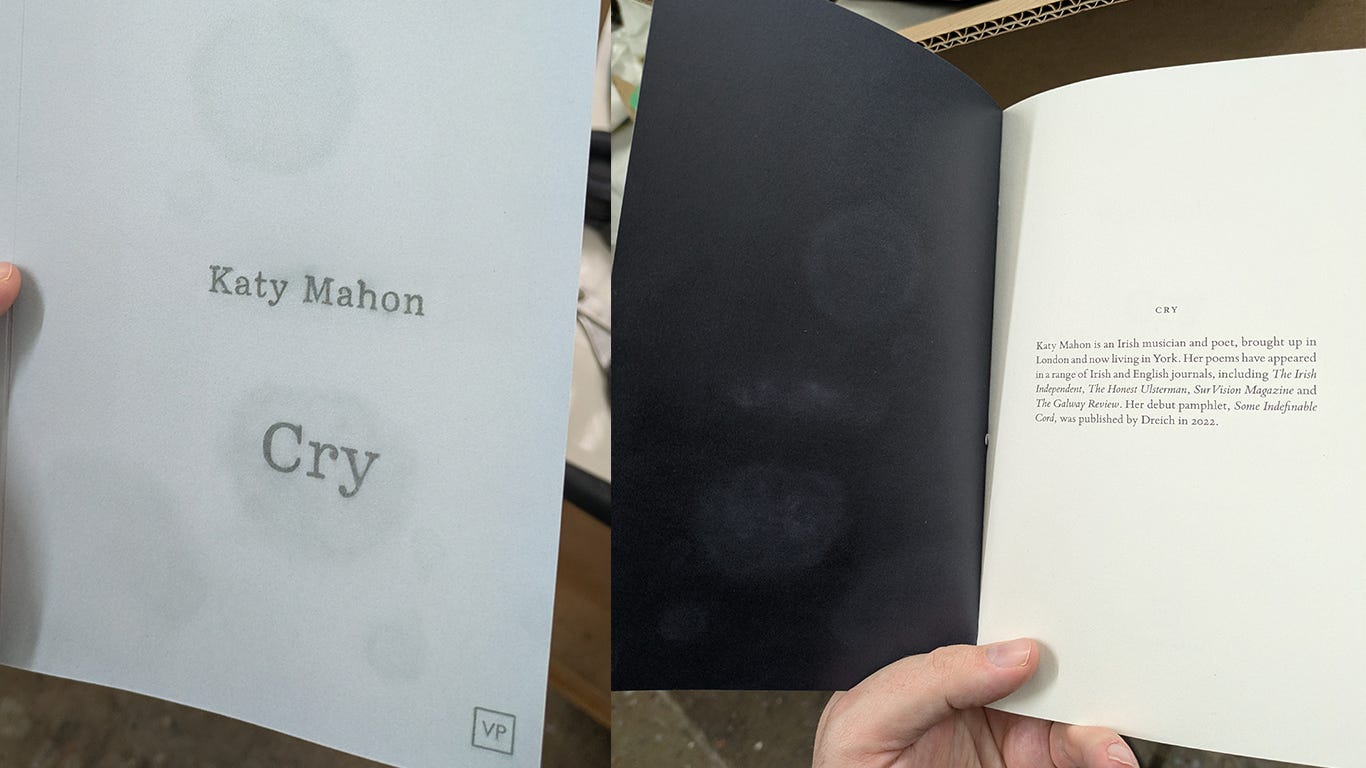
A design note: as we worked on the cover, with Gustav Klimt’s The Three Ages of Woman as the main reference point, more and more ideas came into the frame – various versions of Klimt’s mother and child, a shower of raindrops as a stand-in for tears, and ink drops running down the cover, wetly. The penultimate design had all of those features at the same time; rather busy!
Then, in a moment of sudden daring, we removed everything, and went to print with a plain baby-blue background featuring a few subtle blotches, as if actual tears had been shed on the cover – which is one of only two uncoated/unlaminated jackets in VP history. The inside cover features the same design but inverted, dark navy with pale blotches. What do you think?
In the conversation below, the author reflects on music, grief, poetic inheritance, and the complicated presence of her father, Derek Mahon – one of Ireland’s most significant modern poets – in the story of how she came to write.
JM: Could you tell us about your first experiences of writing, and the significant milestones on your writing journey, up to beginning work on Cry?
KM: I had written on and off for many years – some short stories for children, some articles, but never for publication and never poetry, until the autumn of 2020. As a singer and pianist, these forms were paramount to my creative fulfilment and they occupied my working life. It was only after the death of my father that poetry came at me. I remember it well: a trip to Brimham Rocks, North Yorkshire, with my then-partner and each of our children. My partner’s daughter wore a red puffer coat that grey November day, and the darkness of my complex grief and the brightness of her lit something in me. On returning home, I was standing at my dresser and the words started to form. I had no pen or paper to hand, but called to my son to bring some. The poem ‘Red Coat’ was written on the back of an old envelope with a chewed-end Biro. I still have the scrap of paper.
It was never a conscious decision to start, or carry on, writing poetry. But a winter lockdown – the second, slightly less fraught one – spurred something in me to follow on where I had started. A few courses later (including one with Helen Ivory through NCW/UEA and one with Gallery Press, my father’s publisher, in Ireland), I started to get published, firstly in Ireland. Always at the forefront of my writing was the importance of the act itself; being published was always secondary to the need to create. Some say my father’s death somehow opened a portal for me to begin. I sometimes wonder what he would think of his daughter switching allegiance from her own art form to one he had already been highly successful at. But I have stopped wondering, because it doesn’t matter.
‘Red Coat’ was never submitted for publication, but is hibernating inside Pukka notepad number one. The Liminal Review and Drawn to the Light Press published two other poems of mine in 2021 though – a thrilling start to sharing my poems officially. My debut chapbook Some Indefinable Cord was published by Dreich in 2022, and a writers’ retreat a few years later was fundamental in producing a large part of my second pamphlet, Cry.
While ‘Red Coat’ was about a girl at the start of her womanhood, and Cord was about connection with people in my life, Cry has come from my own female self. There is a quote from one of Maria Popova’s Marginalian articles about motherhood being “the ultimate refutation of the self, the ultimate affirmation that individuality is an illusion”. I thought about this a lot while writing Cry, and wanted the collection to reflect on this ‘unselfing’ (again, Popova’s term). But mainly, I wanted to express, rawly, what many mothers feel they cannot.
JM: What did you think a poet was when you were growing up – and how did that idea sit alongside your early commitment to music?
KM: Someone who typed on a typewriter for hours at night and sporadically throughout the day. Someone who couldn’t be disturbed, who needed peace and quiet. Someone who, despite the latter, always liked his study door open. When my brother and I were young, we never thought about what our father was writing, just that he needed to do it, and that it was very important. I began piano lessons at the age of five. My gregarious teacher would come to our home to teach me, and to chat with my mother afterwards over cups of tea. My father would hide away in his study, and only come down when she had left. Too noisy. Both the piano and her. He wanted me to be an artist, and bought me watercolours, oils, books on how to paint, a little easel for my bedroom. I enjoyed it, but also had to practise the piano most days. It quickly became clear that I was very musical, so it was natural that this took precedence, despite my father’s desire for me to be an artist. Or for his own peace.
Derek was a difficult man to live with, as I learnt later from my mother (and realised myself in hindsight). My parents split up when I was nine, mainly prompted by his alcoholism, and it was only years later, when I was at university studying Music, that he began to take an interest in how my life was unfolding and the choices I was making. In the second year of my undergraduate degree, I sent him a recording of me singing Purcell songs and received a (surprisingly) tender and heartfelt letter back from him saying how I had blossomed into a promising and talented musician. By that point, I had been dipping into his poetry collections and had started to form my own admiring opinion of him as a writer. Consequently, a “creative understanding” emerged between us, and although it was the only connection I had with my father, it continued well into the future; our separate creative arts would sit side by side in a mostly silent mutuality of acceptance and deep respect.
JM: Did you ever feel pressure, internal or external, about writing poetry, given your father’s reputation – or did it feel entirely separate?
KM: I don’t know if it’s a Gen X thing, but kids at our schools often had labels! My brother was the sporty one who was into American history, and I was the musical one. I got fantastic marks for creative writing all through primary and lower secondary school, but it never occurred to either parent to encourage me in this regard. So music it was, and gladly so, I must add. My brother was a very good writer too, but I think he might have felt he couldn’t quite live up to my father’s reputation. With my music, I was on my own path, so in some ways it was easier for me. It has been mentioned by people close to me that, even subconsciously, his death ‘allowed’ me to write poetry; but that first poem and its timing were not conscious acts.
As I wrote more, he was always at the back of my mind. What would he have thought? Would he disapprove of my entering his domain? Probably. But it never stopped me writing. I couldn’t stop once I’d started in 2020. My writing poetry did – and does – feel entirely separate from his. Despite a complex array of emotions about Derek as a father, as a poet I look up to him enormously, and it makes me want to be the best I can. Not for him, but for myself. Actually, maybe a little for him. A psychoanalyst would have fun with me...
JM: How does your background as a musician shape the way you think about rhythm, sound, or structure in your poems?
KM: I went through a big phase of reading current Irish poets in 2020 and 2021, such as Vona Groarke, Alvy Carragher, Eiléan Ní Chuilleanáin, Enda Wyley, Molly Twomey (I mention the female contingent there for solidarity), and I attended online Zoom readings of some of their work. I noticed that when they read, they would ‘tilt’ their voices with vowels, and sometimes linger on consonants when they slowed down a line. I realised that when I am reading my own poetry aloud in my study, I do something similar. There is probably some seeping of my singing voice into my poetry, but I think it’s basically an Irish thing. It’s in the way we speak to one another in the street or the pub. The lilt. The interesting choice of words.
JM: Is new material on its way, and on what subject? Do you see yourself working towards a full collection?
KM: New material is indeed on the go. I’m working on what is now a full collection, though it wasn’t intended, initially, to be one. It started off as a few random prose poems – a form I hadn’t used before – and it has become something quite big. I was in an abusive relationship a few years ago and it has all stemmed from that. Cry has a few possibly-contentious poems in it, but hold my Guinness while I complete sixty little boxy prose poems about being love-bombed, gaslit, and abused by a narcissist…
JM: Do you imagine your children reading Cry one day, and how do you feel about that?
KM: I already knew that if publication was on the cards I’d have to have a word with my fourteen-year-old son about some of the content! He’s a mature and intelligent soul, and dinner-time conversations have often taken the form of politics, feminism and similar subjects, so I hoped it wouldn’t be too difficult to explain a little of what Cry is about. My son knows, for example, that I suffered peri- and postnatal depression, but I have always made it clear that he was, and is, the light of my life and that he was never the reason for those hormone-imbalanced states of being. I’ve also been transparent with him about my feelings on the subject of domestic equality, and if anyone reads Cry they’ll find a few poems about this! He might question those poems, but the subject of inequality is something that I’ve mentioned before. He knows that through it all I loved his late father deeply.
My son was the doorman for the launch of Cry in York, so he has heard a fair few poems from the pamphlet. He probably won’t get some of it right now. Perhaps in time he will. But even if he never understands it, that’s okay. One’s art ceases to belong to you when you expose it; people can respond however they like. At any rate, I think my son was more chuffed to know that the final poem ‘The Wishing Chair’ was directly dedicated to him. “Does that mean I’m famous?” he joked when I received my first copy. Of course it does, son!
Thank you so much to Katy for answering my questions. Cry is available, of course, through the Valley Press web shop, and everywhere books are sold in the UK.
What a colossal privilege it is – as a job of work – to find, edit and design a book like this, get it as close to perfect as humanly possible, see it in bookshops, and put together an article like this to celebrate it. I’ve gone through some version of this process literally hundreds of times since 2009, and it never gets old. As I said above, I’ve no intention of this being my last blog post – but if the stars misalign and it is, this is exactly how I would want to go out.
All being well, however, I will be back in your inboxes soon enough, and look out for Lindsey appearing there in the meantime. Until then, thank you for reading – and good luck to England tonight (with apologies to our five Mexican subscribers!)
Comments
Nothing yet. Say the first thing.
Sign in to join the conversation.