
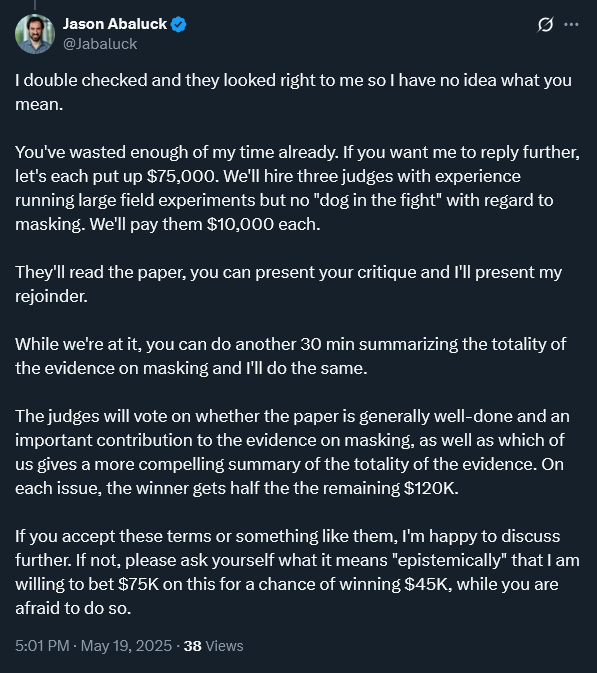
In May, Yale economist Jason Abaluck challenged me to a $75,000 bet over his ridiculous Bangladesh masking study:
“If you want me to reply further, let’s each put up $75,000. We’ll hire three judges with experience running large field experiments but no “dog in the fight” with regard to masking. We’ll pay them $10,000 each.
“They’ll read the paper, you can present your critique and I’ll present my rejoinder.
“While we’re at it, you can do another 30 min summarizing the totality of the evidence on masking and I’ll do the same.
“The judges will vote on whether the paper is generally well-done and an important contribution to the evidence on masking, as well as which of us gives a more compelling summary of the totality of the evidence. On each issue, the winner gets half the remaining $120K.
“If you accept these terms or something like them, I’m happy to discuss further. If not, please ask yourself what it means “epistemically” that I am willing to bet $75K on this for a chance of winning $45K, while you are afraid to do so.”
Hilarious. And creepy. It was too disorienting to write about at the time, so I let it sit for a few months.
If you’re unfamiliar, the Bangladesh study was a cluster-randomized trial that assigned different villages to mask propaganda conditions. The researchers handed out masks — custom designed cloth and surgical masks. They observed mask wearing and measured COVID cases.
1. Most people in the masking arm didn’t wear masks. They didn’t have assigned mask-wearing like DANMASK.
2. Their researchers/observers weren’t blind to condition, and the same observers assessed both control and mask villages... Plus the masks they handed out were very salient given their unique color and design.
3. They mostly observed OUTDOOR masking. I forget whether they entered some buildings.
4. The difference between the two groups is 20 cases of seroprevalence in a sample of over 300,000 people. Twenty. We can’t possibly trust research based on 20 cases in such an enormous sample. They did not disclose this fact in the paper.
5. The Ns are wrong or the descriptions of the Ns are wrong.
6. It was in Bangladesh, a vastly different culture with a much higher population density than the US, limiting even a valid study’s application to the US and other Western countries.
Using complex inferential statistics that I haven’t examined and which we shouldn’t trust, they found a meaningless effect for surgical masks, but only for the elderly. They found no significant effect for cloth masks, but non-effects are as meaningless as effects since the study was invalid. (I recommend not trusting inferential statistics in academic research in general, especially anything complex that rides lots of researcher decisions, that you can’t validate yourself, and where descriptive statistics are not disclosed. Especially research that advances leftist narratives – it’s almost certainly false and/or invalid.)
See my full treatment of the scientific evidence on masking and COVID, and common fallacies on the topic, here.
Abaluck told the media: “I think this should basically end any scientific debate about whether masks can be effective in combating covid at the population level.”
THAT is what drew my attention to the study. Scientists don’t talk like that. Especially when you’re talking about a junk study that isn’t even a proper randomized trial, with all the problems noted above, where your effects were so faint and mushy, and where the topic is something as potentially complex as mask efficacy in the real world. It was incredible to say it ends the scientific debate! A Bangladesh study that didn’t randomly assign or control masking behavior is a terrible basis to make such sweeping claims, and they didn’t even find an effect for cloth masks anyway.
Back to the bet. It’s a bet on the opinions of academics (!), specifically whether these academics would rebuke a famous, peer-reviewed study published by a tenured professor at Yale, one of their own...
Not only that, a study that aligns with leftist dogma on masking (albeit newly-acquired dogma — leftists add arbitrary empirical beliefs to their long list of mandatory beliefs at a steady clip).
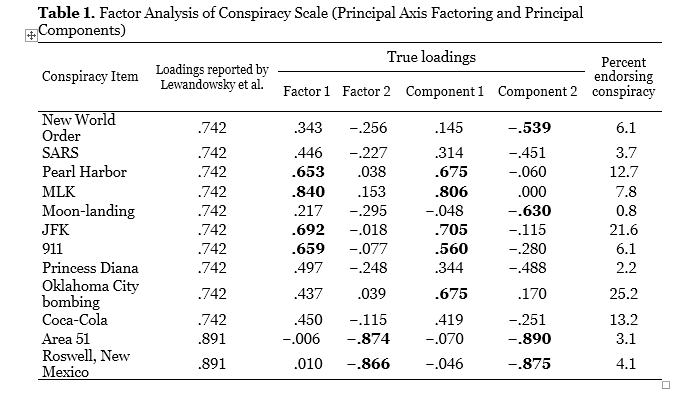
God no, this is absurd. Leftist academics, i.e. academics, won’t even call out scientific fraud if it’s aligned with leftist narratives. I know this from painful experience. You can publish a table of identical, false factor loadings — which is unprecedented and insane — as Lewandowsky, Oberauer, and Gignac (2013) did, and no one is willing to call it out because his fraudulent study maligns conservatives.
In any case, the bet already happened. Abaluck, et al.’s invalid study was peer-reviewed and published by Science, a once prestigious journal now notorious for publishing fraudulent COVID origin papers, false papers on other topics to advance leftist narratives, and for having a deranged partisan maniac as editor, my former Chancellor at UNC, Holden Thorp.
The fact that this junk was published argues against betting on members of the same cloistered, corrupt academic culture even noticing its incredible flaws. Of course, the bet would have me present those flaws, but then I’d be relying on the integrity and intelligence of academics, and I wouldn’t even bet $100 on that. No way, especially not on the criteria: “is generally well-done and an important contribution to the evidence on masking”. That’s mushy academic blather, especially the “important contribution” bit – they’ll be loathe to say that it’s NOT an important contribution.
It’s not just that Abaluck could be in a position to review their own papers and grants (anonymously) and those of their students and friends — it’s that academia is a haven for cowards who all subscribe to the same authoritarian leftist ideology. They don’t call each other’s research invalid and not important, especially if leftist politics is activated, as it is with masking and COVID. Academia is structured in the exact opposite way that you’d design a truthseeking institution.
Finally, while I generally dislike the use of the word “bullying” to refer to interactions between adults (as opposed to children), I think an overpaid1 academic challenging someone to put up $75,000 to continue to discuss his incredibly invalid research probably qualifies as bullying, or at least incredibly elitist and rude. How many people can bet $75,000 on anything? Not many. You pretty much have to be rich (and wifeless) to be able to risk $75,000 on such a risky bet — that leftist academics will rebuke the validity and quality of an authoritarian leftist-aligned paper. You have to be willing to just burn $75k. I don’t think most people even have $75k that they can spend on anything without withdrawing from a 401k, with penalties.
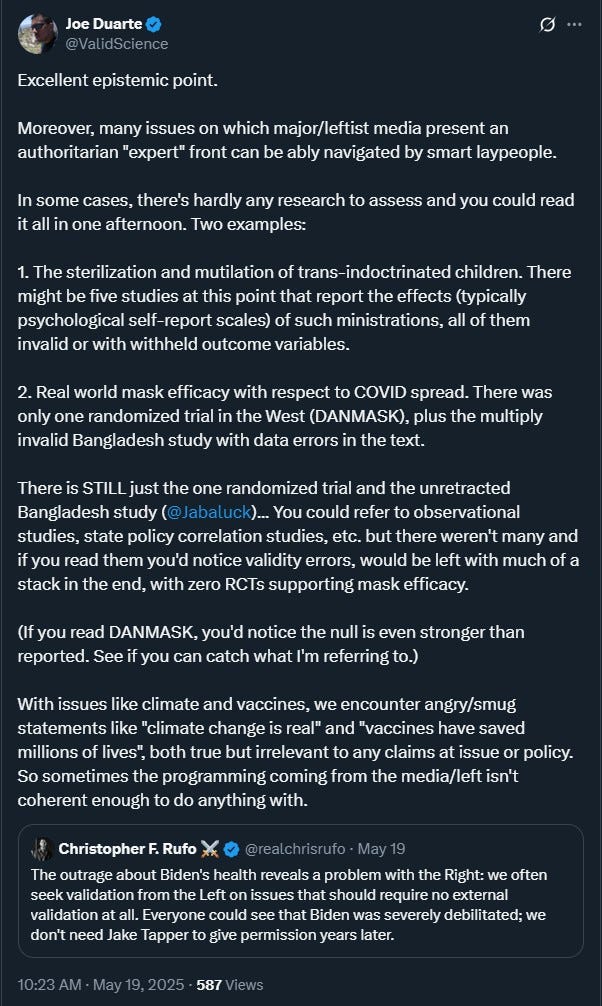
You can see the full thread by clicking on the post below:
Joe Duarte grew up in small copper mining towns in Southern Arizona, earned his PhD in social psychology, and focuses on political bias in media and academic research. You can find him on X here and email him at gravity at protonmail.com.
p.s. Abaluck’s first reply was “Obviously I think you are misinformed or lying.” Who lies about their own views? What is it with leftists always accusing people of lying when they express disagreement with a leftist belief or position? I don’t understand the theory of mind here. They really think a person who writes a critique of their study is lying? Lying in their critique? How would that work?
p.p.s. I don’t know that Abaluck is a leftist – he’s an authoritarian in the way lots of economists are. One gets the impression that many economists would turn you into dog food if it increased “general welfare” or reduced “inequality” (variance in incomes or wealth) according to their equations. (”Equality” is a completely arbitrary, leftist value that they often embed without explanation. Notably, they don’t embed liberty or autonomy as obvious values to optimize – only leftist values.)
Yale School of Management probably pays Abaluck $250k - $500k per year. Business school professors make a lot more than general university professors. An economist in a business school will make more than twice what an economist in an economics department makes, and people like him often find ways to make more money from other sources, like NGOs, consulting, speaking, etc.
No posts
Comments
Nothing yet. Say the first thing.
Sign in to join the conversation.