
There is big news from the United Kingdom: two new diagnostic tests for endometriosis are likely to be introduced under NICE’s Early Value Assessment programme. This has been described as “game-changing.” And perhaps one day they will be, but there is an important distinction between a promising technology and a proven one.
NICE is the UK’s National Institute for Health and Care Excellence, and it is an independent body that evaluates medical evidence and develops recommendations for healthcare practice, including whether new drugs, procedures, and diagnostic tests should be adopted by the NHS.
The tests in question are called Endotest and Endosure, and the draft guidance states these tests will be introduced in the Early Value Assessment (EVA ) programme for three years while data is gathered.
The hope is that these tests will reduce diagnostic delays and allow women to reach appropriate treatment sooner. Currently, it takes 7–10 years for a diagnosis of endometriosis, which is awful and unacceptable. There is no excuse for this. We can suspect endometriosis by listening to a patient’s history, performing an examination, and then starting therapy. I do this all the time.
The delay in endometriosis diagnosis is not typically caused by a lack of laboratory tests. It is usually the result of the normalization of menstrual pain, dismissal of symptoms, lack of clinician education, and an inability to see clinicians with experience in pelvic pain. How this test will help overcome those barriers remains to be seen.
Let’s look at the tests.
Endotest
Endotest is a saliva-based test that looks at a pattern of 109 small RNA molecules called microRNAs. These molecules help regulate how genes are turned on and off, and researchers have found that the patterns may differ in people with endometriosis. The results are then analyzed by a machine-learning model, a type of artificial intelligence trained to recognize patterns in the microRNA data that are associated with endometriosis.
It was developed by the French biotechnology company Ziwig. The key paper is an industry-sponsored study that included 971 women with signs and symptoms suggestive of endometriosis. This was a study to validate their original developmental study. Participants underwent either laparoscopy, imaging (ultrasound or MRI), or both. Those diagnosed without surgery had imaging evidence of endometrioma and/or deep endometriosis with colorectal involvement. The study reported a sensitivity of 97.3% and specificity of 94.1%.
This was a high-prevalence population: 77% of participants were ultimately classified as having endometriosis. The performance of a diagnostic test can change depending on the population in which it is used. Patients presenting with pelvic pain in general clinical practice may have a lower prevalence of endometriosis depending on the setting and referral pathway. We can’t yet say how well this test will perform in the broader population of patients being evaluated for pelvic pain, where the diagnosis is uncertain and many patients will have other causes of symptoms or may have two or more causes of their pain.
The results are analyzed using a machine-learning program called a random forest algorithm. While powerful, these algorithms can inadvertently learn patterns that reflect quirks of the original dataset rather than true biological signals, a problem known as overfitting. Many machine-learning prediction models in medicine have been developed with methodological limitations. This is why robust external validation is especially important before any AI-based diagnostic test is widely adopted in clinical practice.
EndoSure
This is a very different test. A woman fasts, drinks water, electrodes/sensors are placed on the abdomen (conceptually similar to an EKG), and the device records gastrointestinal myoelectrical activity (GIMA), which are the electrical signals associated with smooth muscle activity in the stomach and intestines. A statistical model analyzes features of those signals and generates a probability of endometriosis. Here is a photo from the paper:
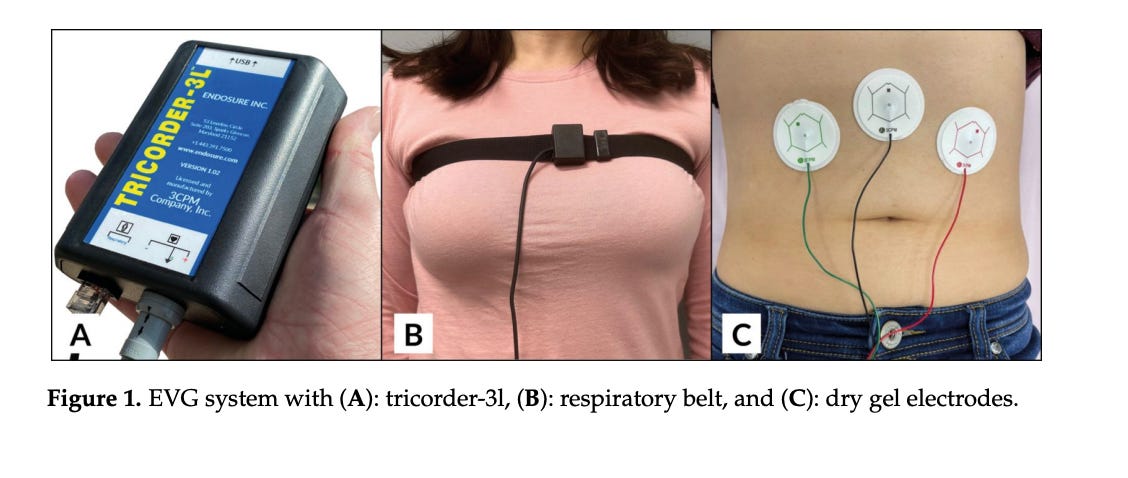
The hypothesis here is that endometriosis changes inflammatory/pain pathways, which alter gastrointestinal motility/electrical patterns, and that the machine can detect a reliable endometriosis pattern.
There is currently only one primary peer-reviewed study. I use that qualification because the authors also published an interim analysis, but it involved the same cohort and therefore represents an additional report from the same study rather than an independent replication. The lead author is a founder and board member of EndoSure, Inc., and holds a patent licensed to the company. This does not mean the research is invalid or that there is anything inherently wrong with the study. However, given these financial relationships, independent validation by investigators without financial ties to the company is especially important.
The results of the test are rather remarkable. The company website claims it “provides nearly 100% diagnostic accuracy.” The paper reports that when the test was negative, 95–96% of those negative results correctly identified people in the study population who did not have endometriosis. For a disease as biologically diverse as endometriosis, that represents an exceptionally high level of discrimination. Some tests really are excellent, but when results are this impressive, they need to be reproduced in independent populations as exceptional performance in an initial study often declines when a test is used in real-world settings.
There are some issues with the paper. Some women in the control group had abdominal pain from other causes, but it is unclear how these women were definitively shown not to have endometriosis. This is a common challenge in endometriosis research because performing laparoscopy on healthy controls solely for research purposes is not practical or ethical.
There is also some inconsistency in how one of the cohorts is described. Cohort 3 appears intended to represent the way the test would be used clinically: women with pelvic pain who were suspected of having endometriosis, who underwent testing before planned laparoscopy. However, later in the paper this same group is described as an “endometriosis-positive validation cohort.” The authors note that only two participants in this cohort were found to be negative for endometriosis. Because this group was overwhelmingly composed of patients with confirmed endometriosis, it provides limited information about how the test performs in the real-world diagnostic setting, where the challenge is distinguishing endometriosis from the many other causes of pelvic pain.
Putting it All Together
The that we need answered is for a woman presenting with painful periods or pelvic pain, is how accurately does this test identify who does or does not have endometriosis? Based on the available research we can’t yet say how well these tests perform.
If the tests are to be offered to women who are referred to a pelvic pain clinic, they need to be studied in that population, where 40-60% of women will have endometriosis, but there will be other causes of pain as well. Do these tests truly identify endometriosis or a general inflammatory response? Can these tests distinguish endometriosis from the real-world differential diagnosis of pelvic pain: adenomyosis, pelvic floor disorders, bladder pain syndrome, fibroids, and dysmenorrhea? What if there are multiple pain conditions? We don’t know the answers.
Some might argue that the greatest value of these tests would be earlier in the diagnostic pathway, before a patient is referred to a specialist. If that is the intended use, then the test needs to be validated in that population, patients presenting earlier with painful periods or pelvic pain. The prevalence of endometriosis in that group will likely be lower than in a specialist referral population, and test performance must be evaluated accordingly.
There is a well-recognized challenge in diagnostic test development; tests validated in a high-prevalence cohort, like with both these tests, may appear to excel, but then perform differently when used in real life. We just need to be aware of that.
With the evidence we have today, the clinical pathway for a patient with pelvic pain is the same whether this test is positive or negative, because the tests have not yet been sufficiently validated to change clinical decision-making. What may change is that a woman with a positive result has additional support when advocating for care. Hopefully she will get treatment and/or referral sooner. But a woman with a negative result still has pain and still needs evaluation and treatment.
It’s important to point out that we have never needed surgical confirmation to treat suspected endometriosis. If I suspect endometriosis, and I do in many patients, they can have medical therapy right away without surgery, or they can have surgery first. Or they can start medical therapy and then have surgery, and have surgery and decide later to have medical therapy. This gets back to the central issue with delays in diagnosis and care, it’s largely about not taking the symptoms seriously.
I can absolutely see a role for tests like this if independently verified and tested in the population who will get the testing. This would allow women to be diagnosed and referred sooner for endometriosis care. Some women may feel more comfortable pursuing medical therapy with a positive test and other may feel better about choosing surgery and those with negative tests can move to other treatment pathways.
An incredible win would be an accurate non-invasive test that could one day be paired with effective medical therapy. I hold out hope that we will develop disease modifying drugs for endometriosis, and in this world, a blood test could identify who is a candidate for the therapy, which they could start without even needing surgery. Just because we don’t have that therapy now, doesn’t mean we won’t one day. Biomarkers often come before we know what to do with them. For example, we knew the HER2 biomarker existed in breast cancer long before we knew what to do with it. Also, having a valid biomarker may signal to a drug company that endometriosis is worth studying, because now there is an easier pathway to recommending a theoretical drug.
Also, if one biomarker ends up looking good, this may spur interest in developing others, and who knows, some researcher may stumble upon an even better one. Once companies realize there is money to be made, it ignites innovation.
There are some potential downfalls of NICE adopting the tests in the EVA program. This doesn’t mean the tests shouldn’t be offered, they are just things to be aware of:
As we don’t know how well these tests perform, someone with a negative test could be dissuaded from exploring endometriosis as a cause and actually have the disease. I don’t see the harm in the other direction, because if the pain is bad enough to do the test, it’s likely bad enough to evaluate and treat.
Many women with endometriosis have other causes of pelvic pain. We don’t yet know how these tests perform in patients with multiple causes of pelvic pain, and whether the reported accuracy will be maintained in this more clinically complex population.
The tests could be offered to people for whom they are not designed, the general population without any pelvic pain. I can easily see expensive private pay clinics offering this to every woman as part of “a complete workup” that “mainstream medicine is keeping from you” in the rush to monetize the quantified self. Many concierge practices promote over testing, as many people conflate testing with caring.
If the tests turn out to be less useful than hoped, removing them from the market may be difficult once they become embedded in consumer marketing, clinical pathways, and patient expectations. This is why we need to be careful about overhyping a test or treatment too early in the evaluation process.
NICE is asking if there is enough evidence that this technology might provide important benefits, and the EVA program is a way to acknowledge the uncertainty based on the limited studies and hopefully resolve that uncertainty over the next three years with data.
Biomarkers are a really interesting frontier, and if one is truly validated in the right population, it would actually be game-changing. However, for a diagnostic test to move from promising technology to routine clinical care, we need the evidence to show the test works in the intended population and that it improves care for those patients. Hopefully the EVA programme will give women this level of validation that they deserve.
References
Bendifallah S, Roman H, Suisse S, Spiers A, Petit E, Delbos L, Dabi Y, Touboul C, Dennis T, Merlot B, Sauvanet E, Fauvet R, Jamard E, Clotilde H, Morgane P, Fedida B, Nyangoh K, Lavoué V, Roger CM, Lucas N, Darnaud T, Boudy AS, Genre L, Leguevaque P, Akldios C, Benjoar M, Chantalat E, Tanguy Le Gac Y, Poilblanc M, Rousset P, Fernandez H, Golfier F, Descamps P. Validation of a Saliva Micro-RNA Signature for Endometriosis. NEJM Evid. 2025 Nov;4(11):EVIDoa2400195. doi: 10.1056/EVIDoa2400195. Epub 2025 Oct 28. PMID: 41147827.
Bendifallah S, Suisse S, Puchar A, Delbos L, Poilblanc M, Descamps P, Golfier F, Jornea L, Bouteiller D, Touboul C, Dabi Y, Daraï E. Salivary MicroRNA Signature for Diagnosis of Endometriosis. J Clin Med. 2022 Jan 26;11(3):612. doi: 10.3390/jcm11030612. PMID: 35160066; PMCID: PMC8836532.
Noar, M.; Mathias, J.; Kolatkar, A. Gastrointestinal Myoelectrical Activity (GIMA) Biomarker for Noninvasive Diagnosis of Endometriosis. J. Clin. Med. 2024, 13, 2866. https://doi.org/10.3390/jcm13102866
Liu Y, Chen PC, Krause J, Peng L. How to Read Articles That Use Machine Learning: Users’ Guides to the Medical Literature. JAMA. 2019;322(18):1806–1816. doi:10.1001/jama.2019.16489
No posts
Comments
Nothing yet. Say the first thing.
Sign in to join the conversation.