
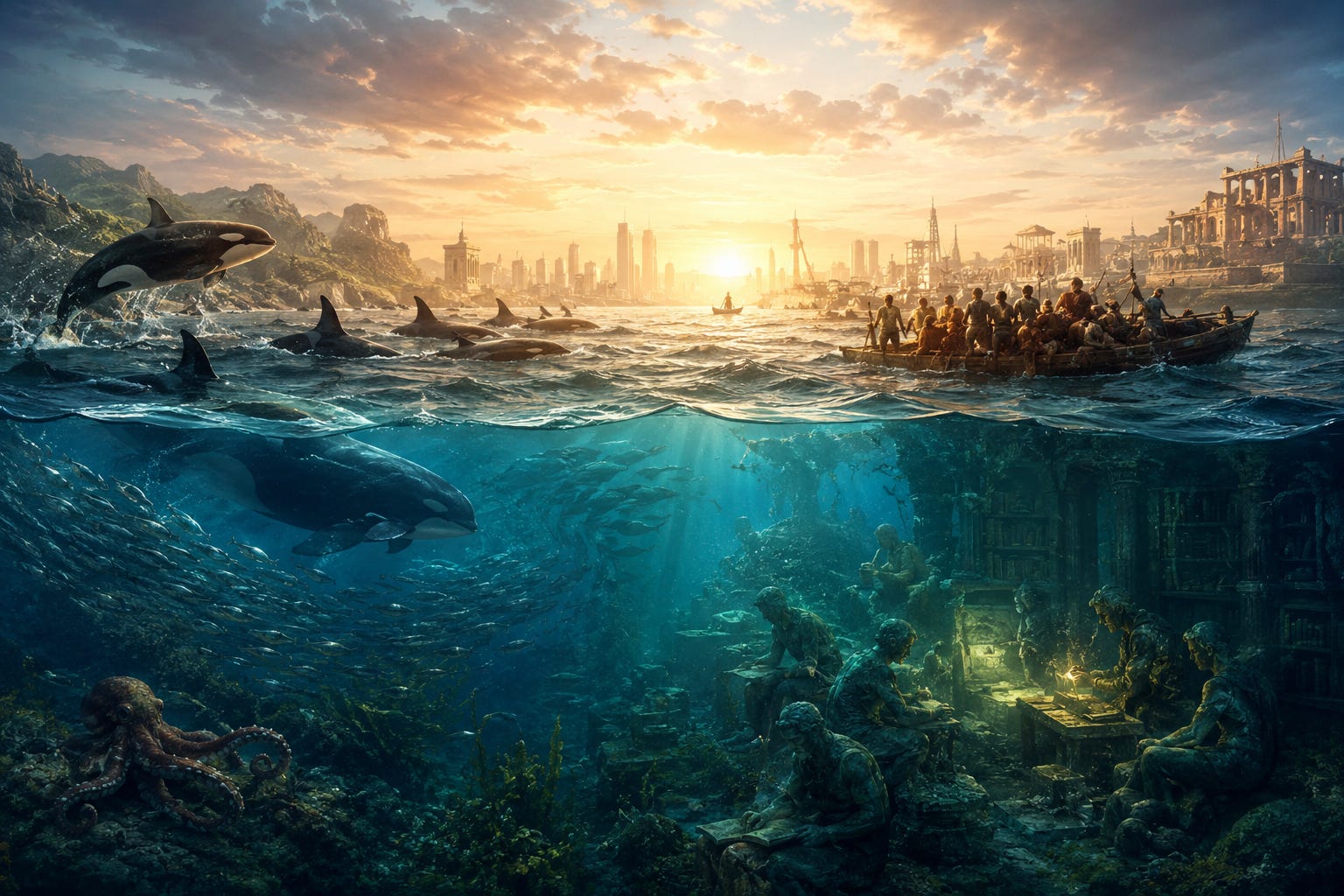
Intelligence is usually imagined as a vertical scale. We calculate whether one animal is smarter than another, one person has a higher IQ than their peer, or one machine solves harder problems than its predecessor. This framing treats intelligence as a finite quantity stored inside a single mind.
That view is useful but incomplete because it misses a second property: how intelligence behaves when it meets another intelligence.
Some minds combine effortlessly. Others remain sealed inside the individual. Still others merge destructively, producing a collective result far poorer than the independent thoughts that created it. This bonding property is the valence of intelligence.
The term comes from chemistry, where valence describes an atom’s capacity to form bonds. A similar principle governs cognition. A mind may be powerful in isolation yet weak in combination; another may be simple alone but formidable in a group. A highly reactive mind might bond so easily that it becomes immediately vulnerable to contagion, panic, or collective delusion.
The intelligence of a system cannot be inferred simply by measuring its component parts.
A bee does not possess mammalian intelligence. An isolated bee cannot comprehend architecture, logistics, reproductive strategy, or temperature regulation. Yet a hive regulates heat, allocates labor, scouts for food, defends territory, selects nesting sites, and survives as a coordinated body. This intelligence does not reside in a single insect. It emerges from the relationships among bees, chemical signals, inherited routines, and environmental feedback.
Ants operate on the same principle. A single ant follows local cues, reacts to pheromone trails, and performs microscopic operations. Collectively, a colony explores vast territory, routes around obstacles, builds complex nests, wages war, farms fungi, and recovers from systemic damage. No individual ant holds the master plan, yet the colony functions with absolute purpose.
This is high-valence intelligence, amplified through multiplication.
The trade-off is clear. Insects achieve collective brilliance because their individuality is heavily constrained. They require no persuasion, they do not convert the hive into a theater for personal status, and they never sabotage the colony because their personal genius went unrecognized. Their behavioral limitations make the collective order reliable.
A solitary predator presents the exact opposite case. A tiger is vastly more intelligent than an ant. It reads movement, memorizes territory, stalks prey, and adapts fluidly to danger. Its intelligence is embodied, focused, and lethal. Yet ten tigers do not form a larger tiger-mind. They compete, mate, or fight, but they never accumulate a shared archive of knowledge.
An octopus is perhaps the most striking example of private intelligence. It explores, manipulates tools, escapes confinement, and displays an alien curiosity. Yet its insights are temporary, bound to one body and a short lifespan. A clever solution discovered by an octopus dies with it. There is no durable accumulation, no archive, and no institution. This intelligence is brilliant, but it is entirely unhistorical.
Orcas occupy a distinct middle zone. They are neither solitary geniuses nor hive creatures. Instead, they live in highly intelligent, deeply social pods that accumulate culture within material limits.
A single orca is formidable, but a pod functions as a family structure, a hunting unit, a memory system, and a cultural lineage. Orcas learn directly from one another, passing down distinct vocal calls, hunting methods, food preferences, and migration routes. Different pods behave differently because they inherit different traditions, not because their genetics vary.
Orca intelligence flows through kinship, imitation, and repeated practice. A sophisticated hunting technique outlives its inventor. An optimal route persists because elders carry the ecological memory. Consequently, a pod possesses knowledge that no newborn orca could discover alone.
This culture remains entirely embodied within living animals. It is stored in voices, habits, and relationships rather than writing or physical infrastructure. It crosses generations through fragile biological continuity. Destroy an orca matriline, and a whole branch of culture vanishes. Because the knowledge has not escaped the body, it has no external backup.
Orcas represent cultural valence without civilization. Their minds bind through life itself, maintaining tradition without tools and social order without formal institutions.
Human distinctiveness lies in the ability to externalize culture. Human knowledge leaves the body and resides in marks, tools, buildings, equations, software, and archives. Because of this, a dead person can still teach. A formula travels farther than a voice. A tool preserves competence for a user who never met its inventor. A legal system coordinates strangers, and a codebase embodies decisions made by engineers scattered across generations.
Under the right conditions, human intelligence achieves extraordinary valence. It compounds across centuries, allowing one mind to serve as the baseline for the next. It preserves insight, filters out error, distributes labor, and builds systems that no single individual could design from scratch.
Yet human intelligence also possesses a potent negative valence: it can combine into systemic stupidity.
More people do not automatically produce greater intelligence. Frequently, crowds generate noise, bureaucratic fog, defensive speech, and imitation. Human beings rarely exchange pure information; instead, they trade status, fear, loyalty, and ambition. Thought quickly bends under the pressure of social conformity.
A crowd is rarely a large brain; it is a large emotional organ that magnifies fast-moving impulses like outrage, certainty, and slogans. Deep reflection travels slowly and requires effort, whereas belonging is cheap. In a poorly structured group, the cheap option wins.
This dynamic explains why brilliant individuals regularly create foolish organizations. A committee of capable people often signs off on cowardly conclusions. A bureaucracy staffed by talent can easily grow blind to reality. A company can neutralize its top performers through incentives that reward internal optics over actual results. The problem is never the raw intelligence of the parts, but the valence of the arrangement.
Human groups turn stupid when social reality overpowers external reality. This shift occurs when people stop asking what is true or testable, and begin asking what is safe to say, what protects status, and what aligns with the dominant narrative. At that point, every additional person adds distortion. The organization becomes recursive, reacting to its own internal signals rather than the world outside.
As large organizations grow, direct perception is replaced by representation: reports replace objects, dashboards replace customers, metrics replace judgment, and narratives replace experience. These tools are necessary, but dangerous. A representation that begins as a window easily becomes a wall, leaving the organization managing a picture of reality rather than reality itself.
Healthy institutions actively fight this decay. They keep decision-makers close to the consequences of their actions. They preserve memory without worshiping precedent, encourage disagreement before consensus hardens into ritual, and attach authority to explicit responsibility. They treat metrics as instruments rather than idols, keeping a channel open for raw reality to enter the room.
Our core institutions exist to regulate the valence of human thought:
Writing ensures thought survives the speaker.
Mathematics renders reasoning compact and checkable.
Science gives physical reality veto power over language.
Law allows strangers to coordinate without personal trust.
Engineering forces talk to become load-bearing structure.
Software demands that logical claims actually run.
Civilization is our ongoing attempt to make human intelligence cumulative without letting it become deranged. The attempt is only ever a partial success. We remain unstable carriers of intelligence. We reason, but we also conform. We discover, but we also flatter. We build tools of memory, then use them to institutionalize mistakes.
This instability makes human intelligence far more powerful than insect intelligence, but significantly more dangerous than solitary intelligence. Ants have reliable combination without freedom. Octopuses have freedom without accumulation. Orcas have culture carried by living continuity. Humans have symbolic accumulation and institutional memory, paired with the constant risk of collective hallucination.
The true human achievement is not isolated genius, but the systems that make insight transferable. A discovery becomes powerful when it can be taught, copied, and used by people less brilliant than the discoverer. The highest form of cumulative intelligence is infrastructure—knowledge made stable enough for ordinary minds to build upon.
A bridge is intelligence turned into steel and geometry.
A vaccine is intelligence turned into biological intervention.
A constitution is intelligence turned into political constraint.
A codebase is intelligence turned into executable memory.
A library is intelligence freed from the lifespan of the author.
These artifacts allow minds to bond across time and absence. Because of them, the living can think with the dead, strangers can coordinate peacefully, and children can inherit the compressed labor of centuries. A functional civilization is simply a system that prevents each generation from restarting at zero.
Crossing the threshold into externalized memory introduces a symmetrical danger: once thought can be externalized, error can be externalized too. A false doctrine can survive its author. A toxic model can be institutionalized. A bureaucracy can preserve mistakes with a discipline no individual could maintain. Written language, mathematics, and software do not guarantee truth; they merely make accumulation possible. What actually accumulates depends entirely on the accuracy of the verification system.
Artificial intelligence intensifies this problem. The critical question is not whether a single model is intelligent, but how that model combines with human users, databases, simulations, markets, and laws. A network of models connected to execution and empirical verification will amplify capability. A network of models connected mainly to each other will simply become a machine for multiplying plausible error.
Raw intelligence is never the decisive factor. The architecture of the network determines whether intelligence compounds or decays.
The concept of valence provides a clearer framework for these distinctions. The future will not be shaped merely by generating smarter individuals or faster machines, but by managing the chemistry of intelligence: how minds bond, how systems filter error, and how knowledge escapes the body without losing its grip on reality.
We remain capable of positive, zero, and negative valence. We can make intelligence cumulative, or we can make stupidity cumulative. We can build systems that preserve breakthrough insights, or systems that protect delusion with total structural discipline. Valence is the boundary line between a mind that ends at the skull, a culture that lives in a pod, and a civilization that thinks across centuries.
No posts
Comments
Nothing yet. Say the first thing.
Sign in to join the conversation.