
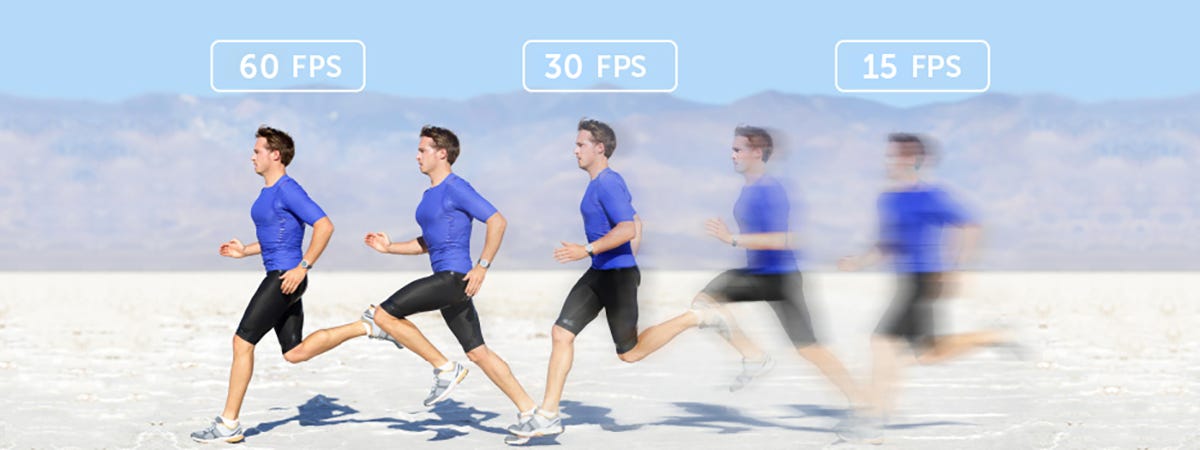
FPS hear dos not mean the First person shooter lingo of Call of Duty! Its the frame per second counter on the corner of the screen.
A Human eye anatomy perspective for future designs of 🤖🦾
https://robopi.ece.ufl.edu/udepth.html
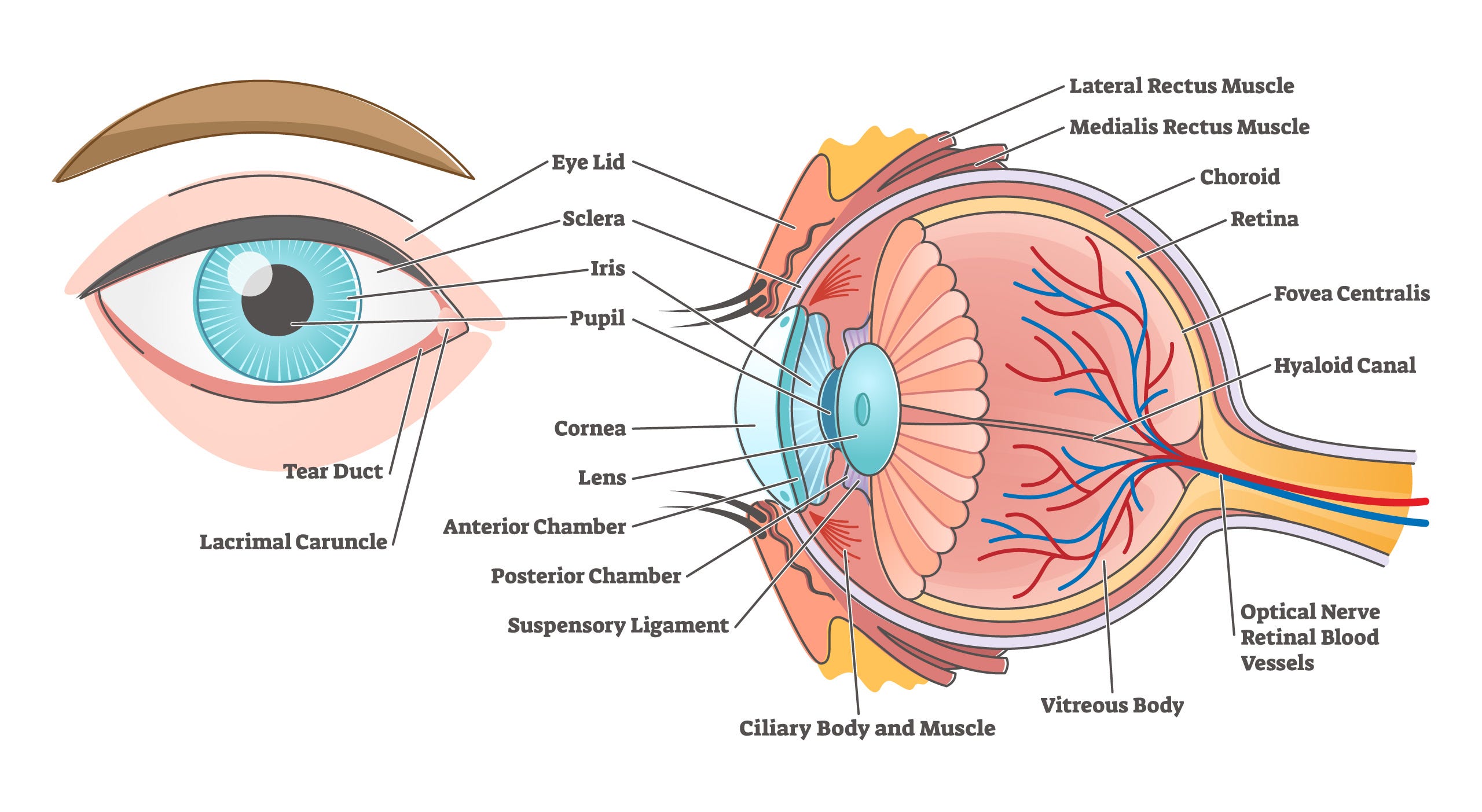
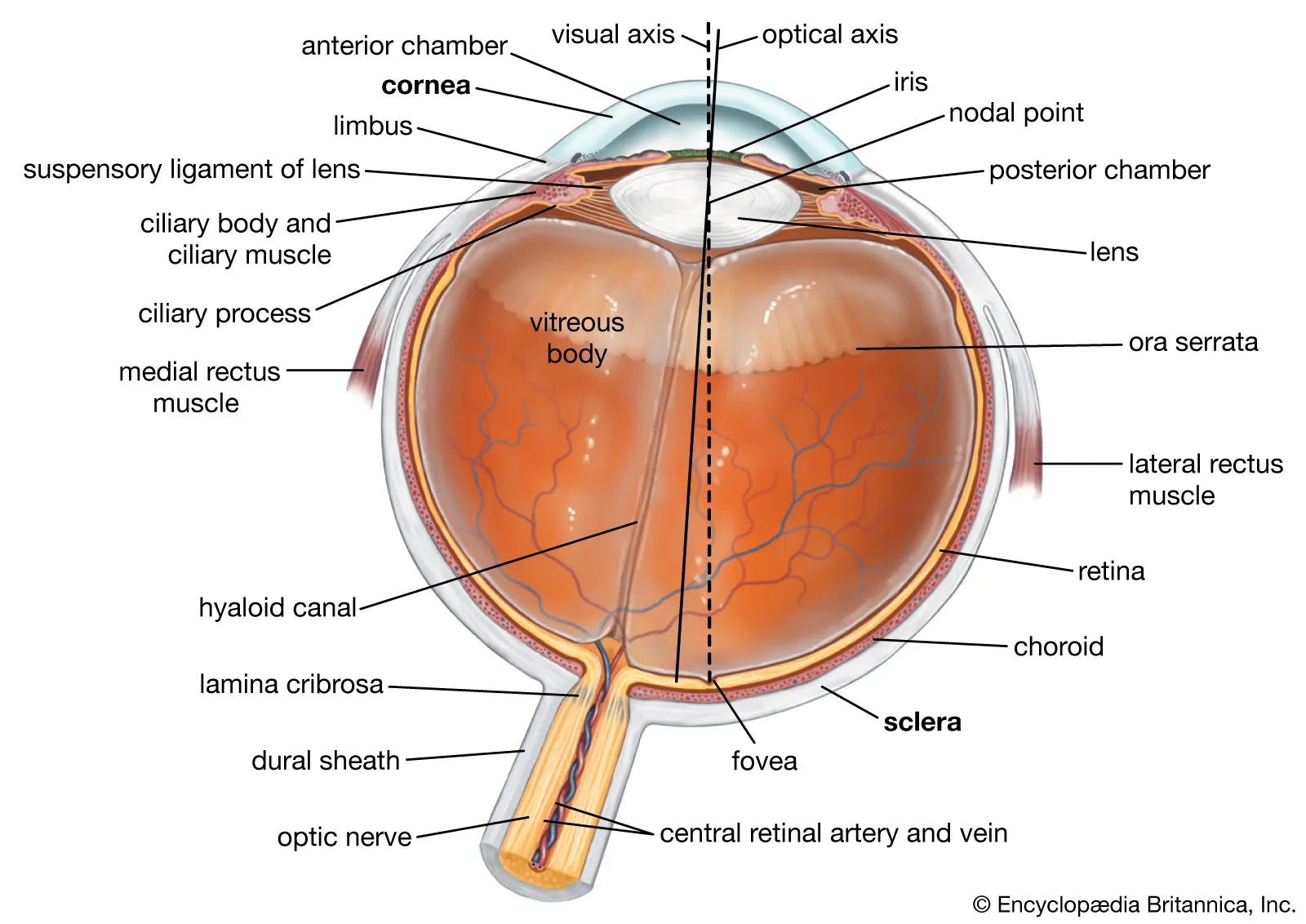
If our eyes had an FPS counter, it would clock about ~4.2 million “frames” per day—using an everyday visual bandwidth of ~60–90 Hz and ~16 hours awake (e.g., 73 Hz × 16 h × 3600 s = 4,204,800 ≈ 4.2M). Vision isn’t truly frame-based; it’s a continuous, bandwidth-limited stream. But the metaphor works: cornea + lens = optics, iris = aperture, retina = sensor; the brain fuses the feed into a sharp, fovea-centered scene updated dozens of times per second.
For nuance, consider fixations: ~3–4 per second. Over 16 h, that’s roughly ~173k–230k “snapshots”—the system’s high-detail sampling layered atop the faster flicker-fusion stream.
From these signals the brain doesn’t store pixels; it computes a probabilistic depth map. Vergence (tiny eye rotations), accommodation (lens refocus), binocular disparity, defocus blur (pupil-set), and motion parallax combine to estimate distance in real time. So while “4.2M frames/day” makes a punchy headline, your visual stack is really an uncertainty-aware renderer—not a camera roll.
Fixation rate: ~3.65 snapshots/s (midpoint of 3–4/s)
Awake time: 16 h/day
Snapshots/day: 3.65 × 16 × 3600 = 210,240 → ≈ 210k snapshots
Human vision is foveated (sharp center, softer periphery). A practical engineering stand-in for a fused, binocular view is ~8 megapixels per snapshot (comfortably in the 5–10 MP range others use for foveated “eye-equivalent” images).
Per-snapshot equivalent: ≈ 8 MP
Pixel-samples/day: 210,240 × 8,000,000 = 1.68192 × 10¹² → ≈ 1.7 trillion pixel-samples/day
If you want a punchier data-rate analogy (just for color): treating those as 24-bit RGB pixels, the raw would be on the order of ~5 TB/day—and yet the optic nerve ships something like tens of megabits per second thanks to predictive coding and feature extraction. Translation: your wetware throws away redundant bits faster than most logging pipelines. Dark, but efficient.
Those ~210k foveated snapshots don’t become a photo reel; they drive a live depth solution—binocular disparity + vergence + accommodation + defocus blur + motion parallax—while hippocampal systems record the who/what/where sparsely, not pixel-by-pixel.
TLDR:
On an average day, your brain chews through ~210,000 high-detail snapshots/frames (≈3.65/s while awake). At roughly ~8 MP of foveated detail per snapshot, that’s ~1.7 trillion pixel-samples feeding a real-time depth map and, selectively, your memories—and of that raw stream [calc: 3.65/s × 16 h = 210,240 snaps/day; × 8 MP = 1.682T px/day; @24-bit RGB → 40.37T bits/day ÷ 8 = 5.05 TB/day], the retina/optic nerve forward only (meat-suit I/O limits) ~10–100 Mb/s [convert: (10–100 Mb/s) × 86,400 s/day ÷ 8 = 108–1,080 GB/day = 0.108–1.08 TB/day], meaning ~79–98% is compressed/“chunked out” before it even reaches cortex [kept 2.14–21.4%; removed ≈ 78.6–97.9%].
(WIP..curating signal)
published lower-bound and a defensible upper-bound logic.
Measured lower-bound (~10 Mb/s). Koch et al. recorded information rates from guinea-pig retinal ganglion cells, summed them (~0.875 Mb/s for ~100k cells), then scaled by human ganglion-cell count (~10×) → ~10 Mb/s for human retina. This is the most-cited, lab-measured aggregate figure.
Why people float higher numbers. Per-cell information rates measured across species span ~5–70 bits/s per ganglion cell depending on luminance and stimulus (mouse awake ~7–9 bits/s; cat up to ~40–70 bits/s in strong stimuli). With ~1.0–1.2 million human RGCs, a naïve sum lands in the few-to-few-dozen Mb/s range; correlations and redundancy mean the true aggregate is lower—which is why ~10 Mb/s is a conservative anchor and anything like ~60–100 Mb/s should be treated as an upper-bound thought experiment, not a measured human total.
Your bracket math (unit conversion) is fine:
Mb/s × 86,400 s ÷ 8 = bytes/day
→ 10 Mb/s ≈ 108 GB/day, 100 Mb/s ≈ 1,080 GB/day (decimal GB). That’s just arithmetic; the scientific part is the ~10 Mb/s anchor above. (If you’d rather be stricter to evidence, use 10–60 Mb/s instead of 10–100.)
Side notes for context (not required for your line): typical fixation/saccade rates of ~3–5/s support your “~210k snapshots/day” heuristic, and everyday temporal bandwidths (critical flicker fusion) live roughly in the tens of Hz under normal conditions. https://www.frontiersin.org/journals/computer-science/articles/10.3389/fcomp.2021.733531/full?utm_source=chatgpt.com
No posts
Comments
Nothing yet. Say the first thing.
Sign in to join the conversation.