
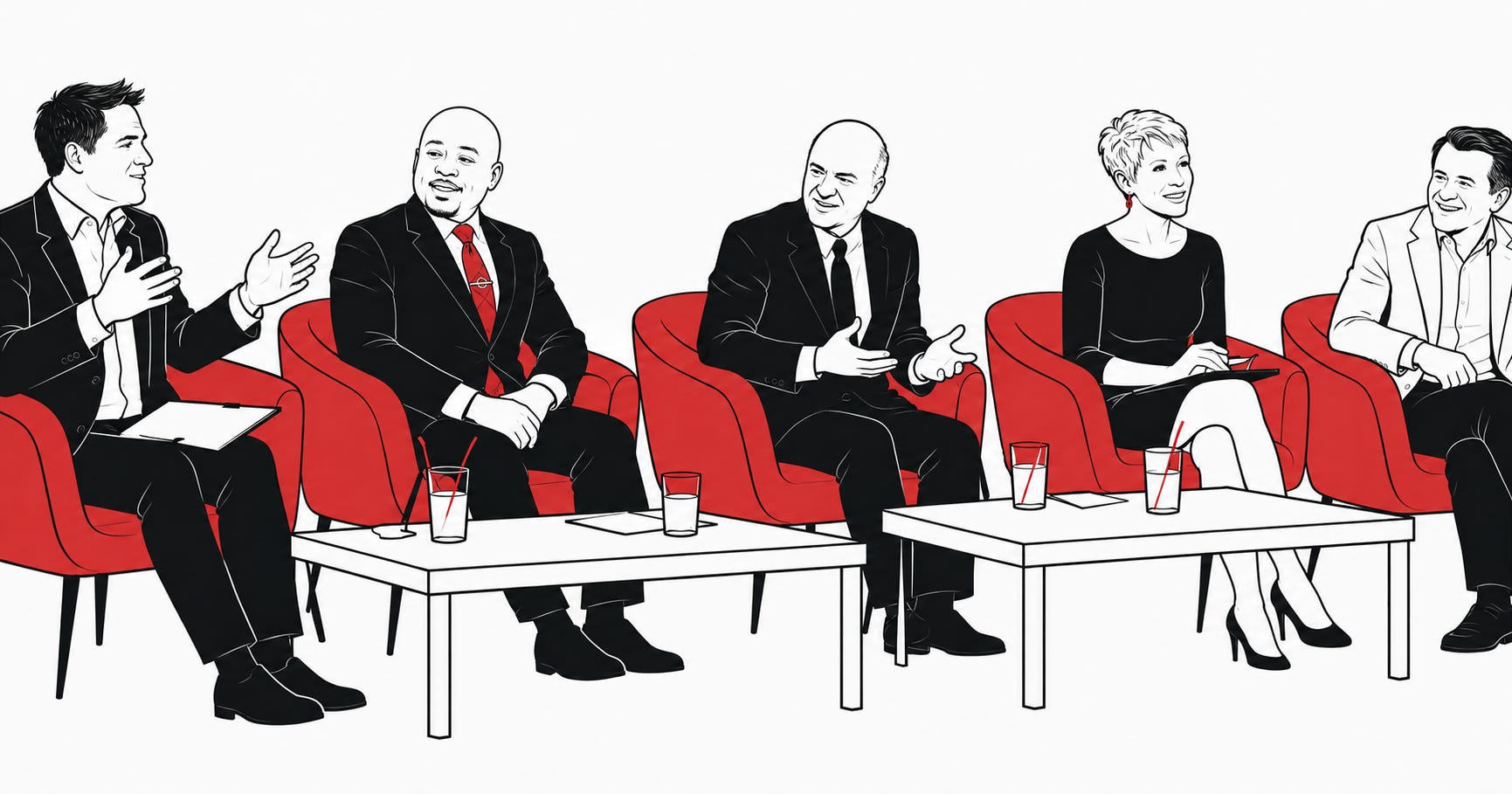
Here it is: the founder is mid-sentence, and then one of the sharks turns away from the founder and says to another shark, something like, “Mark, what are you thinking?”
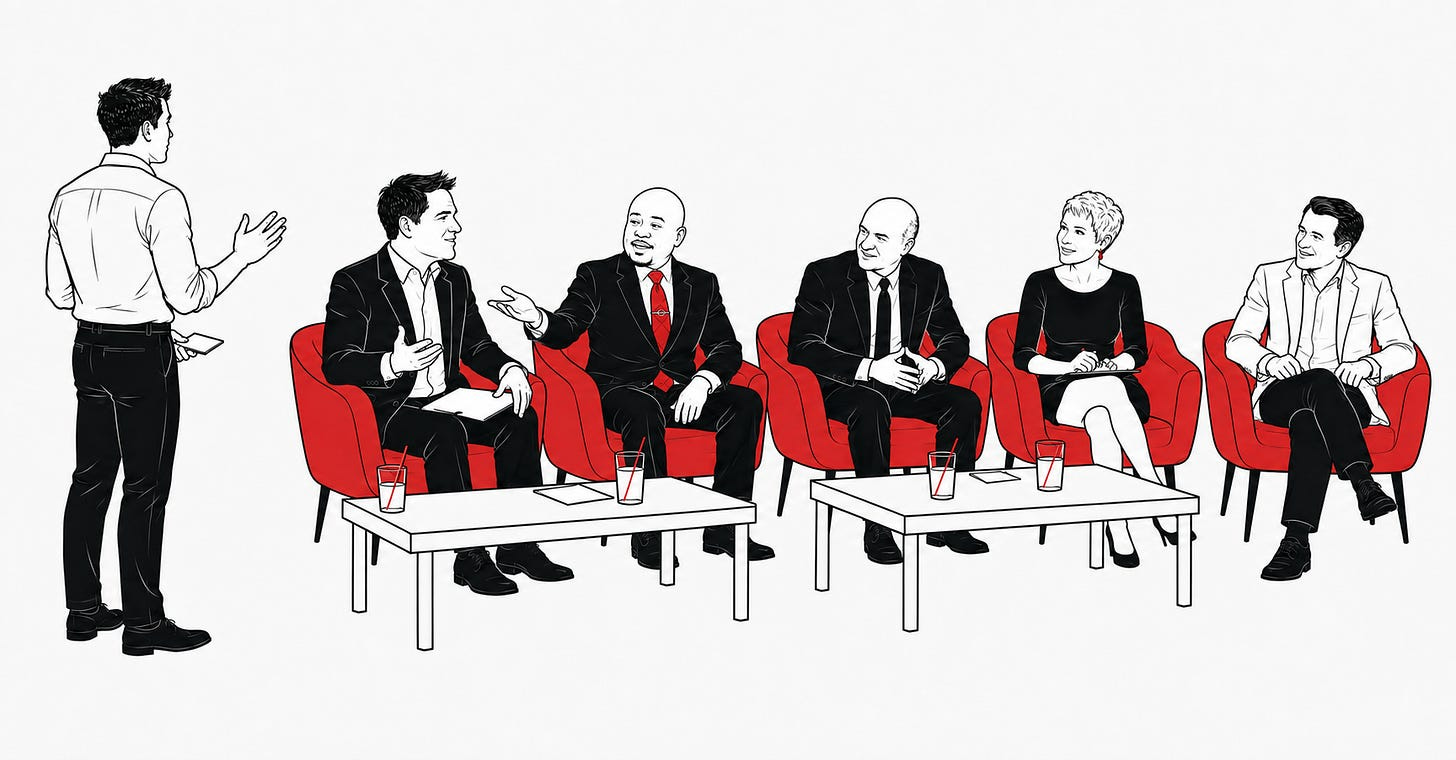
The founder is still standing there, but they’re now “furniture”. Because for the next 90 seconds, the 5 investors talk about the founder’s business, their margins, their likely future, and sometimes even about their personality as if the founder is not even there. The worst of all, they do it in third person while the founder watches. Sometimes one of sharks will say something that the founder desperately wants to correct, but they can’t because the conversation is no longer theirs.
And these 90 seconds is the main reason to watch the Shark Tank if you’re interviewing for a design leadership role now or planning to in the future.
Because this could be YOUR debrief. This is the meeting that decides whether you get hired or rejected. And worst of all, this debrief will probably happen at 4:00 PM on a Thursday, when everyone is busy or tired, and of course, without you in the room.
So the TV show is the only place you’ll ever get to see HOW it happens. Everything else about the Shark Tank is a pitch, but this part is the decision.
Did you know that an average Shark Tank pitch runs about 40 minutes? Some of them are even longer. Barbara Corcoran has said that they can go an hour and a half.
So what airs is usually a 5-10 minutes segment (and producers have been fairly open about what gets cut, things like:
the financial details
the grinding back-and-forth about Unique Economics
the part where the actual reasoning happens
It gets cut because, according to the producers, it’s boring to watch.
Say, you met 4 people, all in one day or over the course of weeks, doesn’t matter. What matters is that you had 4 separate conversations, roughly 240 minutes of you being careful with your words and specific and thoughtful, but then these 4 hours of conversations become a debrief.
And that debrief becomes eventually a paragraph for someone above the people who met you to read and decide.
As you see, the real-life job interview “compression rate” is even worse than the show’s!
And “editors” (i.e. your interviewers) are frequently distracted or overwhelmed with other work tasks (we’re all human after all )
Moreover, unlike the Sharks, your interviewers are not even being paid to make you look interesting.
Yet, most of your interview prep is for the 40ish minutes of your presentation, and almost none of it is preparation for the one-paragraph edit that actually matters in the end.
This is what we are going to fix today.
This is the question that ends more Shark Tank pitches than any other, and it gets asked most brutally of the founders who are already doing well.
For example, a female founder comes on with a product that’s already doing $2 million in sales, with healthy margins and her business growing steadily.
Then Kevin O’Leary asks, “Why are you here? What do you need me for? You have a business!”
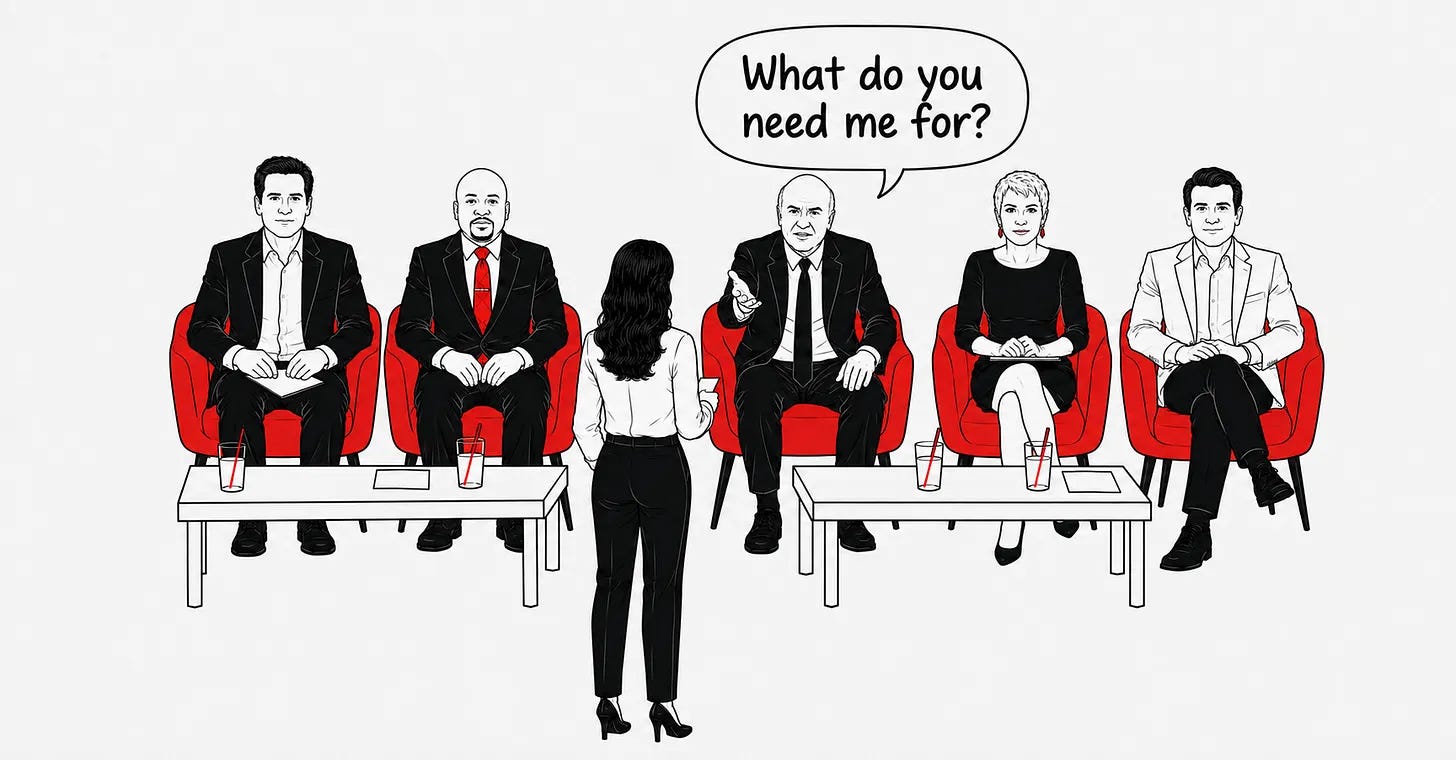
It may sound like a compliment, but it’s not. And the founders who fumble at this question lose the room.
Usually because they would answer with “what money is for” and not “what the shark is for”.
Let’s imagine you are sitting across from a VP of Product who has been shipping products for 3 years without a formal design director. The org still functions, maybe not beautifully, but it functions. It functions in a shape that already suits him, where design comes in after the requirements are written and makes things look good. And he is on your panel, and he is going to be asked whether he supports the design director hire (you).
So what does he need you for? That’s the real question.
This is the part that catches many, many, many experienced design leaders because they have prepared the wrong case entirely. They arrived ready to prove that they’re excellent, but nobody in that room doubted that (i.e. you wouldn’t be in the room if you weren’t, duh)
What’s actually being decided there is the transfer of authority from people in the room who currently hold it - to you, the candidate and potential hire - and everyone in that room can do the math on what they would have to give up.
An IC interview, in comparison, is an evaluation. You are being measured against a bar, and either you clear it or you don’t.
A leadership interview may look identical on the surface, but it’s a completely different event underneath. It’s a negotiation about how much power the room is willing to hand over, conducted mostly in your absence between people who each have something specific to lose if the answer is “a lot”.
And this is exactly why the Sharks argue with each other and not with the founder.
Once you accept the fact that the room is negotiating rather than evaluating you, the following questions start to make sense.
For example, let’s watch a shark decide that they are “out.” Their line would frequently be a version of “I don’t know this space.”
It sounds like a judgment about the business, BUT it’s not!
It’s a pure statement about the shark themselves. It means “my personal cost to make this business work would be high, and given that I have 3 other companies, this one will eat my Tuesdays”.
So you see, what’s happening? Sharks are not pricing your business, they are pricing their own labor.
So is your interview panel, by the way. And this is the thing I wish somebody told me a decade or two ago:
The main questions running under every leadership interview are - (1) how much of my time and political capital will this person cost me before they produce anything meaningful, and (2) what happens to my own job if they turn out to be wrong?
That single reframe should explain to you a set of outcomes that otherwise may look insane.
It should explain why a “merely competent leader with domain experience” beats a “brilliant one from an adjacent industry”.
This reframe also explains what may feel like the “hostility” in the questions.
For example, the PM on the panel may grind you about how you measure impact. Please understand, that it’s very unlikely they are curious about the actual measurement. The reason for the question is the fact that maybe 6 weeks ago the team shipped something design pushed for it, and it did nothing. So he had to sit in the room full of business and finance leaders and account for it. So he is not testing whether you can do the job, but he’s checking whether you will put him back in that room where he needs to explain the lack of impact of your design work.
Or, the Senior Staff designer on the panel may be asking oddly pointed questions about your leadership philosophy because they may have wanted this role to be THEIR promotion.
So every person on that panel walks in holding the last 6 months of their own job…but they will ask you about it in the shape of a question about you.
And here is an important part to avoid→ your instinct would tell you, once you see the “wound”, to name it (i.e “It sounds like you have had a rough time with design here”) DON’T DO IT! The moment you say it, the conversation stops being a conversation and becomes something the other person needs to “manage”, because you have converted yourself from a candidate to a “threat with an insight”.
So please diagnose privately, in you head, and then answer to the diagnosis, but never announce it.
What you do instead is unglamorous but emotionally effective.
Simply describe the specific version of the scene that may have just gone wrong for them, and describe how it would not happen if you were in the role (not your philosophy of collaboration, but the “mechanics”)
For example:
“Before anything goes into a sprint, I want the metric written down and agreed with the PM. If it does not move, we both know what we said we expected, and neither of us is explaining it alone.”
The PM WILL hear “neither of us”, and that’s the whole ball game.
By the way, you do not have to infer all of these.
Some of it, people will simply tell you if you ask in the first 5 minutes of the interview rather than waiting for in the expected “do you have any questions for us?” slot at the very end, when everyone has already stopped listening.
The trick here is asking things a person could genuinely know the answer to.
For example, if you ask the VP of Product what the last design leader struggled with, you may get nothing because it’s not their job to track that or anything they says will be secondhand. Ask them things they knows firsthand. Like, what they want, design deciding in 6 months, that design is not deciding today?
Now, you have handed them a question about their own work, which they obviously have opinions about, and their answer is the map of exactly how much authority is actually being offered..
Here are a few more—
To a hiring manager, who else had to agree to open this role? People usually answer this readily, and it tells you whose budget you are, which is the same thing as knowing who has to be convinced.
To a peer, what would you want out of this role that you are not getting now? This is the “wound question”, but it’s been made answerable, because you are asking about their experience, not something about a predecessor they may barely remember or not want to share.
To anyone senior: what would make you say in a year that this hire worked? If you get a vague answer, nobody has decided what this job is actually for, and you will be the one finding out (better to know this before you start than in month 3 ;)
Also, and this is important, whatever words they use, use those words back later.
If someone on the panel says “the team keeps re-litigating decisions”, the word you want in your closing is re-litigating, not alignment. Their language coming back at them is evidence that you were listening.
Wednesday’s paid issue shows the prep:
how to work out what each person on a leadership panel has been dealing with before you ever meet them, using 4 sources that are all public, and
the rebuild of one client's answer to the metrics question that turned the PM who was blocking her into the person who argued for her.
It’ll be in your inbox on Wednesday, August 12th.
Talk soon!
→ Follow me on LinkedIn for unconventional UX career plays
→ Check my book with practical mentorship frameworks for senior UXers
→ Email with collab ideas, guest writing, and more
→ Reach out if you want to sponsor this newsletter trusted by designers and leaders scaling their careers across Fortune 500s, agencies and high-growth AI startups.
Comments
Nothing yet. Say the first thing.
Sign in to join the conversation.