
Her VP kept piling on more work.
Not some big projects, but a flood of smaller ones: a “quick” review of the onboarding process “by Tuesday”, a competitive teardown by “the end of the week”, 3 new prototypes for an important stakeholder’s pet idea “to show in the meeting on Monday”, an updated narrative for a product strategy deck….the list went on.
Each request sounded reasonable on its own. But together, they had turned the team’s week into a series of broken promises.
The strangest part was that her VP had suddenly become much more organized.
Before meetings, he now used AI to turn his rough thoughts into very detailed briefs.
After meetings, he sent clean summaries with owners and action items.
His ideas that once might have remained as just passing comments now arrived looking fully formed and in “ready to begin” state.
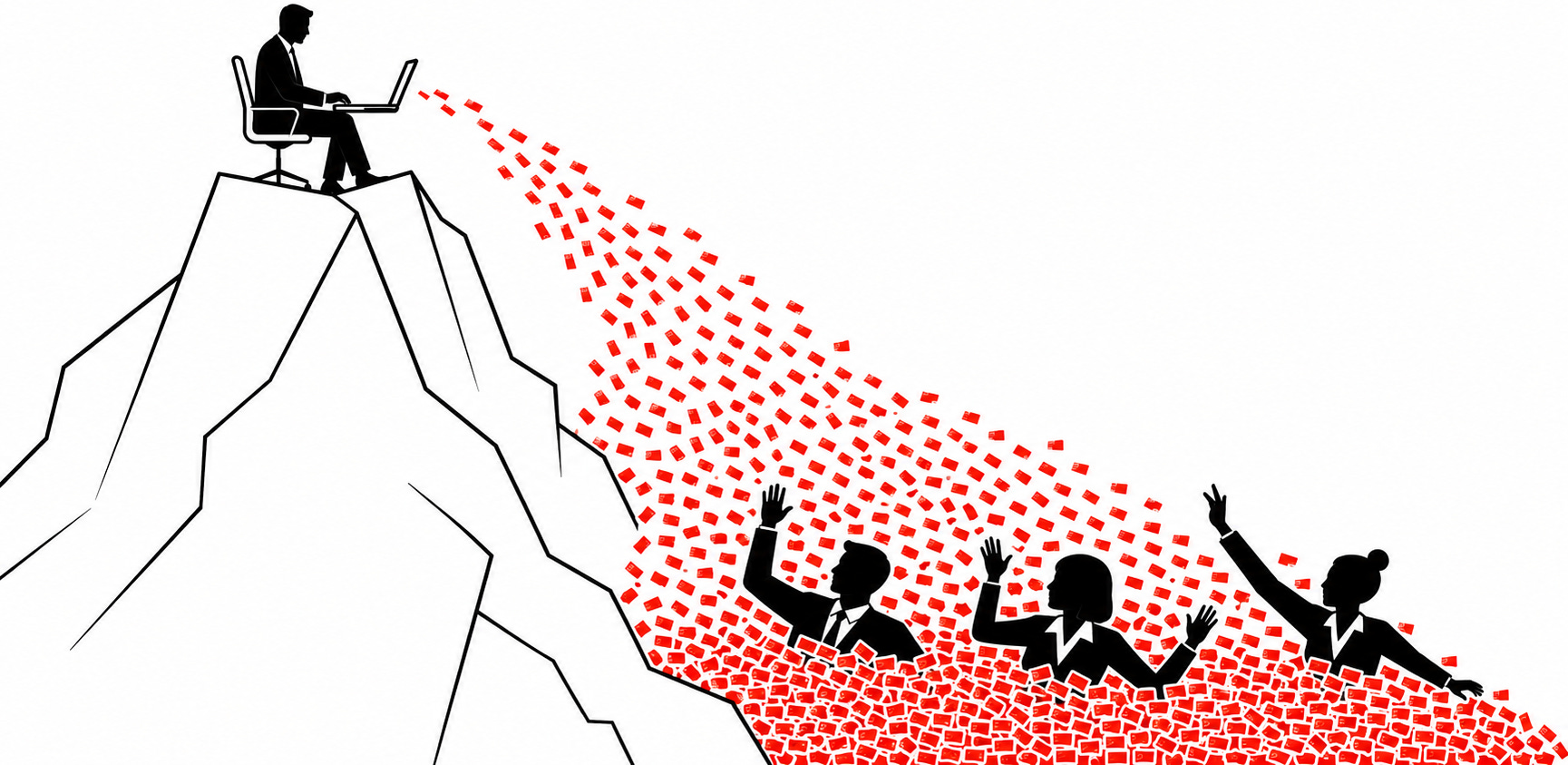
By Thursday afternoon, he could create a week’s worth of new work.
My client’s team could not create another week in which to do it.
She had tried showing him the roadmap, explained that the team was stretched, had asked which requests were truly urgent…he agreed with her every time.
Then another “polished” brief appeared.
Before AI, turning a thought into an assignable request required effort. Sometimes a lot of effort.
Someone had to explain the problem, assemble the context, write the brief, and make the request coherent enough for another person to act on it.
Plenty of marginal ideas died while the requester was trying to articulate them.
AI has removed much of that friction.
Now, any passing thought can become a convincing proposal in minutes.
Basically, an executive can now delegate at the speed of ideation.
But the design team still researches, coordinates, designs, reviews, revises, persuades, and ships at human speed.
This creates a new kind of organizational mismatch: request creation has become nearly free while execution remains expensive.
And because every request arrives looking “complete”, the team ends up treating every one of them as a decision that has already been made.
Often, it hasn’t.
My client kept describing the problem as insufficient capacity.
That language placed the burden in the wrong location.
“We don’t have capacity” sounds like a condition inside the team. Perhaps people need to work faster? Or, more efficiently? Reduce the fidelity? etc.
All while the new request remained intact, the team would become responsible for finding room for it.,,
But capacity is a collection of promises that have already been made.
When new work enters, one of 4 things must happen:
An existing commitment moves.
Its scope shrinks.
Its quality or certainty drops.
People absorb the difference through hidden overtime and cognitive overload.
This was the actual problem inside my client’s team.
Her VP experienced each request individually. The designers experienced the entire portfolio.
He saw a 2-day competitive teardown.
They saw the research session that would no longer be prepared properly, the prototypes that would probably arrive late, and the product manager who had already promised Monday’s review to 3 other teams.
So we gave every new request a price, and called it —
The rule is simple:
New work does not enter the active queue until someone decides what it will DISPLACE.
Every additional priority must answer 4 questions:
Which existing commitment will move, shrink, or stop?
What consequence will that create?
Who has the authority to accept that consequence?
When will the displaced work be reconsidered?
This changes the conversation.
The team is no longer debating whether a new idea is valuable. Many ideas could be valuable.
But now, they’ll comparing that value against the commitments already consuming the same people, time, and attention.
During our session, we used a worksheet built for this rule.
Comments
Nothing yet. Say the first thing.
Sign in to join the conversation.