
👋 You’re reading a free Saturday issue of UX Mentor Diaries by Marina Krutchinsky. ex-VP @ JPMorgan. Every Wednesday I coach designers and leaders 1:1 on getting faster to the next level, overcoming layoffs, prepping for interviews & promotion. What comes up in these sessions becomes this newsletter (fully anonymized, of course) Free Saturday issues give you the “what” - what’s actually holding you back (and usually it’s not what you think). Paid Wednesday issues give you the “how to fix it” part - the exact moves to copy, the templates I use in sessions, and how long it takes to see the change.
⬆️ Upgrade to paid subscription for: Full access to every script and playbook I created after coaching 2,400 designers and designer leaders / Including 50+ Transformative Career Strategy Systems for every career situation / 15+ Exclusive Positoining Templates ($600+ value) & more.
Apparently, most of them had been dead for years…

The traffic lights had been put on automatic timing but nobody took the buttons off the poles.
Two decades later it is roughly the same story, with more than 2,500 of the city’s 3,250 buttons are doing nothing. But they are still there, looking realistic, “actionable” even.
So people keep pressing them.
Thousands of small acts of fake control, performed every day by people who believed they had changed what would happen next…
Elevator “close door” buttons is another famous example.
Since the ADA in 1990, the elevator doors have to stay open for a minimum amount of time.
You press the “close doors” button (or even jab it when in a hurry), the button lights up. BUT the door closes only when the system was ready to close it anyway. Yet, your brain takes the credit.
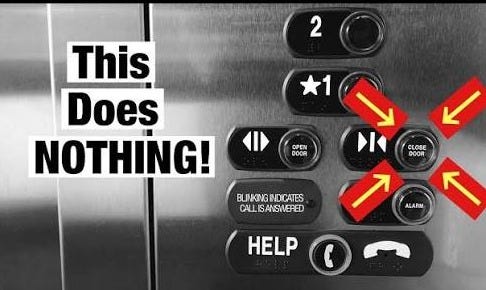
Psychologists call this the illusion of control: our tendency to believe our actions affected an outcome that was already determined.
Like the processes that outlived the problem they were created to solve back in the day.
Or “approvals” nobody is actually waiting for.
Or some old templates copied from a leader who left three reorgs ago.
Or “requirements” that disappear the moment someone powerful needs to move quickly.
Yet people continue pressing them, sometimes for years.
A designer I know was taught that “every project needs a formal discovery phase”. So she always schedules one. Even when every the customer pain point has been documented recently, every mission-critical decision has been made, and engineering is scheduled to start building on Monday.
Another designer was taught that leadership must always be “kept informed.” So he copies 12 executives on every update and sends decks nobody reads.
Yet another designer I worked with, believed work couldn’t be shared outside Design until it had passed through the internal rounds of design critique.
At the same time, if the product lead walked directly into the executive meeting with a rough sketch, they would get the decision. All while the designer would wait for Thursday’s design critique. By then, there would be nothing left to influence.
All of these people are not careless. They are doing exactly what they were told.
And that’s the problem.
At senior levels, nobody is impressed that you can “follow a process”. They are watching for signals whether you can tell when the process matters.
And rhat distinction is where careers separate ↴
Follow every rule and you look dependent on the machinery.
Ignore the wrong one and you become dangerous.
Take any rule you regularly follow and place it into one of these 3 buckets.
These rules protect something the company genuinely cannot afford to lose.
Be it customer trust, or regulatory compliance, or financial controls, or a contractual obligation, or even a decision another team must build against.
This kind of things.
When you skip one, a specific person can explain what breaks.
A load-bearing rule usually has:
A current owner
A known consequence
A history of being enforced, including when inconvenient
A reason that survives contact with urgency
If the CEO wants something shipped by Friday and Legal can still stop it, you have found a real rule.
Do not confuse seniority with exemption from these rules. Breaking load-bearing rules is unsafe for everyone.
These rules demonstrate order without controlling the outcome.
→ Use this template.
→ Invite this group.
→ Run this ceremony.
→ Put the work through this review.
→ Add the research slide, even though nobody will discuss the research.
Theater rules survive because following them is socially cheaper than questioning them.
They may no longer improve the work, but they still reassure someone that the proper performance took place.
Some rituals are attached to a living person’s identity. So if/when you skip the process they created and they may experience it as a judgment on them (this is how people make enemies at work without even realizing it)
Before ignoring a theater rule, ask:
Who built this, and are they still here?
If you can name the person, talk to them first. A 30-second conversation can turn rule-breaking into an agreed exception. But it can also expose a consequence you had not seen.
So if there are still there, talk to them first!
If nobody remembers where the rule came from, you may be standing in front of a dead button.
These sound like instructions, but they are really tests of judgment.
For example:
“Keep me in the loop.”
“Bring people along.”
“Make sure we have enough research.”
“Be more strategic.”
A literal reading is impossible. They could mean different things to different people, like —
How often should you update them? Which people need to come along? How much research is enough? What should you stop doing to become more strategic?
Nobody specified.
The thing here is that ambiguity IS the test.
More junior people often respond by doing more. Like more booking meetings, creating more documentation, sending more updates, producing more evidence…
Senior people decide what the instruction must mean in this situation.
So after hearing what sounded like an instruction, they respond with a recommendation—
“I’ll update you when the risk, cost, or decision changes”
or
“I’ll send you a short summary on Friday unless something needs your attention sooner.”
These responses show judgment.
Sending a daily status report shows obedience (which is a junior behavior)
A surprising amount of “executive presence” comes down to knowing when an instruction requires interpretation rather than compliance.
Let me explain this one with an example.
I once watched a strong designer delay a leadership conversation for weeks because she believed her director needed to approve the deck first.
Nobody told her that.
But in her first year with the company, her director had once asked to review an important presentation before it went out to teh senior leadership.
One request became a standing policy in her head.
So for years after, she was following the memory of a previous situation.
That is a 4th category worth watching: phantom rules.
YOU invented them from some old correction, or one manager’s preference, or something that happened to a colleague 3 years ago…
This is why phantom rules do not need to be broken, they just need to be deleted.
Write down the rules you followed during the past month.
Include the official ones and the tiny ones you rarely notice:
Who must approve your work?
Which meetings you are expected to attend?
When research is required?
What can be shown to leadership?
Which decisions Design is allowed to make?
How polished work must be before it leaves the team?
Who is permitted to contact whom?
etc
Put each one on a separate sticky note
Now, sort the sticky notes into 3 columns by asking questions below in this order:
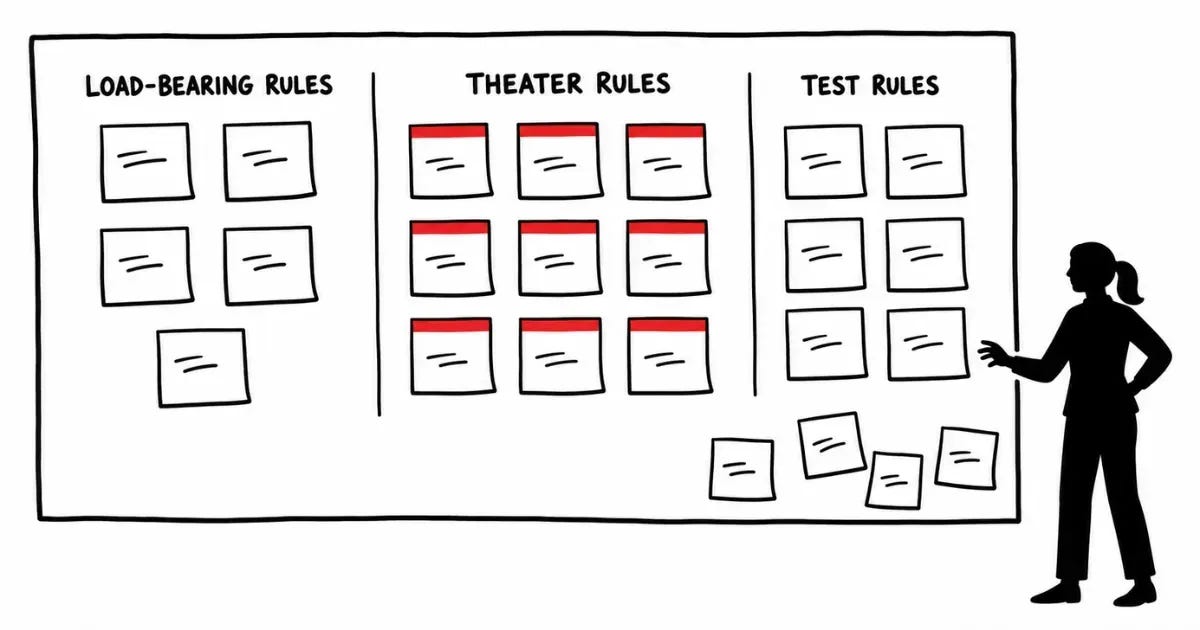
What exactly happens if I skip this?
A real answer includes a person, consequence, or dependency.
(is it a load-bearing rule?)
Next ask:
When was this last enforced against someone with more power than me?
Rules that only apply downward are often status controls disguised as operating procedures.
Then ask:
Does following this change the decision, or merely prove that I followed it?
That question will fill your theater column quickly.
And finally:
Am I being asked to comply, or to exercise judgment?
All “unclear ones” put to the side (that’s your “ask for clarification” pile, for later)
And that’s useful.
But senior roles exist because some situations cannot be handled by rules.
This is why companies need people who can see that a process no longer fits, understand what it was protecting, and change course without creating avoidable damage.
If you press every button because the label tells you to, you may be dependable.
But you are not demonstrating senior judgment.
And if you break buttons simply to prove that you are “brave”, nobody will trust you.
The promotion signal is the quality of your sort:
→ Protect the load-bearing rules.
→ Handle theater with political intelligence.
→ Interpret the tests.
→ Delete the phantoms.
Your company probably has more dead buttons than anyone wants to admit ;)
And let me know if you need help sorting them the buckets :)
Wednesday’s paid issue is the full sort, done on a real org. One client's twenty-item list with every item placed and argued, including the 4 we got wrong the first time and how we found out.
Plus, the 3 phrasings of the “say-it-out-loud sentence”, for a peer, for your manager, and for a room with an executive in it, where the wording has to change.
It’ll be in your inbox on Wednesday, August 5th.
Talk soon!
I work with a small number of super seniors designers, managers and directors who are ready to be positioned as the “obvious choice”.
This is for you if:
You’ve been passed over for roles you were qualified for
You’re a director at a startup struggling to be taken seriously at larger companies
You know you’re ready for the next level but can’t make your work “visible” no matter how hard you try
I’ve helped designers go from “not ready yet” to promoted, hired, and finally seen as the senior leader they already were.
→ Follow me on LinkedIn for unconventional UX career plays
→ Check my book with practical mentorship frameworks for senior UXers
→ Email with collab ideas, guest writing, and more
→ Reach out if you want to sponsor this newsletter trusted by designers and leaders scaling their careers across Fortune 500s, agencies and high-growth AI startups.
Comments
Nothing yet. Say the first thing.
Sign in to join the conversation.