
👋 This is a free edition of UX Mentor Diaries by Marina Krutchinsky. ex-VP @ JPMorgan. Every week I coach product designers on speeding up their path to leadership, overcoming layoffs, prepping for interviews & promotions - and their most recent and pressing questions become this newsletter.
⬆️ Upgrade to paid subscription for: Full access to every script and playbook based on career patterns from coaching 2,400 UXers / 50+ Career Strategy Systems / 15+ Exclusive Positoining Templates ($600+ value) & more.
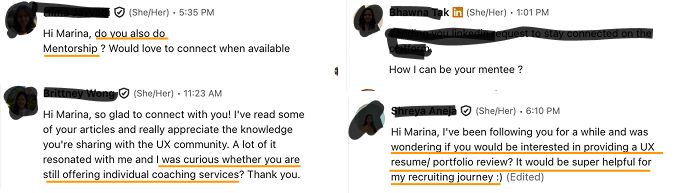
But one reader asked a much better question.
He had been doing UX since before UX was a common job title. He had spent years inside companies where there was little room to advance. And before paying anyone to help him, he wanted to know:
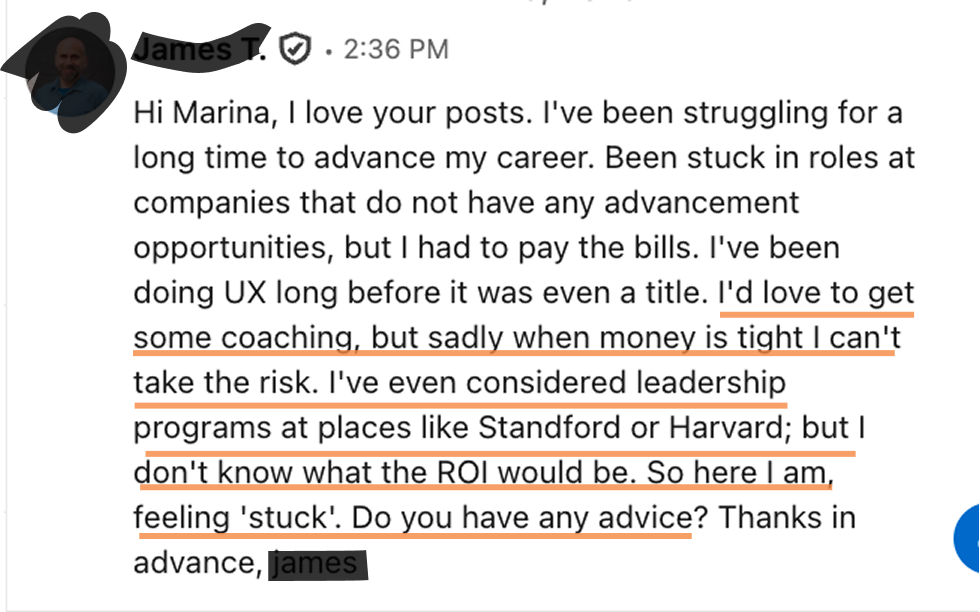
So the actual question worth asking is this one—
Could coaching actually change anything, or was she expecting another person to solve a problem her company had created?
Coaching is a waste of money for some career problems.
If you are missing information, you can usually find the answer yourself. You can read the article, use the template, ask AI, rehearse the interview, or have one honest conversation with your manager.
Yet, information is not what keeps so many experienced designers stuck.
They already know they should “speak more strategically”. “Build visibility.” “Show impact”. “Develop executive presence”. “Delegate more”. “Stop waiting to be invited”…the list goes on.
They have heard the advice so often they could teach the workshop on this topic.
And yet the same problems keep surviving the advice.
That is because there are 2 very different kinds of career problems ↴
1 → You do not know what to do.
2 → You are solving the WRONG problem.
The first kind is often fixable for free.
The second is almost impossible to diagnose from inside your own career.
Here is how to tell which one you have ↴
You can hear a coworker describe a career problem and see their blindspot in 5 minutes.
One coworker keeps doing Director-level work … but describes herself as the team’s dependable problem solver and carries it as a badge of honor…
Another one says “leadership overlooks design”, but in reality, every update he gives starts with process and ends before any business consequence even mentioned.
Third one keeps applying for leadership roles while telling stories that prove they are an excellent IC (wrong altitude)
From the outside, the mismatch is obvious.
Then you look at your own cryptic review feedback and suddenly nothing is obvious.
Psychologists call this Solomon’s paradox: we tend to reason more wisely about someone else’s problem than our own.
Your intelligence can’t protect you here. In some cases, it makes the problem worse.
The more experienced you are, the more evidence you can produce for your preferred explanation—
“There was no room to advance.”
“My manager never advocated for me.”
“Leadership does not value design.”
“The recruiter did not understand my background.”
Any of these may be true.
But a true explanation can still hide the useful one.
Maybe there was no room to advance.
→ The real question then is why you stayed 3 MORE years?
Maybe your manager did not advocate for you.
→ Or, maybe you didn’t give her a case she could repeat in calibration without you in the room?
Maybe leadership does not understand design.
→ Or, maybe you haven’t translated your work into a decision they were already responsible for making?
Maybe the recruiter missed your value.
→ Or, maybe your story required too much interpretation?
Career progress often begins when you stop asking, “Is my explanation accurate?” and ask, “Is THIS explanation helping me make a better move?”
Open a blank document and write:
“[You name] has been trying to get promoted for 2 years. Here is what [your pronoun] has tried. Here is what keeps happening.”
Use your own name (it’s important!) and write as if a respected colleague sent you the situation and asked for your bluntest advice.
Then answer the 3 questions:
What is [your name] assuming?
What is [your name] avoiding?
What would I tell [your name] to do in the next 30 days?
Third-person distance interrupts the internal defense brief. You are more likely to see the pattern than argue the excuse.
Do NOT write a list of everything you accomplished.
Instead, write the case your manager would need to make for you in a promotion or talent-review room you will never enter.
Heres’ how and, please keep it to ONE page:
What larger scope are you already operating at?
Which decisions changed because you were there?
What became less risky, faster, cheaper, or more valuable?
Why is the next level the logical recognition of work already happening?
Wherever the argument becomes vague, your case has a gap.
That gap may be missing evidence…or it may also reveal that you have spent a year becoming indispensable at your current level instead of credible at the next one.
Telling yourself to “be more visible” is NOT a plan.
Neither is “show more executive presence” or “act more strategically.”
Turn the advice into a behavior you CAN OBSERVE. A few examples—
“If my project comes up in Monday’s review, I will open with the decision, the risk, and my recommendation before I show the work.”
“If a leader asks my team for options, I will recommend one and explain the tradeoff instead of presenting three neutrally.”
“If I hear about a planning conversation after it happened, I will find out who shaped the agenda and speak with that person before the next cycle.”
Vague aspirations create guilt, but scripts create action!
Do NOT respond to your career frustrations with “one giant move”.
Instead, run a small test that can teach you something within a week.
Something like this —
Lead one update with the business risk.
Ask your manager what argument against your promotion would be hardest to answer today.
Request one piece of work that increases your decision scope (not merely your workload)
Tell a leadership story without explaining the design process and notice which questions follow.
The goal here is not some immediate success, but a better evidence.
If you keep changing 5 variables at once, you will remain busy and learn nothing.
AI is very useful for rehearsal, reframing, and pattern detection. But it becomes dangerous when you use it to validate the story you already believe.
❌ Do not ask: “Can you improve my promotion case?”
✅ Ask: “Assume this promotion is denied. What are the 3 strongest arguments the calibration room could make against me?”
❌ Do not ask: “Does this interview answer sound strategic?”
✅ Ask: “What level does this answer actually signal, and which sentence creates that impression?”
❌ Do not ask: “How can I communicate my impact?”
✅ Ask: “Which claims in this story depend on the listener doing the translation for me?”
AI is much more valuable as a hostile reviewer than a supportive coach.
But it has one hard limit: it only knows the case you give it.
It cannot see the meeting where you became defensive.
It does not know that your VP uses “more strategic” to mean “bring me a recommendation before I ask.”
It cannot notice that all your leadership stories begin after someone else sets the direction.
It cannot tell you that the strength you are proudest of … is the same strength keeping you trapped as the reliable executor (very common trap, btw)
The missing evidence is often outside the prompt.
the problem is visible,
the feedback is clear, and
you act once you know the move.
You probably do not need ongoing help to prepare for one interview, rewrite one case study, make one decision, or practice one difficult conversation.
✔️ The same problem has survived for 12 months despite real effort.
✔️ You keep receiving vague feedback with phrases like “executive presence,” “strategic thinking,” or “leadership readiness.”
✔️ You perform well in interviews but repeatedly lose near the end.
✔️ You are doing work above your level, but nobody with power seems to interpret it that way.
✔️ You know what you should do and still do not do it when the moment arrives.
✔️ You are moving from senior IC to leader, or from functional leader to executive, and the behaviors that made you successful are starting to work against you.
The important decisions happen in rooms you cannot observe.
So the list above represents the interpretation problems.
With these, you need to understand—
what other people are concluding from your behavior,
which signals you are sending without realizing it, and
whether the problem you keep solving is even the one blocking you.
A Principal designer once came to me convinced she needed stronger interview answers.
Her answers actually sounded really strong, BUT every signle one of her stories showed the same scenario—
She entered a mess,
Rescued the work, and
Got the team over the line.
She thought she was proving leadership.
The hiring panel though was hearing something else: an excellent super senior IC who could save a project after trouble started, but had not shown that she could build the conditions that prevented the trouble.
“More practice” would have made the wrong story smoother.
The useful move here was to change the leadership thesis beneath every answer - from HEROICS to PREVENTION.
And that’s the difference between advice and diagnosis.
Advice tells you how to improve the answer.
Diagnosis tells you that you are answering the wrong question.
And that’s the only reason to pay for outside help.
There’s no “secret answer”, it just that experienced person can see the pattern your intelligence, experience, and proximity have made harder for YOU to see.
Probably NOT as your first move.
Start with the free stack.
Use third-person distance.
Write the argument that must survive without you.
Turn vague advice into an IF-THEN behavior. Run one cheap experiment.
Make AI challenge your case.
Then watch what survives.
If the problem changes, you needed a better tool.
If the same problem pattern survives every tool, you may need another set of eyes.
That’s the test.
Tonight, start with this sentence:
“[Your name] has been stuck on this for [X amount of time.] What is she still assuming is true?”
The first honest answer may save you a lot of money!
The answer you cannot produce may tell you something too ;)
🔓 Coming this week for paid subscribers
Two clients. Only one of them moved.
Two real (anonymized) coaching journeys - one lead designer whose review said “think more strategically” and turned a reorg into a promotion, and another who answered every diagnosis by getting another certificate.
The exact weeks where the paths split, and the self-test that tells you which path you’re on.
Talk soon!
P.S. If you know a designer who keeps giving everyone else flawless career advice while sitting on the same stuck problem for a year, send them this one (do it gently ;)
I work with a small number of super seniors designers, managers and directors who are ready to be positioned as the “obvious choice”.
This is for you if:
You’ve been passed over for roles you were qualified for
You’re a director at a startup struggling to be taken seriously at larger companies
You know you’re ready for the next level but can’t make your work “visible” no matter how hard you try
I’ve helped designers go from “not ready yet” to promoted, hired, and finally seen as the senior leader they already were.
→ Follow me on LinkedIn for unconventional UX career plays
→ Check my book with practical mentorship frameworks for senior UXers
→ Email with collab ideas, guest writing, and more
→ Reach out if you want to sponsor this newsletter trusted by designers and leaders scaling their careers across Fortune 500s, agencies and high-growth AI startups.
Comments
Nothing yet. Say the first thing.
Sign in to join the conversation.