
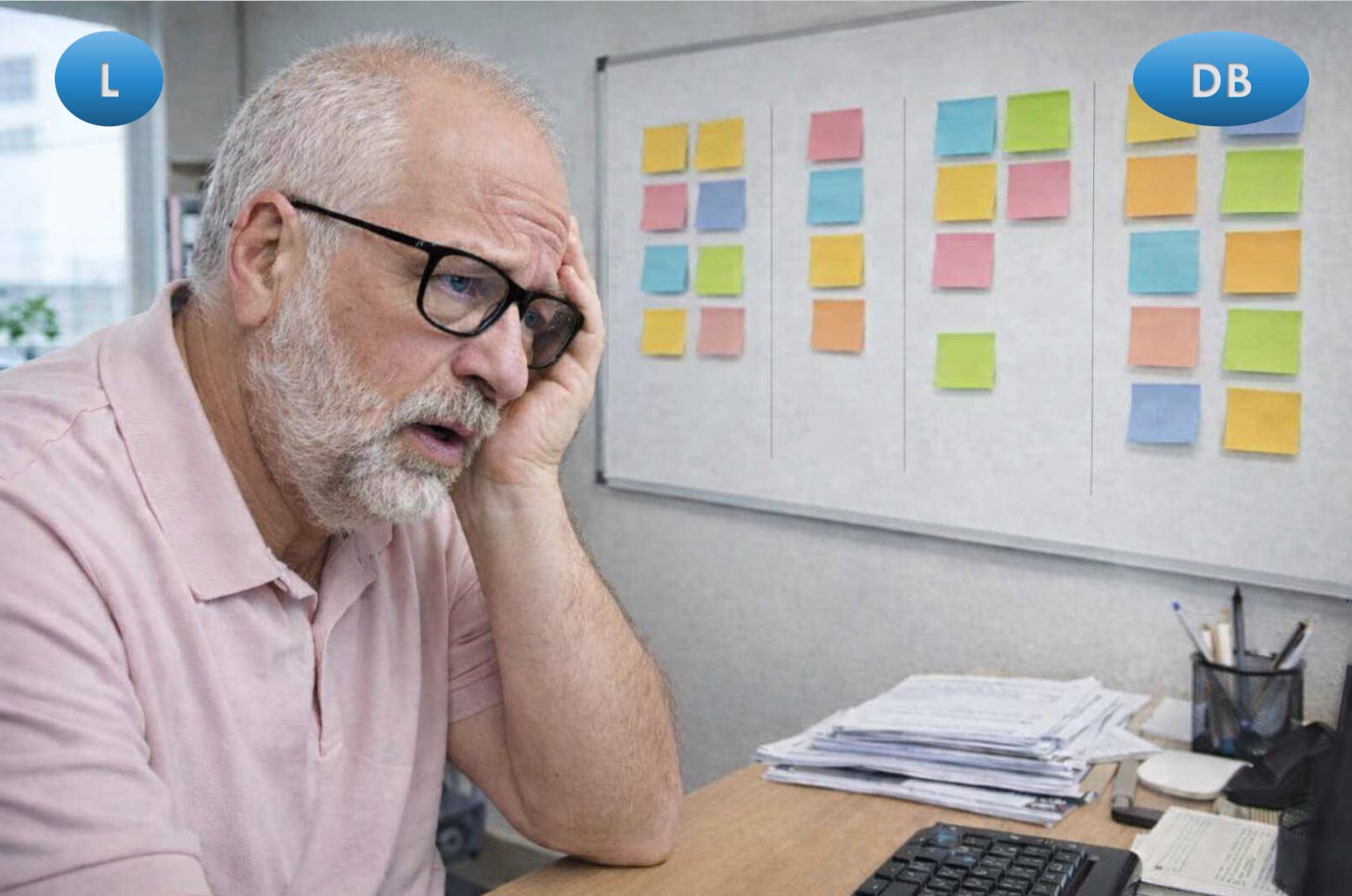
Sometimes you know exactly that something is wrong – and do it anyway.
Sounds familiar?
As Director for Entire Vehicle Development, I was responsible for three areas: vehicle concept and architecture, product documentation with the interface to the production system, and the processes in the product engineering organization.
We were in a crisis. Again.
The task was clear: Every division manager had to reduce headcount by x percent to cut the company’s fixed costs.
That put me in the usual dilemma.
Should I apply the watering can principle: cut everywhere a little and make the remaining people work more efficiently?
Or should I cut one activity entirely and let the corresponding people go?
I thought I was being clever.
I asked within the organization: Which of our activities would our internal customers be most willing to do without?
The answer surprised me:
“You have that team responsible for the Shopfloor method, don’t you. You can cut that. First, we can handle it ourselves – and second, Shopfloor is costing us an hour every week that we’d rather spend working. We’d get more done.”
I brought the scenario to the management meeting for discussion.
Do we really want to do this?
Honestly, I was too much of a coward to take responsibility for the decision against the proposal myself. It would have meant: all remaining employees in all line functions would have to work more.
The feedback was loud and clear: Do it. Best solution. Hardly any consequences.
Hardly any consequences?
I had some bad days after that.
I still remember exactly the meeting where I had to tell the team. It feels like it was yesterday. Some things you never forget.
At first: none at all.
The people landed well. Outstanding colleagues, found new roles without any problems. Some went on and had a very impressive careers.
But five years later:
• All projects are permanently in the red.
• Schedule delays have become the norm.
• Every project ends in a task force.
• And in that task force, as if by coincidence, Shopfloor Management suddenly starts happening.
Some structures only reveal themselves as irreplaceable once you’ve abolished them.
What did I learn from this?
Shopfloor Management is not a nice-to-have. It forms the foundation on which work flows and results emerge.
A second lesson: It requires dedicated resources. Concrete, qualified people who take care of the process.

ToDo Management is a core component of my Pomegranate Tree Model. It grew directly from my Shopfloor experience.
It is the fourth and therefore lowest level of the system. This is where concrete planning and execution happen.
The levels above derive meaningful goals, prioritize them, and put them into a timeline.
The ToDo level delivers them.
In the pomegranate, the seeds represent the ToDo’s.
They embody the real value – they carry the flavor. They are the reason we buy and eat the pomegranate.
The ToDos generate the substance, the content. This is where the work gets done.
ToDo Management shares a lot with Scrum from the agile project world – but also a lot with Shopfloor Management from Lean Management.
The idea is simple and clear:
Define the concrete approach to achieving the set goals, given the available resources, time, and competencies – and execute it within a short given time frame.
Then tackle the next stage.
Even within this short time interval, the four DCVI stages apply.
Definition: Planning, who does what by when.
Creation: The work gets done.
Validation: The result finds confirmation in the team.
Implementation: The results are handed over to those who need to work with them.
The Creation phase takes the longest. Definition, Validation, and Implementation happen quickly.
But that must not lead to skipping these stages or treating them as trivial.
Even if they can be completed quickly, their purpose must be achieved – otherwise the required efficiency effect never materializes.
My opening example made that clear.
Simply working away on your own does not lead to stable results.
Let’s set out some rules that must be followed if we truly want to achieve our purpose:
The ToDos are aligned with the Drum Beat deliverables.
The result is fixed.
The path to get there is flexible.
This is probably one of the most demanding rules in the entire framework.
Following it requires a great deal of creativity, accountability, and willingness to take risks.
I’ve heard it all too often:
That won’t work,
I can’t do that,
there isn’t enough time!
The fight for goal achievement is rarely a walk in the park.
In most cases it requires willingness to compromise, going the extra mile, or accepting a risk and taking responsibility for it.
And precisely because this is so difficult, a moderator is needed.
Someone must help the team work out these compromises from a neutral position and find a way forward.
And often the boss simply has to step in and shoulder at least part of the responsibility.
ToDo Management takes place in the organizational unit that also bears the responsibility for execution.
This is a fascinating aspect I’ve already written several articles about, and will probably write more.
In matrix organizations, responsibility should be clearly assigned.
1. The project bears responsibility for achieving the project goals.
2. The line organization bears responsibility for ensuring work is completed with the right quality and on time.
Since I look at not only projects but everything else the organization needs to accomplish with ITEM Management, organizational ownership becomes even more critical.
The team plans together everything it needs to complete in the next period.
And that across all projects and ITEMs from which contributions toward the agreed results are required from the team.
The line manager bears and shares the responsibility jointly with the team. All activities are integrated and aligned with available resources.
Contributions from others must be identified and coordinated in time.
That’s why planning happens in a coordinated way – everyone at the same time. Not each person at some point on their own.
Here I want to address a rule I long considered self-evident, but which perhaps hasn’t always been understood that way more recently.
Everyone is personally responsible for organizing the contributions they need from others.
What do I base that on?
Well, over the years I’ve heard statements like these all too often:
The project manager needs to make sure the colleagues finish everything I need on time.
Or: I put it in the plan for the colleagues, if they don’t do it, that’s not my fault.
Or: It was obvious I needed that, it’s always been this way, I shouldn’t have to explain it to anyone.
Everyone is the project manager of their own areas of responsibility.
That doesn’t mean doing everything yourself, but you must ensure everything is organized.
In ToDo planning, that means making sure tasks are either included in colleagues’ plans or that compromises are found when things don’t work as hoped.
At the end of the ToDo sprint, results are shared across the team.
How detailed this review is in any given case must be decided in context.
The goal: everyone knows what they need to know so the next stage can start meaningfully.
Important: No decisions are made during the results review, and results are not evaluated here. If that’s necessary, it must be done beforehand.
This moment is solely about bringing everyone to a shared level of knowledge.
The results must, where necessary, be passed on beyond the boundaries of the organizational unit. What’s finished must also arrive where it’s needed.
I shouldn’t have to say this – but I’ve heard it far too often:
“I’m done, but I don’t have time to report it as done.”
Listen: you’re not done until the person who needs your result has accepted it and started working with it.
Whether you’re not yet done or your finished result is collecting dust in your desk drawer makes no difference to the organization!
It sounds absurd. But the problem is real. So please – pay attention to this.
Professional execution requires trained personnel to be available.
My view: above a certain size, an organizational unit should have a small number of highly qualified people dedicated to this role.
I also accept the model of using employees who take on this task as part of their working time. That has the advantage of having more people who are more deeply integrated into their respective organizational units.
In both models, the necessary time must be planned and invested. No placeholder titles, please.
Believe me: the time invested here pays back many times over in the efficiency of the entire organization.
Don’t make the mistake I once allowed to happen.
Every method must be continuously trained, executed, improved and consolidated. Stop doing that, and the method simply disappears one day.
Organize these employees as a tight-knit team that builds its own identity around keeping ToDo Management running efficiently and at a high operational level in the organization.
Yes, this applies to small companies too! No company is so small that it can afford to work without structure.
ToDo planning starts with a planning meeting.
The team plans together for the next sprint. For this, it uses an IT tool in which the backlog is maintained and progress and results are documented.
The planning stays short and focused. Ideally one hour. In my experience, two hours is more realistic if you truly want to arrive at a solid plan.
It depends on team size. My recommendation: no more than ten people. Five is ideal.
The cadence: weekly. Either at the start of the week or at the end of the previous week.
Contributions with other organizational units are coordinated by the responsible parties on their own initiative before the planning session. Not during the meeting. Before!
After planning, everyone works on their ToDos and updates progress continuously. A brief status update at the end of each day. That sounds like a lot. It takes two minutes.
At the end of the week there’s a short check-in. Everyone reports briefly: What’s been completed.
That way the whole team knows what’s happening.
Absolutely.
I’m a strong advocate of department meetings where the manager discusses with the team the things that need their attention. I’ll examine how often these meetings should take place in a dedicated article.
In this meeting, there should be a brief look at how ToDo Management is running.
A simple set of numbers is enough: How many ToDos were planned? How many completed? Where are the problems?
I know: some will now say this is micromanagement. The boss should trust, not control.
But I was a manager long enough to say this with conviction:
There is nothing more uncomfortable than not knowing whether your team is performing or heading straight for a crisis.
Do your boss the favor of showing them everything is running well. And if there are problems: use the meeting to inform them before they hear it from somewhere else. Or ask for their support. A good boss won’t turn that down.
Shopfloor Management and ToDo Management are not bureaucracy. They create the structure that makes results possible in the first place.
As the fourth and lowest level of the Pomegranate Tree Model, this is where the actual substance – the content of the work – is created. This is where the value that drives the company’s success is generated.
ToDo Management follows rules and has a structured, defined approach that is carried out with discipline and professionalism.
To keep the method alive, the organization needs appropriately qualified people who have made this topic their own – people who continuously develop the method further and help colleagues apply it correctly.
And: The manager can and should know how things are going. Transparency protects everyone, which is why they must be involved in ToDo Management.
Do you have questions or your own experiences with ToDo Management? Feel free to write in the comments or send me a message.
In the next article I will go into operative detail again and explain, using my database, how everything can work in very concrete terms.
If you dont want to miss it, please subscribe to the newsletter.
If you found this article helpful, don’t forget to share it with others who might enjoy it too!
Comments
Nothing yet. Say the first thing.
Sign in to join the conversation.