
By Kathryn Dunn Tenpas and Chris Piper
The recent departure of Labor Secretary Lori Chavez-DeRemer, along with the firings of Attorney General Pam Bondi and Homeland Security Secretary Kristi Noem, mean that three members of President Donald Trump’s cabinet have lost their roles in just 46 days. They also represent three of only five female cabinet secretaries in the second Trump administration. Linda McMahon, secretary of education, and Brooke Rollins, secretary of agriculture, are the last standing female Cabinet secretaries.
With no movement in Trump’s cabinet during the first year, one might have assumed that the president had learned from his first administration that high rates of turnover caused instability and ultimately undermined his first-term agenda. However, the early departures in the second year now saddle Trump with the second-highest level of cabinet instability (going back to Ronald Reagan)—second only to himself (2017-18). At this point in his first administration, Trump had lost four cabinet secretaries.
Data on Trump’s “A” Team, or senior staff within the Executive Office of the President, paint a similar picture. Turnover at the end of 2017 was a record-setting 35 percent and in 2025 the level was 29 percent, the second-highest rate. So, while there is a perception that the second Trump administration is more stable than the first, that is true only on the margins. Turnover remains quite high relative to his predecessors.
The turnover picture is only half the story, and while executive office staff do not require Senate confirmation, roughly 1,300 jobs across the executive branch do. In the past year, the administration’s capacity to fill vacancies has steadily declined. In the roughly 12 months since the end of the president’s first 100 days (April 30, 2025 to April 26, 2026), the pace of nominations has dropped off significantly—the lowest of any president going back to Reagan. Trump’s nominations in the period between the 100th day and now (201) are less than half the historic average between Reagan and Biden (451).
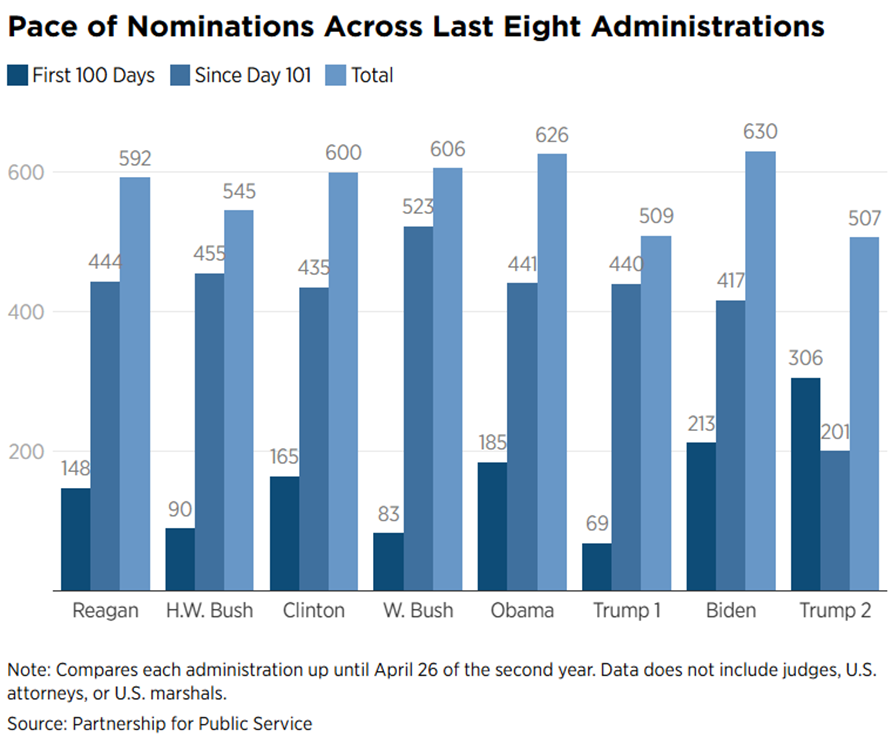
Typically, the pace of nominations increases over time, but as of April 26, 2026, Trump has made the fewest nominations (507) since Reagan—even fewer than in his first administration (509). Put more starkly, Trump has made more than 100 fewer nominations compared to Presidents Joe Biden and Barack Obama.
The impact of declining nominations will likely have ripple effects across the executive branch, as thousands of government employees will be working in departments and agencies with temporary leadership. Such a situation limits long-range planning and cross-agency collaboration and can create unnecessary anxiety and lower job satisfaction.
More importantly, critical roles remain vacant with no nomination in sight. Trump has yet to nominate an administrator for the Federal Emergency Management Administration, a director of Immigration and Customs Enforcement, an administrator of the Transportation Security Administration, or an undersecretary for food, nutrition, and consumer services to oversee critical agriculture department programs like the Supplemental Nutrition Assistance Program.
Additionally, due to Trump’s record level of withdrawn nominations—the highest of any modern president—and the increase in turnover resulting from recent resignations or firings, many other prominent roles lack a nominee: the United States attorney general, labor secretary, the deputy secretaries of education and treasury, and the commissioner of the IRS—all consequential, critical positions in the federal government.
If data going back to President George W. Bush is any predictor, staff turnover is only going to increase—and each departure adds to a vacancy pool that the nomination pipeline is already struggling to fill. Data show that turnover consistently increases in the second and third years of each administration. Given this trend, it is likely that vacancies will proliferate across the federal government. The lack of leadership will eventually limit the government’s capacity, creating opportunities for government failure, missteps, or an inability to provide critical services. In addition, unless Trump’s pace of nominations picks up, many key roles will remain vacant for lengthy periods and will be led by interim officials selected unilaterally by the president, without the Senate’s consent.
This scenario looks similar to the days of the first Trump administration when the president referred to parts of his leadership team as “my actings” and said the use of acting appointees gave him “more flexibility.” If past trends hold, temporary leadership will become the rule rather than the exception across wide swaths of the executive branch.
The White House Office of Presidential Personnel is the government unit best positioned to unclog the nominations pipeline. This office must quickly and capably find successors for key White House positions and, more importantly, identify and vet appointees so that their nominations can be sent to the U.S. Senate. The inability to do so will ultimately undermine the president’s agenda and compromise his performance.
Kathryn Dunn Tenpas is a Miller Center senior fellow. She is the director of the Initiative on Improving Interbranch Relations and Government and a visiting fellow with Governance Studies at the Brookings Institution. She is also an advisory board member of the White House Transition Project.
Chris Piper is a manager of public policy and stakeholder engagement at the Partnership for Public Service, a nonpartisan nonprofit dedicated to building a more effective federal government. He is also an adjunct professor at George Washington University.
Comments
Nothing yet. Say the first thing.
Sign in to join the conversation.