
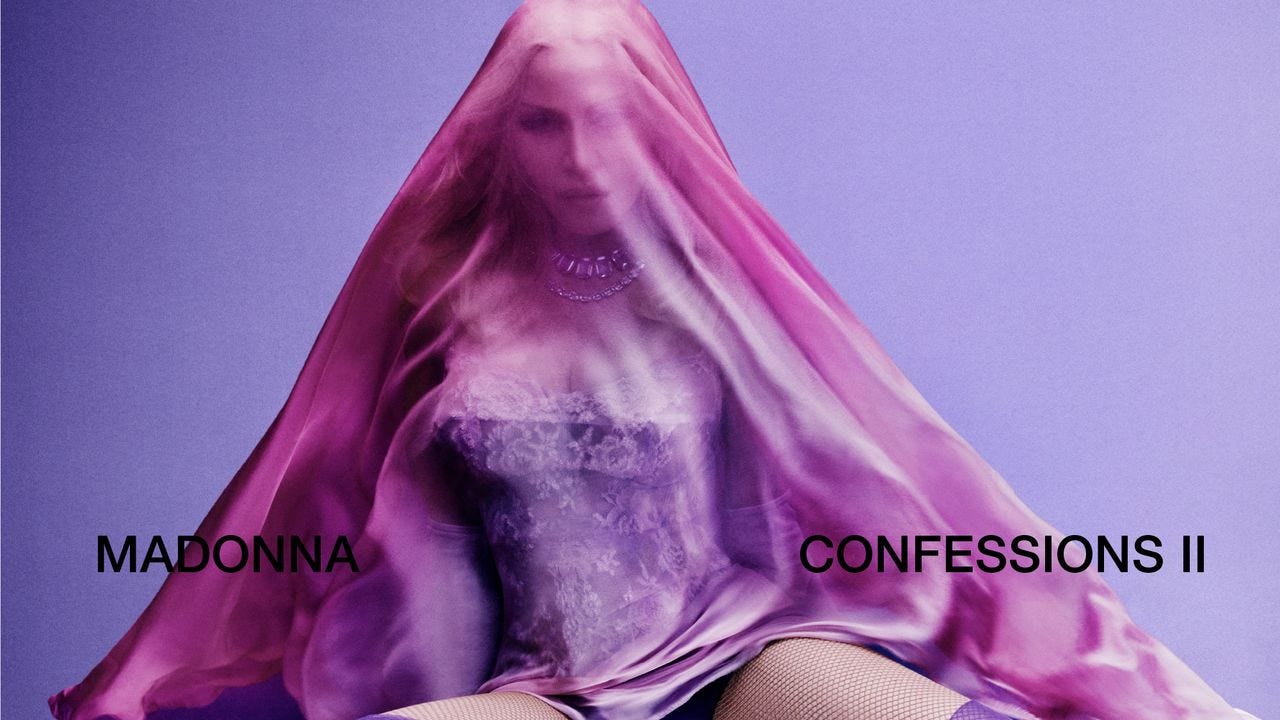
Confessions II (2026) is here and it’s time to address it.
Madonna is a tricky one to talk about for a variety of reasons. While still obviously huge, the mythology surrounding her has arguably been eroded by a pseudo-cultural literacy defined by recency bias. Or, in simpler terms, people don’t want to like her. For good and bad reasons. So they dismiss her as an unimportant piece of pop culture despite all evidence and ignore direct references to her output. Her influence is so pervasive through popular music that it is impossible to extricate her from basically all genres.
You like Sabrina Carpenter’s bawdy sexuality and willingness to tackle political themes through a personal viewpoint? Madonna.
You like Taylor Swift’s penchant for spectacle and her ability to swing between big pop choruses and confessional songwriting? Madonna.
You like Cardi B and her highly sexed persona that maintains an inherent dignity and self-possession? Madonna.
Every single pop star (and beyond) who has debuted in the past forty years owes at least a little something to Madonna. While cultural commentators have rightfully placed her in context of artists who came before her like Donna Summer, Diana Ross Cher, the truth is what Madonna didn’t invent, she almost certainly popularised. Her contemporaries looked to her for inspiration and their successors looked to her for direction. We live in the world she built.
But she’s now looking backwards. Which isn’t a novel concept.
Comments
Nothing yet. Say the first thing.
Sign in to join the conversation.