
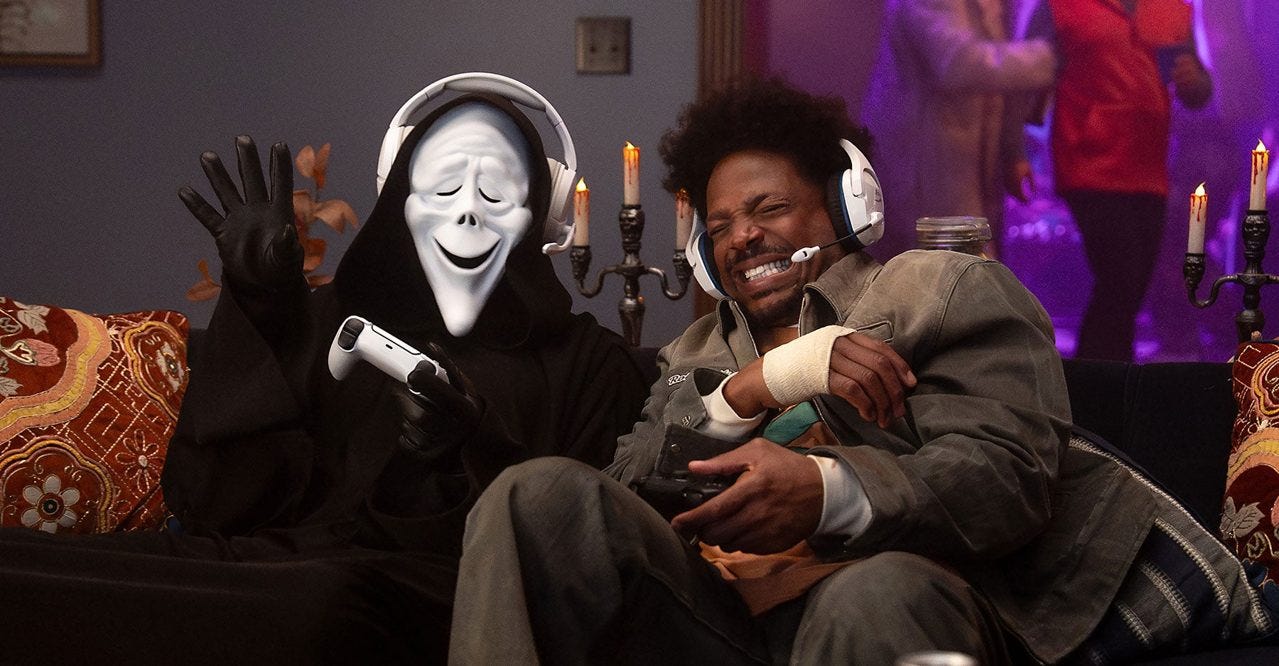
I did not want to see Scary Movie (2026) for a variety of reasons. The main of which was that, as an adult with at least the facsimile of taste, 2000s parody films are some of the worst things I have ever seen. Yes, I have laughed at some of the jokes. That does not negate their general lack of quality.
But also…I’m a little unclear on what the Wayans brothers were going to bring to the table in 2026. The answer is, apparently, a point of view. One which goes back to the original Scary Movie (2000) - something I think people forget.
Scary Movie as a franchise is primarily a compilation of references as jokes. In ninety minutes the original film pokes fun at Scream (1996) and I Know What You Did Last Summer (1997), with references to then-current cultural touchstones like The Matrix (1999), Kazaam (1996) and American Pie (1999). It is silly and tacky in the way comedies of the era are, but with a production sheen that set it apart from the imitators to come out later in the decade.
I’m not going to explain or list the jokes that work. This is not a listicle of the funniest moments in Scary Movie. But what I will say is, you can tell that Keenen, Shawn and Marlon Wayans are more skilled and funnier than any of their imitators and surrounding parody based comedians. The “wazzup” scene, so often repeated by goofy men trying to have a personality, would not be nearly as funny if they hadn’t thought to change the expressions in the mask without drawing attention to it. It’s a joke, but not the joke. That simple choice is extremely fun and works without being a direct reference to the original film. The punchline preempts the parody. By contrast, the awful Shriek If You Know What I Did Last Friday the 13th (2000) is littered with writing that falls flat because it is more concerned with referencing than telling a joke.
The Wayans framed Scary Movie primarily around the absurdity of the Scream franchise. By the year 2000, Scream was already self-cannabalising as the premise butted against it’s own success. The third Scream film, that I covered in 2023, was released just five months before Scary Movie and was referenced in the final product. The film thawed the icy remove of the first two instalments to make something distinctly human and tragic. It also looked out at the landscape of the genre with discomfort. Scary Movie, by contrast, finds the outcomes of people trying to repeat the success of Scream to be hilarious.
“Scream was what you call an “unfunny spoof”…it just said some things. We’re doing the things that Scream thought about doing but didn’t do.” - Marlon Wayans, 2000
This is how Marlon Wayans explained the film’s philosophy in a 2000 behind-the-scenes featurette for the DVD. The crux of the premise, and the explanation the film gives, is that it exists to take the satire of the original film and expand it to cover what genre conventions it had to allow to take exist as a sincere narrative. Keenen Wayans, in this same featurette, explained that the film could not repeat the jokes of Scream, which led to the often wacky subversions of the original subversions. Scary Movie layers on genre jokes, pop culture references, and stand alone jokes with a deftness that obfuscates how hard that is. Even if the film itself isn’t for you, it is easy to tell that it is well-crafted. The climax, with Bobby and Ray explaining their motives do not make sense, bluntly outlines all of this. Those movies do not make sense, and so this one does not either.
But time has embittered the film’s creators to the Scary Movie franchise and the genre it parodies. Contract negotiations with Miramax ended in the franchise being handed over to famed parody director David Zucker, who took the franchise and gradually shifted to a less specific (and less funny) direction. Much like the original Scream franchise issue of genre rot, these new parodies existed within a comedy environment that was directly inspired by Scary Movie. Zucker had made successful comedies and parodies before, but his wackier sense of humour did not jive with the Scary Movie archness that underpinned the humour. The jokes got lazier and whatever commentary was there flattened under the need to cram in the references.
The Wayans Brothers, meanwhile, all continued to establish comedic identities together and apart. They moved through television and film with an easy confidence and eventually had enough clout (and nostalgia) on their side to take back their franchise. Scary Movie (2026) returns to these established roots. But…with a bone to pick. So I have to ask…is Scary Movie a Black franchise?
It is certainly backed by Black creatives. The Wayans brothers are Black. Outside of them there is Regina Hall, one of our great comedic (and dramatic) actresses, who was incredibly early into her career when cast as Brenda Meeks. Keenen Wayans became immediately established as one of the most successful comedy directors, Black or otherwise, with the film’s success. A 2001 Newsweek review of Scary Movie 2 (2001) described Keenan as “the most successful black director in history” without any caveats. In a 2026 interview promoting the film on Shannon Sharpe’s Club Shay Shay podcast, Marlon Wayans spoke on this success as breaking a glass ceiling of what differentiated “black success” for filmmakers from more general success.
In many ways, that distinction is correlated with how the film is spoken about in a wider cultural context. A Black director should not indicate an intended audience, and Scary Movie is loved by many. Maryann Erigha in the Journal of Black Studies (Vol. 47, No. 6, SEPTEMBER 2016) places Keenen’s direction of Scary Movie (2000) in the context of Black directors leading franchise instalments, rather than specifically “Black” ones. It is in conversation with films like Tim Story’s Fantastic Four (2005) and Angela Robinson’s Herbie: Fully Loaded (2005) as exceptions to a trend where Black filmmakers are excluded from these high profile opportunities. That might speak to a wider truth. But it is important to note that Keenan’s ownership of Scary Movie and the Wayans’ original pitch for the first three films (of which they only helmed two) are the foundations of the franchise. The films exist in the context of these Black creatives and their presence is felt even past their involvement.
Scary Movie (2000) featuring Black characters at all was notable for the times. Their presence was, in it’s own way, subversive of the slasher as a rarely integrated sub genre. The films certainly didn’t stop playing with the juxtaposition of references to Blackness within a very white genre. Brenda continued to be a pillar of the films until the fifth instalment, and is regularly referenced online as a pivotal part of the franchise’s memorability. The scene were Cindy Campbell (Anna Farris) has a black husband in Scary Movie 4 (2006) goes viral with semi-regularity. The “rap battle” scene in Scary Movie 3 (2003) includes several real life Black musicians and rappers like Master P, Macy Gray, and Method Man, along with the presence of Queen Latifah as the Oracle. While this type of joke is obviously not new to lazy comedies, many of these choices do feel like (bad) attempts for the franchise to remain cohesive with the creatives who had once lead Scary Movie. Maybe these are just lazy jokes that use race as a punchline. But they, in context, feel intentional to the wider franchise at please. If not a “Black franchise”, Scary Movie is indebted to the Wayans and their specific brand of humour.
All of this is why the climax of Scary Movie (2026) feels so oddly poignant. Shawn and Marlon Wayans team up to figuratively and literally take back the franchise in it’s final moments. The film both parodies and rejects the notion of the Scream franchise to replace the cast with younger actors in similar roles, ending with a burning of all but the necessary elements of the franchise. Amongst the bodies are Anthony Anderson and Shaquille O’Neal, who are both executed as traitors for participating in non-Wayans helmed instalments. The original quartet are reunited and Scary Movie has metaphorically cleansed itself of over two decades of tension and drama.
The film itself is a pretty direct parody of Scream (2022), which sought to reboot the franchise and shift the focus to a new cast. This choice was ultimately aborted in the most recent (and poorly reviewed) instalment as a result of behind-the-scenes drama, most of which was political and reflects poorly on Spyglass Media Group. But in that mess comes Scary Movie, which reflects that chaos into it’s own film. It is an interesting and ultimately effective choice to tie the film to a real world narrative, which (maybe unintentionally) mirrors how horror films built off IP tend to mirror and distort real world conflicts.
That all suggests that the film is particularly deep. It’s still Scary Movie. It would be dishonest to suggest the film is anything other than fine. The jokes are still crude, the writing for the first two acts is often lazier than you’d want, and the culture war stuff (an extended murder sequence for a non-binary character in particular) feel weirdly mean spirited. But what sets it apart from itself and the wider comedy and horror landscapes is the meta narrative that the Wayans brothers get to play with. If the first film differentiated itself by actually having a point of view, that spirit returns in 2026. The Wayans are back. Let’s hope they can keep it this time.
No posts
Comments
Nothing yet. Say the first thing.
Sign in to join the conversation.