
The new ban on fatbikes in Vondelpark coming into effect in May is the latest example of policies which will fail to have the desired impact of improving safety and inclusive mobility. We suggest alternative policy options which approach the issue from a different perspective.
Fatbikes, a form of e-bikes nicknamed after their wide tires, have been the subject of intense debates and media scrutiny recently, especially in Amsterdam. They have become wildly unpopular with certain road users, media outlets and politicians. Conflicts have arisen between fatbike users and other cyclists, as well as with pedestrians and drivers. As such, municipalities across the Netherlands have been trying to implement different policies to restrict the use of fatbikes. However, these policies fail to address the issue meaningfully, and cities would be better off approaching the issue from a different angle.
Part of the reason for this animosity is a conflict of speed: fatbikes are seen as going too fast. This can be true, as some bikes are illegally souped-up to reach speeds above 25km/h. Due in part to a lack of enforcement, the few that are modded have come to represent all fatbikes in the eyes of some, making all fatbikes unfairly stigmatised.
Fatbikes have also proved difficult to target with regulation. The Ministry of Infrastructure has stipulated that local councils are not allowed to differentiate within the legal e-bike category, and several studies have shown that creating a separate category for fatbikes based on tire width is pointless, as manufacturers can adapt them so that they avoid this label.
The demographics associated with fatbike users also feeds into the stereotyping and negative perception of these bicycles. Fatbike use is often seen among individuals from ethnic minority backgrounds and young teenagers, groups which are more frequently demonised in media, and this has resulted in reporting on and perceptions of fat bikes that is rooted in stigma.
In response to this negative storm, the municipality of Amsterdam has recently taken the decision to ban fatbikes, which they defined as electric bicycles with tires wider than 7 cm, from cycling through Vondelpark, a ban which came into effect on 11th May 2026. This comes against a backdrop of similar bans sweeping the country – the town of Enschede became the first town to ban fatbikes in its city centre (in March 2026), and Utrecht city council is said to be planning a similar ban.
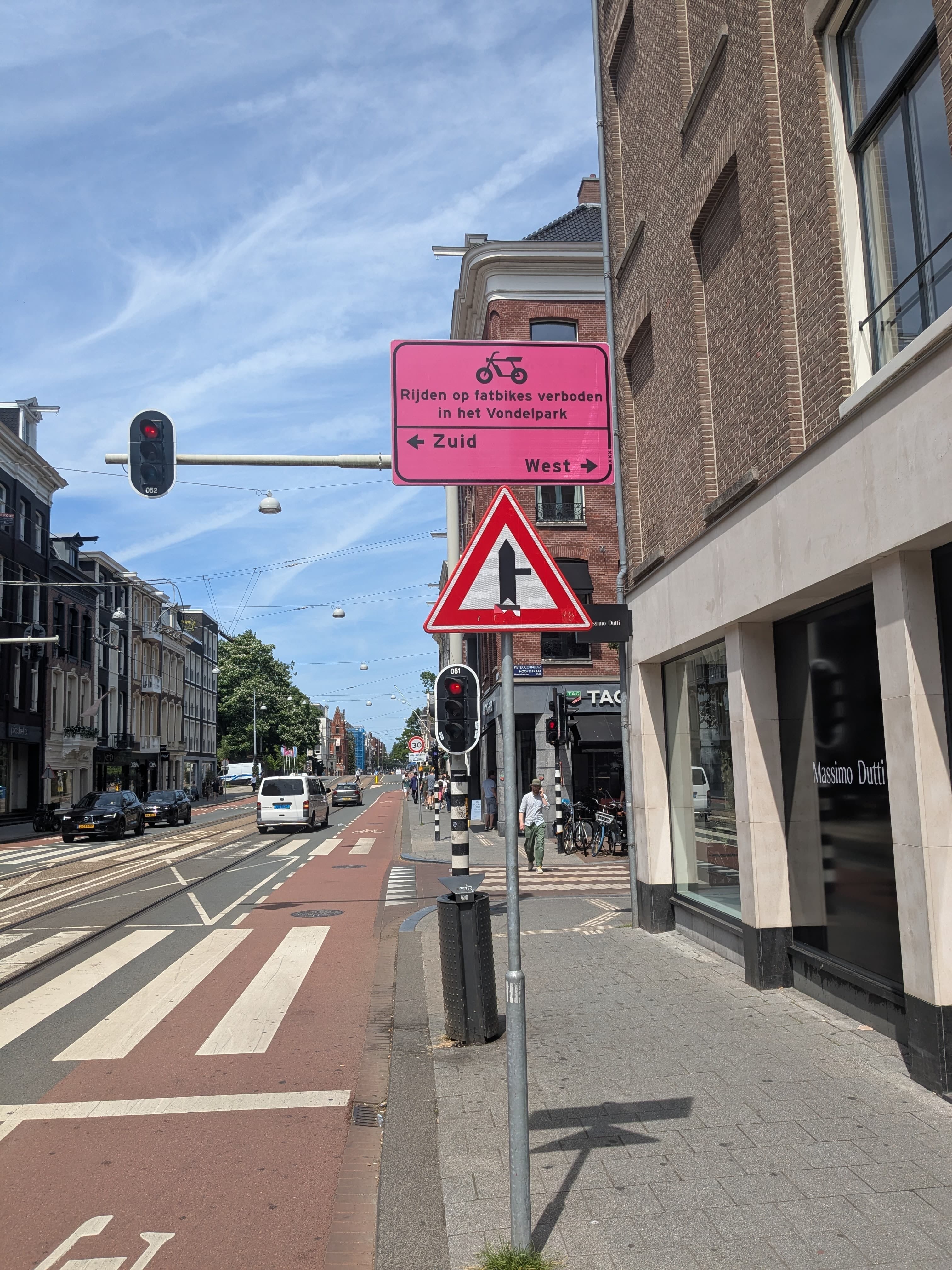
This move by the city of Amsterdam comes as a direct response to Vondelpark users reporting a number of incidents of nuisance and hazards related to fatbikes in recent times. The municipality will monitor the effects of the ban for a few months, and then decide whether it can be extended to other locations in the city. The ban is being implemented via an amendment to the General Local Ordinance (APV), which allows the city to take action independently of the national government.
But it remains to be seen whether this policy of exclusion is going to have the desired effect of improving safety and reducing conflict – or whether it will reinforce divisions within the city, and contribute further to the demonisation of fatbikes and their users.
There are four key reasons why: it is too heavily influenced by media; it is inequitable; it will be ineffective; and it does not consider the mobility benefits that fatbikes provide.
Instead of grounding decisions in evidence-based research, policy has been shaped largely by negative media coverage and social tensions surrounding fatbike use. There is a dominant narrative framing fatbikes as a public nuisance and a threat to safety, reinforced by widespread media coverage of accidents and illegal souping-up to increase speed. Fatbikes have also been framed in direct opposition with the traditional Dutch cycling ethos, which further erodes their legitimacy with the public. The fact that the ban is in Vondelpark, where there have been a high number of complaints by the public, highlights how heavily popular opinion has influenced this policy.
This selective view influencing the policy also makes it inequitable, as the perspectives of fatbike users have been marginalised, leading to a one-sided and ineffective result. The policy-making approach, whereby the municipal council can pass the regulation through the APV, is such that fatbike users were not consulted as part of the decision.
Secondly, by restricting access to Vondelpark, a key thoroughfare and central hub for activity in the city, the policy risks increasing social divisions and exclusions. It thereby risks stoking the flames of the tensions surrounding fatbikes. Indeed, the potential for this was acknowledged by the GroenLinks party, who were initially critical of a ban on fatbikes in certain areas, saying that it could have a “stigmatising” effect. In addition, since Vondelpark is in a socioeconomically wealthier area of Amsterdam, and was previously a place only for the rich of Amsterdam were allowed to access, this policy has the potential of entrenching division along existing class lines and uncomfortably harking back to that era.
A further deficiency is that the policy does not address the core issue with fatbikes, which is that they are sometimes souped-up to ride too fast. Expulsion from Vondelpark does not address this problem, and instead it may exacerbate conflicts by increasing congestion on the residential roads around Vondelpark. Therefore it will not necessarily lead to a safer overall environment for road users, despite the absence of clear speed and safety regulations for fatbikes being what undercut public support for fatbikes in the first place.
Lastly, this policy is not addressing the reasons why people use fatbikes. Firstly, fatbikes are filling a gap in mobility options: they are both more affordable than scooters and cars, with prices starting around €500, and they offer a larger range of distance covered compared with regular bicycles, allowing suburban residents to access the city centre more easily. Another reason why fatbikes are popular is practicality – their robust size allows users to carry more items such as groceries etc. on the back of their bikes. Finally, the “cool” factor of fatbikes makes them popular among youth and other users, who have historically neglected the bicycle. The ban therefore disproportionately affects those who may only cycle in large part because they have fat bikes – otherwise they may resort to driving cars. Without acknowledging and accounting for these benefits, the policy has set itself up for failure.
Alternative policy solutions need to take into account these mobility benefits, but must also be effective, equitable and inclusive. As such, one option is to adjust street design to account for fatbike users. Bike paths in busier areas could be made wider to facilitate overtaking with these wider vehicles more safely. Since this is already the nature of policy-making for cars, with street design adjusted such as through the width of streets and speed bumps to ensure that they drive slower, this could also work effectively when applied to fatbikes. Furthermore, there are co-benefits to widening bike paths as riders of cargo bikes as well as users of mobility scooters and families cycling together would also benefit from added space.
Another option is to invest in advertising mechanical bicycles in a way that matches the “cool” factor of fatbikes, to appeal to young users that are currently drawn to fatbikes, such as through street art initiatives, promoting bicycles as sport (such as BMX), or ad campaigns which feature and target younger audiences. Finally, education could be improved on safe cycling for younger groups, as well as for some communities who may not feel as comfortable cycling mechanical bicycles. This could include expanding education in schools on how to ride e-bikes and fatbikes safely, not just mechanical bicycles, and widening access to cycle safety courses for older users by directing municipal funds towards existing independent initiatives. This would encourage a culture whereby anyone can feel safe to get on a bike, both for themselves and for others.
Policies like this aim to better balance safety, mobility access and equity through regulation of fatbikes, but, when ill-informed, can have the opposite effect. Therefore, it is crucial that policymakers consult fatbikes users and ensure that their views and mobility needs are reflected in policy.
Do you have an opinion on this ban? Has it affected how you move in the city? Share your thoughts with us in the comments!
Read next:
Amsterdam.nl. (2026, May 7). Fatbike verboden in Vondelpark. https://www.amsterdam.nl/nieuws/nieuwsoverzicht/fatbike-verboden-vondelpark/
Amsterdam.nl. (n.d.). Vondelpark. https://www.amsterdam.nl/leefomgeving/parken-recreatiegebieden/vondelpark/
Bike City Amsterdam. (2024, January 17). Measures against souped-up fat bikes. https://bikecity.amsterdam.nl/en/measures-against-souped-up-fat-bikes/
Courrier International. (2026, April 13.). Mobilité : pourquoi le fatbike est devenu l’ennemi public n°1 aux Pays-Bas et en Belgique. https://www.courrierinternational.com/article/mobilite-pourquoi-le-fatbike-est-devenu-l-ennemi-public-n-1-aux-pays-bas-et-en-belgique_240980_1
De Kanttekening. (2024, May 2). De fatbike als motor van de vooruitgang. https://dekanttekening.nl/columns/de-fatbike-als-motor-van-de-vooruitgang/
DutchNews.nl. (2026, March 11). Enschede bans fatbikes from town centre despite legal concerns. https://www.dutchnews.nl/2026/03/enschede-bans-fatbikes-from-town-centre-despite-legal-concerns/
Glaser, Meredith. 2026. “Banned, Blamed, but Beneficial: The Fatbike as a Critical but Contested Enabler of Accessibility, Affordability, and Autonomy.” Urban Cycling Institute. https://urbancyclinginstitute.org/the-fatbike-as-a-critical-but-contested-enabler-prof-meredith-glaser/
JOU. (n.d.). Fatbikes: love it or hate it. https://www.jou.nl/themas/trending/fatbikes-love-it-or-hate-it
Klessens, M. (2025). Master thesis [Master’s thesis, Eindhoven University of Technology]. Eindhoven University of Technology Repository. https://pure.tue.nl/ws/portalfiles/portal/364393169/Master_Thesis_Mandie_Klessens.pdf
LEVA-EU. (2025, February 3). Research study questions the need for separate legislation on fat bikes. https://leva-eu.com/research-study-questions-the-need-for-separate-legislation-on-fat-bikes/
“‘Mama Agatha’ Gives Cycling Lessons.” Holland.com, Netherlands Board of Tourism & Conventions, https://www.holland.com/global/tourism/get-inspired/bring-yourself/mama-agatha-gives-cycling-lessons . Accessed 10 June 2026
NL Times. (2025, December 5). Utrecht city council backs plan to ban fatbikes in city. https://nltimes.nl/2025/12/05/utrecht-city-council-backs-plan-ban-fatbikes-city
NOS. (2024, February 19). Amsterdam voert toch fatbikeverbod in: PvdA en GroenLinks overstag. https://nos.nl/artikel/2603161-amsterdam-voert-toch-fatbikeverbod-in-pvda-en-groenlinks-overstag
NOS. (2025, April 1). Amsterdam kiest voor fatbikeverbod in Vondelpark, verbod geldt vanaf mei. https://nos.nl/artikel/2608729-amsterdam-kiest-voor-fatbikeverbod-in-vondelpark-verbod-geldt-vanaf-mei
Het Parool. (2025, December 18). Amsterdam plans to ban fatbikes from parks: Vondelpark set to be first — “It’s time for unorthodox measures”. https://www.parool.nl/international/amsterdam-plans-to-ban-fatbikes-from-parks-vondelpark-set-to-be-first-it-s-time-for-unorthodox-measures~b43241af/
SkipperJack Amsterdam. (2024, June 12). The Vondelpark. https://skipperjackamsterdam.com/the-vondelpark/
Van Berlaer, T. (2026, February 18). ‘Fatbikes zijn stoer’: waarom de fiets met de dikke banden Vlaanderen verdeelt. Knack. https://www.knack.be/nieuws/belgie/fatbikes-zijn-stoer-waarom-de-fiets-met-de-dikke-banden-vlaanderen-verdeelt/
VeiligheidNL. (2026, February 4). Niet de fatbike, maar de snelheid vraagt om beleid. https://www.veiligheid.nl/themas/verkeersveiligheid/blog/niet-de-fatbike-maar-de-snelheid-vraagt-om-beleid?_gl=1*1uof5de*_up*MQ..*_ga*OTQ1Mzg2MDMuMTc3ODI0MTU2Mg..*_ga_RFJ7YRGMBP*czE3NzgyNDE1NjIkbzEkZzAkdDE3NzgyNDE1NjIkajYwJGwwJGgw
No posts
Comments
Nothing yet. Say the first thing.
Sign in to join the conversation.