
Upward Growth is a health plan market advisory firm. Our weekly newsletter covers payor market strategy, regulatory shifts, and go-to-market insights for health tech vendors, investors, provider organizations, and consultancies competing in the health plan market.
🤝 Work with us on payor market strategy: Contact me
🟦 Connect with the author, Ryan Peterson, on LinkedIn.
🎧 Listen to the Upward Growth Podcast: Apple | Spotify
📰 Newsletter sponsorships: Learn More
Every health tech company whose product touches a Medicare Advantage member is now contributing to its health plan customers’ Star Ratings. Most don’t know it yet.
Here is what one of those touchpoints looks like. A nurse practitioner sits at Bob’s kitchen table in suburban Tampa. Bob is 74. She has 45 minutes to complete a Health Risk Assessment (HRA), document hierarchical condition categories, and close two care gaps. She is kind, professional, and efficient. To Bob, she is also one of the only people from “the health plan” he has met all year.
Two years from now, when the Centers for Medicare & Medicaid Services (CMS) Health Outcomes Survey (HOS) arrives in Bob’s mailbox and asks whether his physical and mental health is improving, staying the same, or getting worse, that 45 minutes will sit somewhere in his memory, whether Bob can name the company that sent her or not.
The risk adjustment vendor that sent her doesn’t lead with Stars in any pitch. The touchpoint they just created is now an input into one of the fastest-growing measure categories in the 2027 Star Ratings calculation.
In the CY 2027 Final Rule (published April 2, 2026), CMS tripled the weight of two HOS measures (Improving or Maintaining Physical Health and Improving or Maintaining Mental Health) starting with the 2027 Star Ratings. By 2029, HOS, plus the Consumer Assessment of Healthcare Providers and Systems (CAHPS), will account for close to 40% of the total Star Ratings weight. The measures CMS removed are ones plans could fix with internal operations. The measures CMS elevated are ones plans can only move by reshaping the member’s actual experience over two years.
That experience is almost entirely a portfolio of vendor-delivered moments held together by an ID card. Whoever creates one of those moments owns a slice of what the member will remember about their plan when CMS asks. Your share of member memory just got more expensive to lose and more valuable to win.
You may have read the CY 2027 Final Rule, seen “Star Ratings,” and filed it away as someone else’s problem. It is now your problem.
🎙️Episode 2 of the Upward Growth Podcast is the audio companion to this article.
It introduces member memory as the vendor-facing lens for understanding what HOS is actually capturing, and walks through a four-stage progression every vendor should be running against their health plan customer relationships before the next renewal. Apple | Spotify | Web
Two things in the April rule look small individually and significant together. CMS removed 11 administrative and topped-out measures from Star Ratings, and CMS elevated the weight of the remaining survey-based measures. The directional message is a shift of relative weight toward survey-based and clinical outcome categories.
For HOS specifically, the two functional-status measures are now triple-weighted. Plans have three times as much riding on whether members report improving or maintaining their physical and mental health over the two-year survey cycle.
The broader pattern is consistent: CMS continues to refine Star Ratings by removing process-oriented measures and reinforcing the categories that capture how members actually experience care. That direction has been visible in CMS signaling for several cycles. The 2027 rule is the version that finally puts real Quality Bonus Payment (QBP) dollars behind it. Total QBP spending will reach at least $12.7 billion in 2025, more than quadruple the 2015 number, with the average plan earning roughly $400 to $500 per enrollee per year in bonus revenue. Every measure reweighting moves real money across plan P&Ls and across vendor budgets downstream.
Most health tech vendors read this rule, scanned for the line item that affects their product, found nothing, and closed the tab. Most risk adjustment vendors don’t lead with Stars. And most prior auth vendors don’t either. Care management vendors increasingly do, but mostly through the side door of HEDIS quality measures. Engagement platforms talk about member experience without connecting it to a specific Star Ratings measure with a dollar value attached.
That filing was a mistake. The measures CMS elevated do not sit inside any vendor’s product. They sit inside the member. The member is in regular contact with vendor-delivered touchpoints, whether the vendor recognizes it or not.
To understand why this matters for vendors who never thought of themselves as Stars-relevant, start with what HOS actually asks.
HOS is a longitudinal survey. CMS samples roughly 1,200 members per MA contract at baseline and resurveys the same members two years later. Has your physical health improved, stayed the same, or worsened? Has your mental health improved, stayed the same, or worsened? Are you able to do the things you used to do? Do you have help when you need it?
The detailed survey methodology and current measure documentation are available on the CMS HOS site. Three things about HOS matter for the rest of this article.
First, members are not asked about specific vendor encounters. HOS does not ask whether they liked their care manager, their meal delivery, their MSK program, or their prior auth experience. It asks about the overall functional trajectory over a two-year period.
Second, samples are small, and the data is anonymized at the plan level. No vendor can credibly point at a Star Ratings movement and say “we did that.” (Anyone selling that claim is selling something else…)
Third, the cohort is already in the field. CMS HOS Cohort 29 baseline samples are being collected through 2026, with the two-year follow-up landing in 2028 to feed the 2029 Star Ratings. Plans have roughly 16 months to influence the experience of members who have already been surveyed. That timing also explains why plans are tightening discipline across the entire vendor portfolio in 2026 and not just on Stars-specific programs. With margins compressing into 2027, plans are evaluating total value across every vendor relationship: product ROI, implementation effort, proactive partnership, and the member experience signature each vendor leaves behind. HOS is one input to a broader review already underway.
One boundary worth naming: providers carry the largest share of the clinical arc HOS measures. The PCP, the specialist, and the hospital drive most of whether the member is getting healthier. Vendors are not the whole story. But what vendors do carry are many of the recurring, memorable non-clinical interactions inside the two-year arc the survey is asking about, and that share is more than large enough to move HOS at the margin.
Outside of their doctor, what members remember most is the human who called them back, the meals that showed up, and the app that worked. Often, those are vendors.
That is the link vendors miss. HOS isn't measuring your product. It's measuring what happened to your health plan customer's members over two years. In the survey's eyes, your product and the member's experience are the same thing. Outside of their doctor, what members remember most is the human who called them back, the meals that showed up, and the app that worked. Often, those are vendors.
To understand which vendors are about to matter more to plan buyers, start with what members actually carry from one year to the next.
Members do not remember formulary decisions, claim adjudication, the PBM contract, or network adequacy. They remember a small number of concrete experiences across two years, and those experiences fall into four categories. Each category has its own vendor types, its own upside, and its own downside.
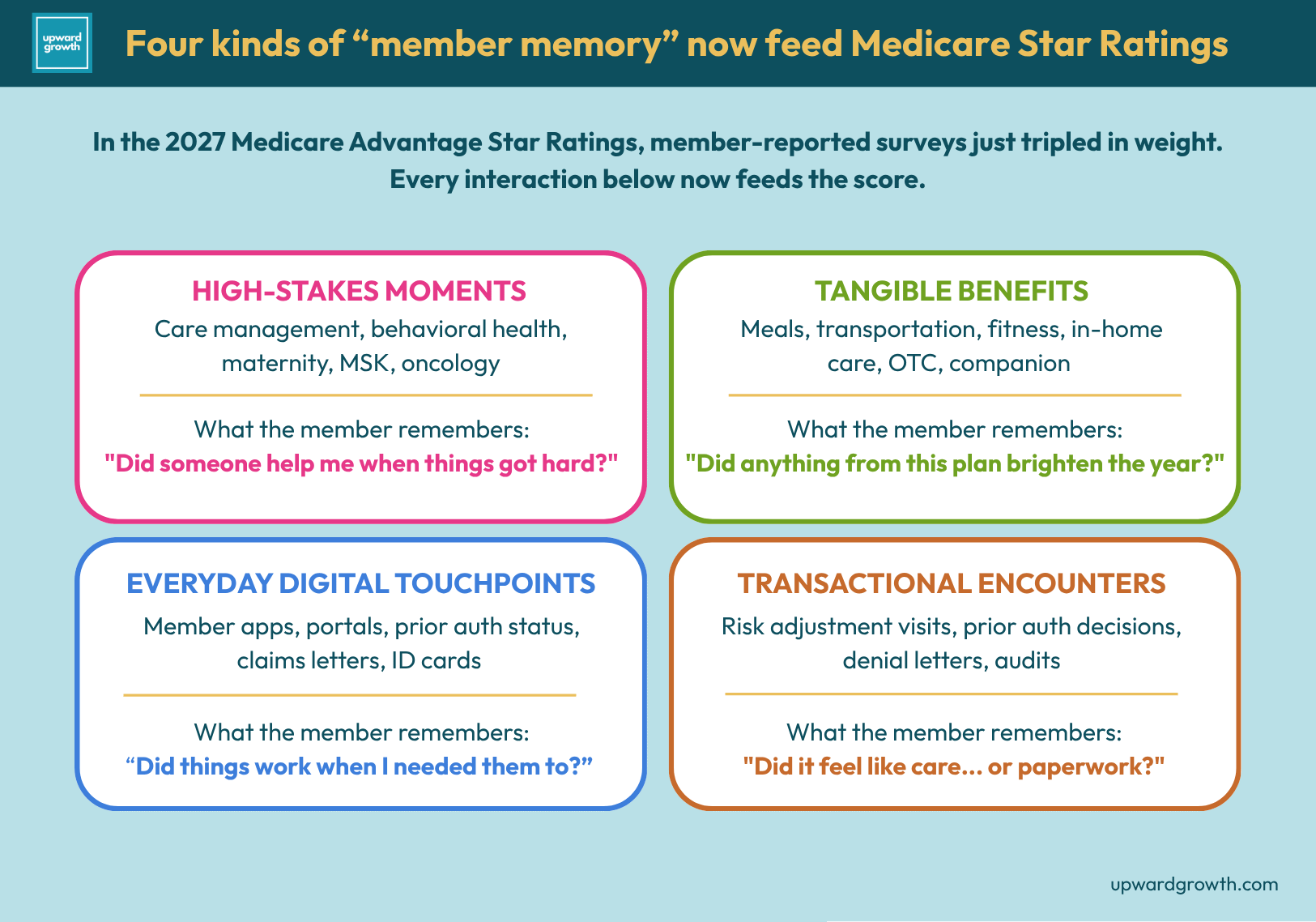
High-emotional-bandwidth moments. These are the encounters that happen when the member is at a hard point. The behavioral health intake call. The maternity navigator. The MSK program after the back gives out. The oncology care coordinator. The care manager who answers the phone after a hospital discharge. These touchpoints carry the most memory per minute spent, because they happen when the member needs help and is paying attention. A care manager who calls back when she said she would becomes the answer to “is your plan helping you” for two years. A behavioral health vendor who can’t get the member into a therapist appointment for six weeks becomes the answer, too.
High-frequency ambient moments. Member apps, portals, prior authorization status pages, and benefit explainers each create small interactions, but the cumulative imprint is large. Members rarely remember individual sessions. They remember whether things worked or whether things were broken. Vendors in these categories own the ambient feel of the plan relationship. A clunky app does not create a single bad memory, but it can create a steady, background sense that the plan is not put together.
Tangible benefit moments. Food delivery after a hospital discharge. Companion care visits for isolated members. Transportation. OTC. Fitness benefits. These touchpoints were originally bought as enrollment and retention plays. They are increasingly being bought as Stars plays too, because they are designed to be memorable and to leave the member with a positive answer when CMS asks. The strategic question for vendors in this category has shifted. Plans used to ask how many members used the benefit. They are starting to ask what the member said about it three months later.
Transactional moments that help or hurt. This is the category most vendors don’t recognize as a member experience moment. Risk adjustment home visits. HRA documentation. Prior auth decisions. Payment integrity letters. Coordination of benefits outreach. None of these are sold as member experience programs. All of them are member experience moments. A fast, well-explained prior auth decision (even when the answer is no) leaves a different memory than a slow, opaque one. A home visit that feels like care leaves a different memory than one that feels like an audit. Vendors in this category have been measuring themselves against operational metrics such as turnaround time and capture rate; health plans are now starting to measure them by the impression they leave behind.
Within these four categories lies a problem most plans have known about for years, and most vendors have missed. Most vendor-delivered member experiences never get connected to the health plan brand. The member remembers the meal company that showed up after a hospital discharge, not the plan that paid for it. The member remembers the companion who came over on Thursdays, the gym they used, the ride that took them to dialysis, or the nurse who arrived for the in-home visit. The plan paid for all of it. The member does not always know that. Commonwealth Fund data shows nine in ten MA enrollees say supplemental benefits are important, but only seven in ten report using them. A meaningful share of the seven who do use them never trace the experience back to the plan that funded it. That disconnect is an HOS leak. Plans are paying for experiences they are not getting survey credit for.
The way members actually behave throughout the plan year has long been an underappreciated factor in MA economics. The CY 2027 rule put a dollar value on it.
Vendors who help plans close that leak will start winning conversations they used to lose on price. That means co-branded delivery, plan-attributed follow-up surveys, member welcome packaging that includes the plan’s name, and program communications that thread plan attribution through the experience.
Winning those conversations starts with what you say next, and most vendor sales teams are about to say the wrong thing. Your sales team will want to add a Stars claim to the pitch. The instinct is right; the standard execution is what gets vendors cut from consideration.
You cannot prove HOS attribution. The survey samples too few members per contract, the data is anonymized, the questions don’t reference your product, and the two-year cycle puts any movement downstream of dozens of variables.
What you can do is build the evidence base plans are starting to ask for. Not satisfaction scores from the moment of service. Peer-reviewed work on NPS in healthcare has shown that single-item, point-of-service measures have well-documented limitations for assessing the kind of complex, longitudinal patient experience plans actually care about. What plans want is member sentiment data months later, longitudinal experience tracking through the program, and brand attribution data showing whether the member connects the experience to the plan or to your company.
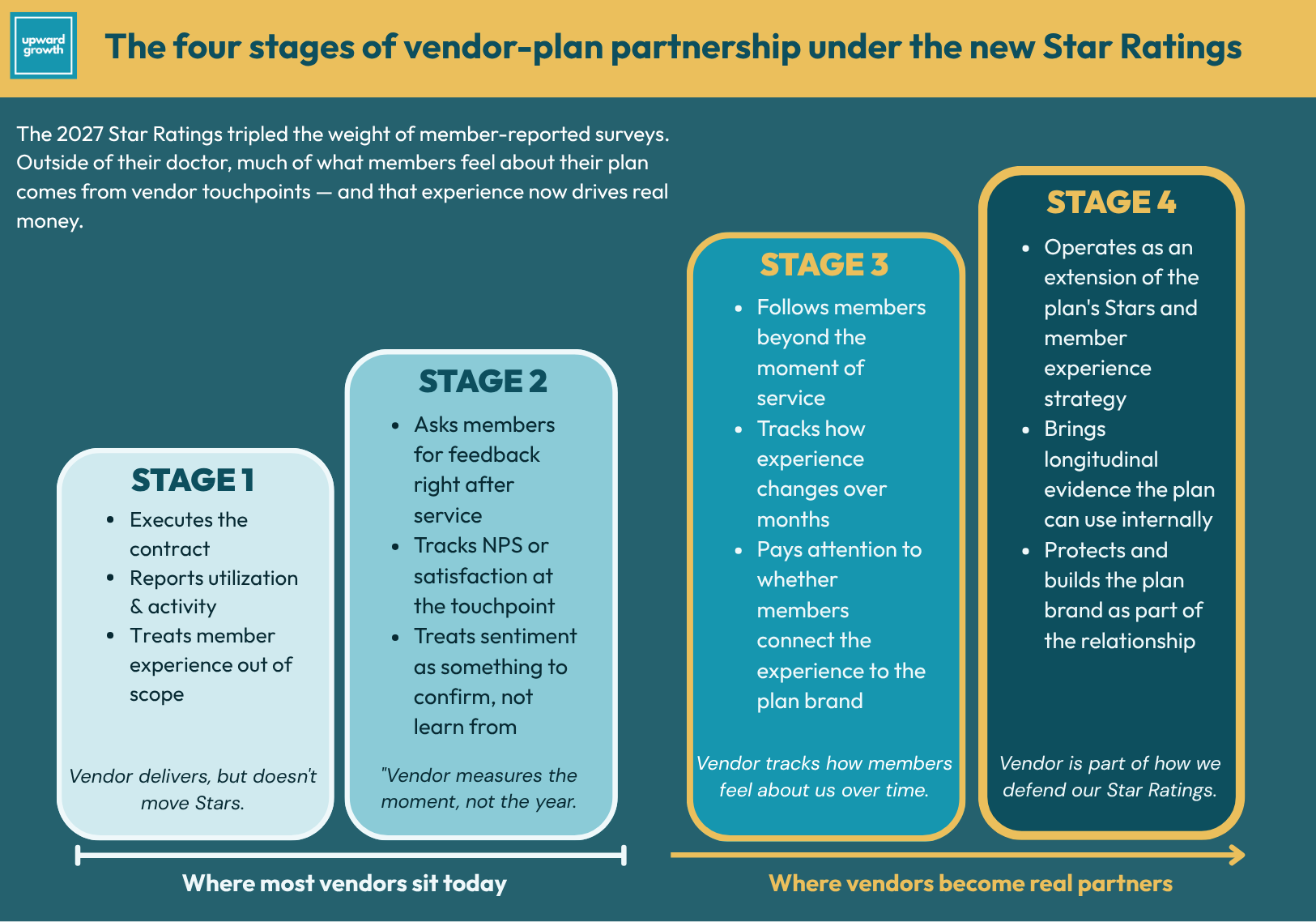
At minimum, the shape of credible evidence looks like three things. A short member sentiment instrument administered at 90 days and again at 12 months after a member’s first interaction with your program. A brand attribution question that tests whether the member can name your customer’s plan when asked who provides the service. And a sample size large enough that the plan’s Stars leader can defend the data in an internal portfolio review. The instrument design, cadence, and report-out structure are custom work for each vendor and each plan customer. The starting point is committing to measure these things at all, which is more than most vendors do today.
What the Stars leader hears as marketing: “Our program lifts member experience and that lifts Stars.”
What the Stars leader hears as evidence: “Here is what members say about your plan three months after we engage them, here is how those responses changed over twelve months, and here is the percentage who connect the experience back to your plan brand.”
The second version is the kind of evidence a Stars leader can take into a portfolio review.
A note: I’ll be on the Health Outcomes Survey panel at Qualipalooza in Frisco, TX on June 30, alongside DUOS and Blue Cross Blue Shield of Rhode Island. If you’re attending, find me there. 👋
We’ve covered why every vendor that touches a Medicare Advantage member is now in the Star Ratings math, what HOS actually measures (and what it doesn’t), the four categories of member memory your product is creating right now, and what separates a credible Stars story from a pitch that plans will stop believing.
Below is the operational layer beneath it all: the four shifts reshaping how plans evaluate vendors, the discovery question that opens unbudgeted Stars money (and what to do with the answer), the case-study evidence plans are starting to demand, and the three diligence questions investors should be asking.
Paid subscribers get this, plus 50+ frameworks, scripts, and deep dives built for health tech teams selling to health plans. One qualified conversation from these frameworks is worth more than a decade of subscription.
🔓 Upgrade to a paid subscription to keep reading.
Comments
Nothing yet. Say the first thing.
Sign in to join the conversation.