
Upward Growth is a health plan market advisory firm. Our weekly newsletter covers payor market strategy, regulatory shifts, and go-to-market insights for health tech vendors, investors, provider organizations, and consultancies competing in the health plan market.
🤝 Work with us on payor market strategy: Contact us
🟦 Connect with the author, Ryan Peterson, on LinkedIn.
🎧 Listen to the Upward Growth Podcast: Apple | Spotify
📰 Newsletter sponsorships: Learn More
Employee ownership changes everything, and members notice that.
As an employee-owned organization, HOMELINK brings a level of accountability that’s hard to find in healthcare. Because every associate is personally invested, our team treats every member and every claim as their own. With a directly contracted national network and a 9.8/10 Member Satisfaction Score, we help health plans deliver the kind of experience members remember for the right reasons.
Interested in sponsoring Upward Growth? Contact Us
A quick note before we get into it: I’m currently booking Q4 speaking sessions and on-site trainings for health plans, health tech vendors, investors, and consultancies. A few great engagements are already on the calendar for October and November, and we’ll announce those soon. Q4 is filling in fast.
The speaking sessions are keynote and panel spots at industry events, board and investor days, and executive offsites where the room needs a sharp outside read on where the payer market is actually heading in 2027 and what that means for their book. Recent talks have covered ACA repricing, the MA reset, and how CFO-driven procurement is reshaping vendor selection.
The on-site trainings (in-person or virtual) are half-day and full-day sessions for leadership teams navigating a shifting payer market: commercial and growth teams selling into health plans, product and strategy teams building for them, and investment teams sizing exposure across payer-adjacent portfolios. We cover how plans actually make buying decisions, what the market is signaling for 2027 and beyond, and how leadership should be repositioning strategy, roadmap, and go-to-market against what’s happening at the plan CFO level right now.
If you’re thinking about Q4 or Q1 2027, the fastest way to start the convo is the Upward Growth contact form, and we can scope what would land best for your team.
Separately, I’ll be at RISE West in San Diego next week. I’m especially interested to hear what the Office of the Inspector General (OIG) has to say this year, given everything moving in the payer market right now. If you’re going to be there, come say hello and let’s catch up. 👋
In May, I wrote a piece called Five Health Plan Postures to Understand During the 2026 ACA Shakeout. The argument was that plans in the Affordable Care Act (ACA) individual market would take different postures on their 2027 rates depending on how they read the risk pool without the Enhanced Premium Tax Credits (EPTCs). That article was pre-filing, so most of what I laid out was speculative.
What’s on the table now is different. Plans filed their 2027 rates, a federal judge paused most of the rule they filed under six weeks later, and Q2 earnings from ACA-exposed public payors and hospitals showed what year one without EPTCs is actually costing the market. That combination has put plan CFOs with an ACA book in the position of defending 2027 pricing decisions against conditions that have already changed underneath them.
The 15% median premium increase across 276 insurers is going to get most of the headlines, but really the number plan leadership is actually managing to is messier. And that’s because some 2027 payment rule provisions may or may not apply by Open Enrollment Period (OEP). Further, provider economics are already visibly cracking on Q2 earnings calls, and the appellate ruling most likely won't come down before the Medicare Advantage (MA) Annual Enrollment Period (AEP) opens October 15 or the ACA OEP opens November 1.
Six months ago, how plans would behave in year one without EPTCs was a forward-looking read. What we have now is evidence, and plan CFOs with an ACA book are running it against their filed 2027 posture right now, before Q3 earnings force them to say publicly whether the posture still holds.
Every state’s 2027 filings are in, and the story they tell is not the median.
Peterson-KFF’s national tracker puts the median proposed increase at 15% across 276 insurers. The number tells you the market repriced. Where plans landed inside the range tells you what they think happens next. Filings inside the same OEP window include 22% state averages, 52% individual carrier requests, book-wide repricings, and outright market exits. Plans clearly do not agree on what the retained risk pool looks like.
The actuarial memos supporting the filings cite five drivers consistently:
Morbidity of the retained risk pool after EPTC expiration
Expected further enrollment decline through 2027
The EPTC expiration itself and its downstream effect on take-up rates
Tariff-driven pharmaceutical and durable medical equipment (DME) cost pressure
Uncertainty about which provisions of the 2027 Notice of Benefit and Payment Parameters (NBPP) would actually apply
To me, that last one matters most as plans were telling regulators, in writing, that they were pricing 2027 rates against a rule they weren’t sure would even hold. Actuarial memos are not opinion pieces, and that caveat is on file in dozens of state Departments of Insurance right now as the plans’ own record of what they believed about the regulatory environment.
At the state level, the split gets sharp. UnitedHealthcare of New York filed a 52.1% requested increase, the highest single filing in the country, inside a state where the individual market request averaged around 21% overall. Washington’s preliminary rate request averaged 22.4% statewide. In Oregon, both Providence Health Plan and PacificSource exited the individual marketplace entirely, leaving Oregon consumers to shop across four plans rather than six. Further, PacificSource is also exiting the individual market in Idaho, Montana, and Washington, and leaving Montana entirely across every line of business. Two plans filing rates 20 percentage points apart on the same population made two different bets on the retained risk pool. But both actuaries can't be right.
At the plan level, the divergence tells the same story. Molina Healthcare walked, announcing a $1B reduction in marketplace premium exposure for 2027 alongside consolidation to roughly six core states. Centene held ground and repriced. UnitedHealthcare tested the ceiling with the New York filing. Providence and PacificSource concluded that no rate could stabilize their books and exited. What’s clear now is that a market filing inside a 15% median but including 52% requests, book-wide repricings, and multi-state exits is not a market operating with shared assumptions.
The CFO is the one making all of these calls. As I wrote in The CFO Filter last fall, CFOs became the actual decision-makers on vendor spend at most plans over the past two years. They're now the ones defending the 2027 ACA rate posture too, and both decisions are landing on the same desk against the same conditions. And all of this got priced before the rule got paused.
The rule plans wrote their 2027 rates against aren’t fully in force anymore. A federal district court in Maryland paused eight of its provisions in mid-July, four days before the effective date. HHS is expected to appeal to the Fourth Circuit Court of Appeals, with a September 14 deadline to file. Separately, 22 states led by New York filed their own challenge to the NBPP two weeks after the ruling. None of it resolves before OEP opens November 1.
The paused provisions touch enrollment verification, higher out-of-pocket limits for bronze plans, catastrophic plan eligibility, network adequacy, standardized plan requirements, and tax reconciliation. Katie Keith at Georgetown has been running a multi-part series on the 2027 payment rule and the Columbus II litigation for Health Affairs Forefront, and I’d recommend her coverage if you want the substance. What matters for plan-side decisions over the next three months is that whichever way the appellate ruling lands, the rules plans priced 2027 against will not be the rules that govern the market they wrote their posture for.
Plans priced 2027 against a rule the court partially paused, and the appellate court ruling will land after members are already shopping.
Plans are already inside the OEP marketing window. Consumer-facing materials, plan design communications, and network disclosures are being drafted or are already live, built on 2027 regulatory assumptions that no longer fully hold. If the paused provisions come back, some of that content has to be reconciled with rules that were not in force when it was finalized. If they stay paused, plans that wrote pricing memos against the full rule are running a book against a floor they never stood on.
The downstream effects of what plans priced against are already visible in Q2 earnings from both hospitals and payors.
Projections about what EPTC expiration would cost the healthcare economy have been in the market for a year, but Q2 was really when the projections stopped being models and started being receipts.
In September 2025, the Urban Institute and Robert Wood Johnson Foundation (RWJF) modeled what EPTC expiration would cost the market. Their numbers landed at $32.1 billion in lost provider revenue and $7.7 billion in uncompensated care in 2026, with 7.3 million people losing subsidized coverage and 4.8 million becoming uninsured. The assumption underneath the RWJF numbers was that members losing coverage would stop using care. Q2 said the opposite. The newly uninsured are still showing up, and they are just not paying for it. That makes uncompensated care the line item where EPTC expiration is landing hardest, and it’s landing faster than any 2026 model priced in.
HCA Healthcare made the point most plainly. On the July 24 Q2 call, CFO Mike Marks told investors HCA’s original 80-85% assumption for exchange-to-uninsured conversion was “closer to one-for-one”, and the company cut 2026 EBITDA guidance from $15.6B-$16.5B to $15.4B-$16.1B. That single assumption change roughly doubled HCA’s modeled full-year exchange headwind to $1.0-$1.2B. Marks and CEO Sam Hazen laid out the mechanism on the same call. Exchange volumes fell about 15% year over year. Uninsured volumes rose about 15%. The migration is almost dollar-for-dollar, and the utilization decline HCA and its peers assumed would soften the hit did not materialize.
The rest of the sector confirmed the pattern with their own numbers. Community Health Systems (CHS) raised its ACA-related EBITDA loss projection from $20-$30M to $50-$75M in Q2, with uncompensated care running about 20% higher year over year. Universal Health Services (UHS) downgraded 2026 guidance citing the same dynamic. Tenet Healthcare raised guidance and outperformed, on cost containment and a higher-acuity mix that outran the ACA headwind. Even at Tenet, exchange revenue fell 17% year over year. Tenet being the exception doesn’t weaken the pattern. It tells you which operators have enough non-ACA levers to absorb the drag without cutting guidance, and which don’t.
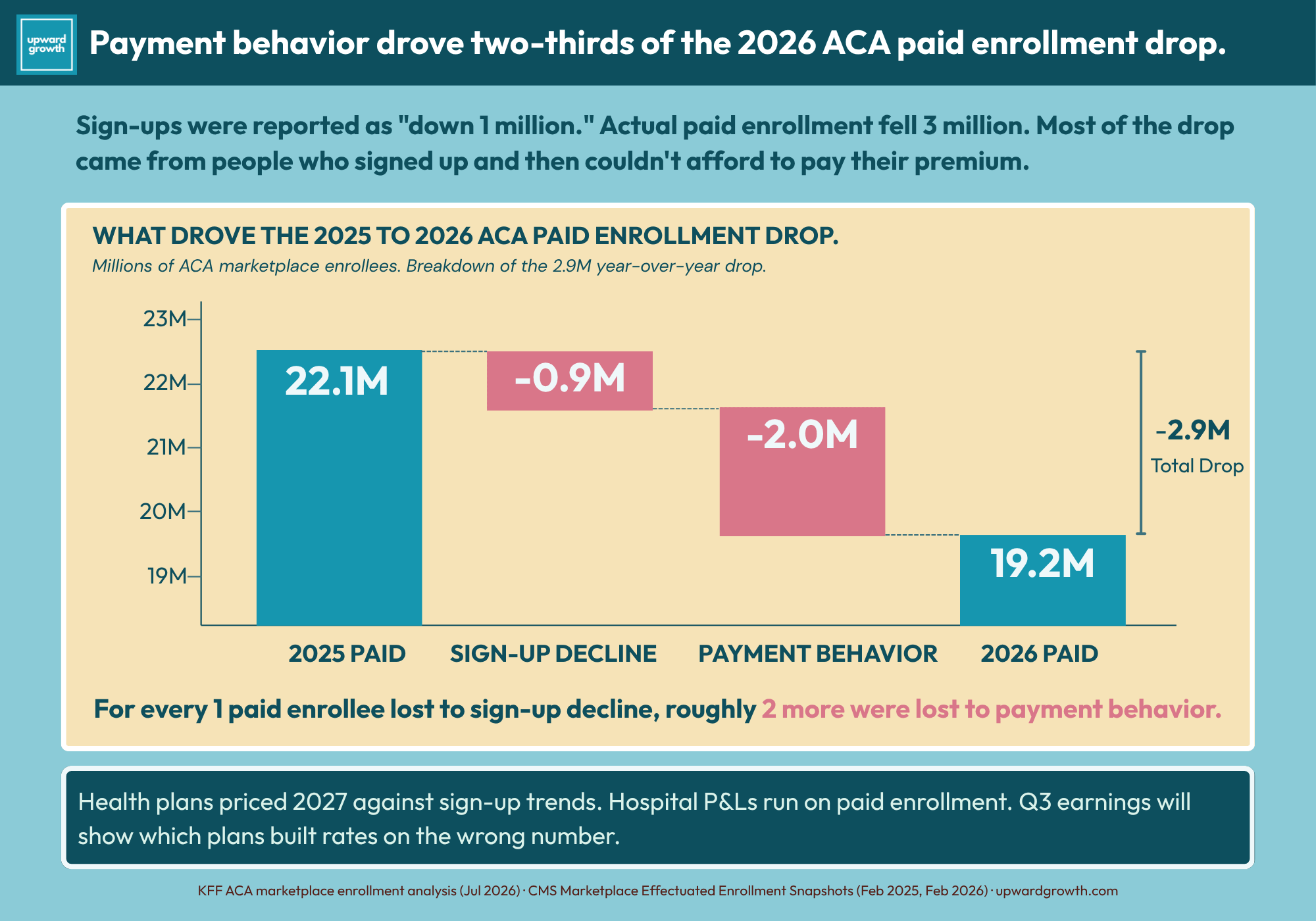
The mechanism connecting rate filings to hospital P&Ls sits in the CMS effectuated enrollment data. Plan sign-ups for 2026 fell by roughly one million versus 2025. Effectuated enrollment, which counts the people who actually paid their premiums, fell by nearly three million, from 22.1 million in February 2025 to 19.2 million in February 2026. That is the largest single-year drop since the ACA marketplaces launched in 2014. The gap between click-through enrollment and paid coverage is the channel through which EPTC expiration is landing on provider P&Ls, and the size of the gap makes HCA’s one-for-one revision look conservative rather than aggressive.
On the payor side, Q2 produced the first real look at how plan management teams are absorbing the same dynamic. Two of the most ACA-exposed publicly traded payors reported within days of each other, and they used the same underlying market data to tell opposite stories.
Molina told the market it had mispriced the acuity of the retained pool and was shrinking to a book it believes it can price. Q2 marketplace membership fell to 283,000 from 655,000 at the end of 2025 and 690,000 a year earlier, and marketplace medical loss ratio (MLR) ran 88.9% against the 85.5% originally guided. CEO Joseph Zubretsky told investors, “we did include an element in pricing to account for the potential for an acuity shift. We underestimated the stickiness of high-cost members,” and announced the $1 billion reduction in marketplace exposure and consolidation to six states for 2027. The plain read: Molina’s current footprint can’t be priced to margin, and the smaller, geographically concentrated version it’s shrinking to is the one it believes can.
Centene told the market it can price the book…with an asterisk. MLR improved to 89.6% from 93% year over year, and Q2 profit rebounded to $1.1B from a $253M loss in Q2 2025. But CFO Drew Asher told investors approximately $0.50 of Q2 earnings came from settlements of 2025 items that would not recur in 2027, including $180 million in Marketplace risk adjustment favorability. Marketplace membership itself fell from roughly 5.9 million to 3.5 million year over year. The asterisk is about the 2027 earnings bridge, as management is telling analysts the pricing model works and asking them to remember the $0.50 when Q2 2027 comes around.
Same market and same members, but two different calls on how to price them for 2027. Q3 tells us which call the rest of the industry is closer to, and I walked through the broader payor picture in What the Q2 Health Plan Earnings Calls Locked In for CY 2027 last week.
Plan CFOs with material ACA exposure are trying to make one decision under three simultaneous pressures: the 2027 rates they already filed, the rule those rates were priced against that isn't fully in force, and what Q2 said about the retained pool. Q3 is where the pressure becomes public. Boards, state regulators, and everyone who buys from them or sells to them will be listening to how leadership talks about all three at once.
The six weeks between the September 14 HHS notice-of-appeal deadline and ACA Open Enrollment on November 1 are where those simultaneous pressures collide. MA AEP opens October 15 in the middle of that stretch. Appellate hearings on the NBPP are likely to run in late October. Q3 earnings from public payors and ACA-exposed hospitals land in the same window. Every decision gets made against all of it at the same time.
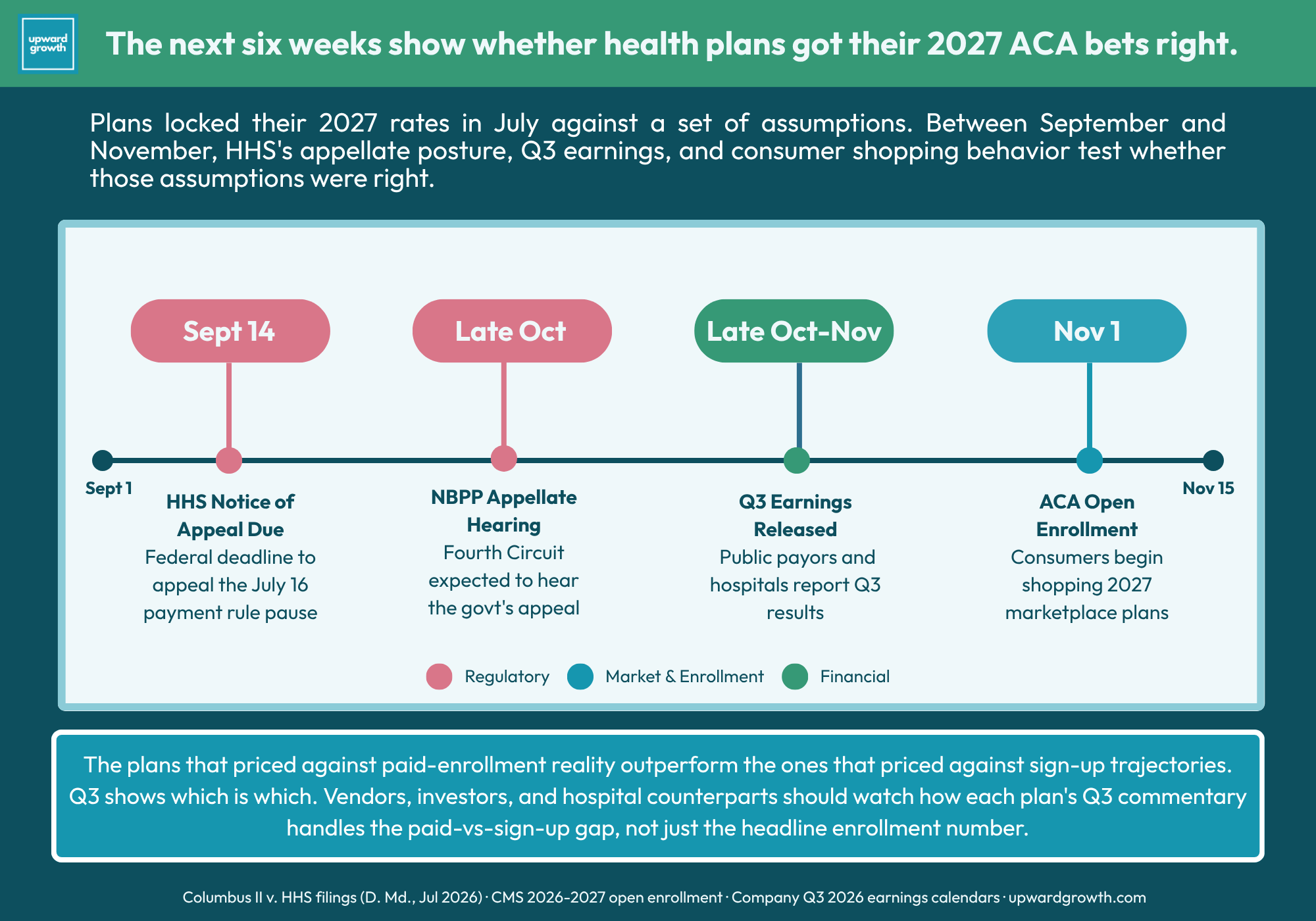
These postures matter because boards, regulators, and everyone across the table will grade plan leadership on the call they made and how it held up. Q3 is where Molina's shrinkage, Centene's discipline-with-an-asterisk, UnitedHealthcare's 52.1% ceiling test in New York, and Providence and PacificSource walking away become public commitments leadership has to defend for the rest of 2026 and into 2027.
Q3 earnings calls will get the coverage, but they're a lagging read. What plans are doing right now, between the appellate uncertainty and the OEP marketing deadlines, is where the real decisions get made. Plans are drafting rate-filing amendments against multiple appellate-outcome scenarios, sequencing network-narrowing communications for pre-OEP versus post-OEP release depending on how the appellate hearings look, and writing consumer marketing that has to hold up whether the paused provisions come back or don't. The sharpest plans are running competitors through the same lens, watching for amendments and footprint changes that move faster than any earnings release. By the time all of this surfaces on an earnings call, the operating decisions behind it are already six weeks old.
One piece of this hasn't shown up on any Q2 call yet, but it will soon. When Providence, PacificSource, Molina, and the other exiting plans left their markets, their members didn't disappear. They land on the plans that stayed, and the receiving plans priced 2027 based on their own historical book. Those members aren't a random cross-section. Some will fit the health status assumptions built into 2027 rates. Some will be exactly the kind of high-cost members Molina told the market it mispriced. Receiving plans will see it in their MLR before they've done the math on it. That conversation happens on Q2 2027 calls next summer, and by then the 2028 posture is already set.
The pattern I’ve written about before, of plans absorbing simultaneous pressure across every line of business, applies here. ACA is not the only book a plan CFO is reading Q3 signals from. What each plan says about ACA in Q3 also carries information about how the rest of the book is being read, and tracking compound shocks absorbing into plans over multiple quarters is how each earnings call becomes a read instead of just a data point.
None of this stops at health plans either. Hospital finance teams will use Q3 payor commentary to model Q4 rate negotiations, and the uncompensated care trajectory Q2 established walks into provider board meetings as the payor conversation heats up. Vendors selling into ACA-heavy plans are watching which buyers priced with conviction, because those are the ones who commit in Q4 and the rest can't move until Q3 resolves. And Q3 gives investors the first market-wide read on which management teams priced discipline versus optimism, which reprices ACA-exposed payor comps and ACA-adjacent hospital comps before Q4 closes.

Between now and mid-November, the market grades a set of bets plan leadership made this spring about the rules, the risk pool, and how far the retained members would stretch. Q3 earnings are the first grade. 2027 OEP results close the book on it.
Inside that window, listen for whether plan CFOs’ Q3 commentary matches their 2027 filed posture, what Q3 hospital calls say about the trajectory Q2 established, and whether the appellate court signals reinstatement during oral arguments. Read together, those signals tell you which management teams treated the ACA repricing, the NBPP pause, and the Q2 provider evidence as one connected story, and which ones treated them as separate news cycles. The first group is going to look considerably better in Q4 than the second.
If any of what's above touches your 2027 planning, Upward Growth is a health plan market advisory firm built for exactly this kind of moment. We work with health tech vendors, investors, provider organizations, and management consultancies on strategy that starts from how health plans actually buy, operate, and make decisions. Contact us here.
Thanks for reading.
Here’s to upward growth,
Ryan Peterson
The frameworks in the weekly Upward Growth newsletter help health tech vendors, investors, provider organizations, and consultancies work the health plan market as it shifts.
If your colleagues are in those conversations, they should be reading this too.
💰 Invest In Your Team with a Paid Subscription.
💡 Pro tip: Many subscribers expense Upward Growth through their company’s professional development, training, or learning budget. Here’s a one-minute email template to get your manager to approve expensing your subscription.
Comments
Nothing yet. Say the first thing.
Sign in to join the conversation.