
Upward Growth is a health plan market advisory firm. Our weekly newsletter covers payor market strategy, regulatory shifts, and go-to-market insights for health tech vendors, investors, provider organizations, and consultancies competing in the health plan market.
🤝 Work with us on payor market strategy: Contact me
🟦 Connect with the author, Ryan Peterson, on LinkedIn.
🎧 Listen to the Upward Growth Podcast: Apple | Spotify
📰 Newsletter sponsorships: Learn More
🎁 Unlocked: This post includes the full deep dive
Most Tuesday articles start with a free section and then continue behind the paywall. Today’s post is left completely open so you can read the entire edition.
Paid subscribers get the full deep dive every week, plus playbooks, case breakdowns, and the ability to reply with their own questions.
The first half of 2026 hit nearly every line of business a health plan operates, and the headlines understated the picture.
Medicare Advantage (MA) absorbed the CY 2027 Final Rule with the largest Stars overhaul in a decade, a Clover Health ruling that opened a bid recalculation window in the middle of an already-compressed bid cycle, and a Risk Adjustment Data Validation (RADV) audit cadence that has not let up.
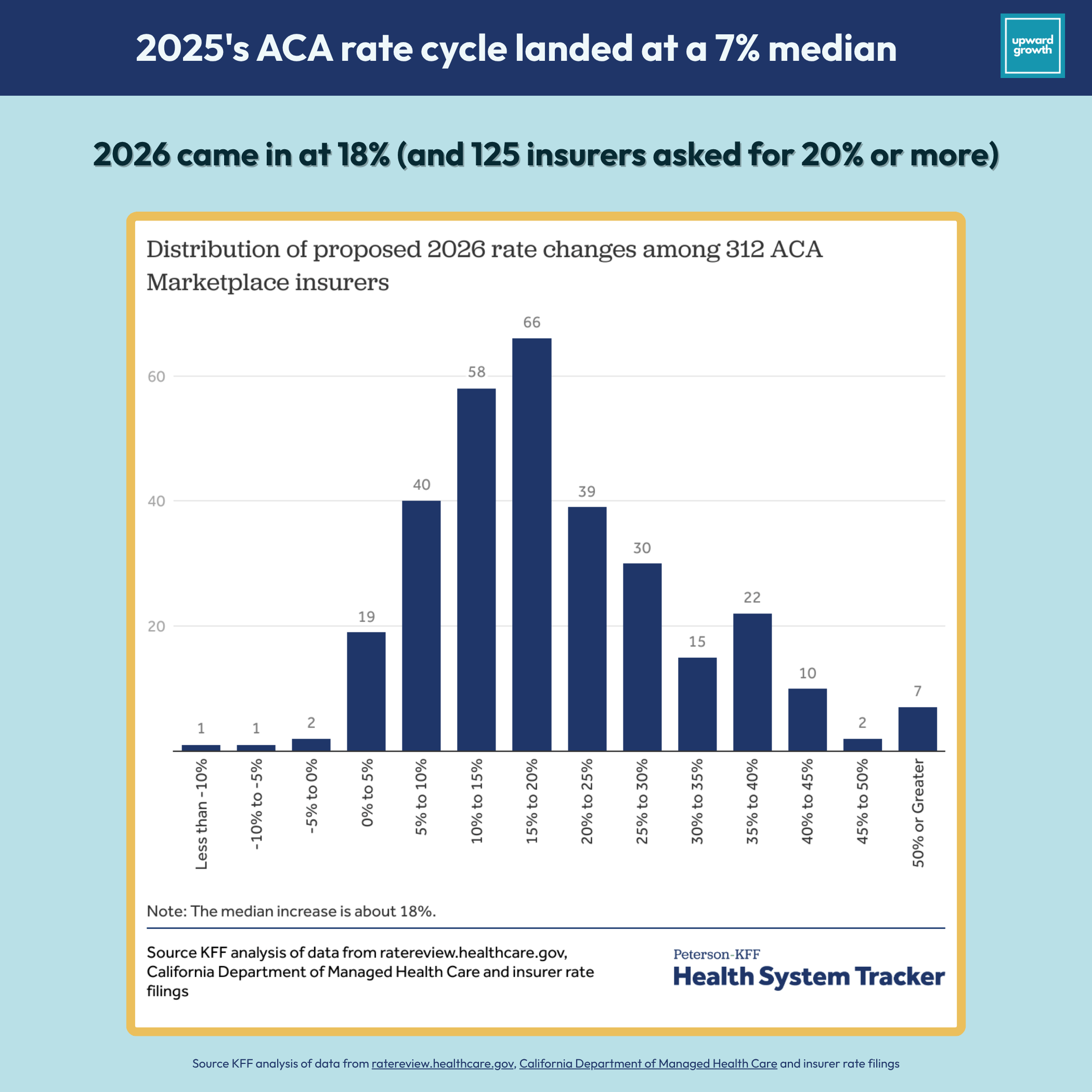
Affordable Care Act (ACA) enrollment shed nearly 4 million people in the first month after the enhanced premium tax credits expired and dropped from 23.1 million covered lives to 19.2 million, with double-digit 2027 rate filings already on file in early-filing states.
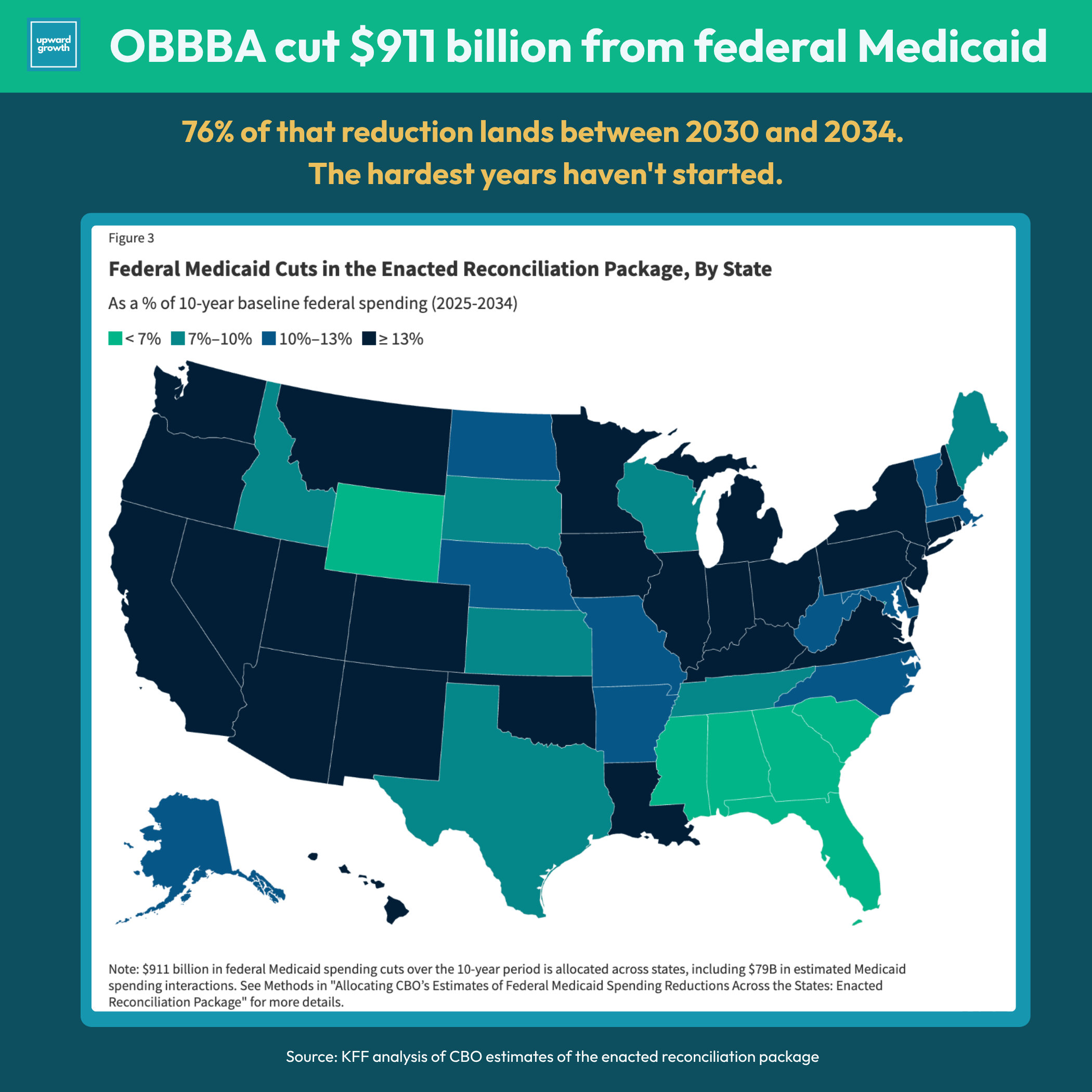
Medicaid began absorbing the One Big Beautiful Bill Act (OBBBA) roughly $1 trillion in cuts across work requirements, eligibility redeterminations, provider payment changes, and state rate setting, on a state-by-state timeline that runs through 2030.
Group (employer-sponsored commercial) absorbed Mercer’s 6.5 percent cost projection for 2026, the highest single-year increase since 2010, with 59 percent of employers responding with cost-cutting plan design changes in the first half.
MA, Medicaid, ACA, and Group commercial are each uncomfortable on their own. Health plans operating across multiple lines of business are absorbing all that compounding simultaneously, and the picture is materially worse than the individual stories suggest. A plan can absorb a major hit on one line of business and respond. The finance team reorders priorities, specialists get redirected, reserves get rebuilt, and the strategy calendar adjusts. None of that works when multiple lines of business take major hits at the same time, against one finance team, one actuarial bench, one provider contracting team, and one compliance staff. The response to each one is constrained by the responses to the others. The compounding is the story.
What follows is what the executive leadership team at the plan you are selling to, investing in, or advising is solving for in H2, and why the Medicaid phase-in running through 2030 is the variable that will keep rewriting the math on every other decision the plan makes for the rest of the year.
Picture a regional Blues plan running roughly $4 billion in annual revenue across MA, Medicaid, ACA, and group commercial, with several hundred thousand to over a million covered lives in each. That plan has one finance team modeling reserves across all four lines, one provider contracting team negotiating with the hospital systems that anchor every line, one actuarial bench supporting bid recalculations and rate filings and audit response simultaneously, and one executive leadership team making the cross-line prioritization calls. The decisions that team makes in H2 will shape how the plan operates through 2027 and 2028.
The org chart will tell you the lines run separately. Plans have LOB Presidents for each major line, separate operating units, and specialist teams that don’t share much day-to-day work. None of that changes the company's fundamental structure underneath. The plan is one enterprise with one P&L, one capital allocation conversation, one executive leadership team, and one strategy-planning process, in which the lines are prioritized against each other during annual planning. Reserves are held at the company level. Major vendor commitments above a threshold get reviewed by an enterprise committee that includes the CFO and General Counsel. Multi-year strategy decisions are made by the CEO and CFO, with the LOB Presidents weighing in but not deciding.
Cross-line pressure gets sorted at that enterprise level, and the lines act on each other. MA pulling the actuaries through bid recalculation leaves ACA pricing on the same queue, waiting on the same people. Hard ACA reserve decisions in spring shrink the capital pool the Medicaid impact analysis was also drawing from. A state-level Medicaid rate assumption that just shifted in Q1 reaches back into the commercial pricing the plan was preparing to lock for renewal. Each move on one line is a constraint on the next move on another. These trade-offs get made by the CEO, CFO, and executive leadership team, not at the LOB level.
If you are reading the plan from the outside, this is the level to read. The headlines in MA tell you about MA, but the same plan's response also tells you about its capital posture, specialist availability, and strategy attention across every other line. Capital posture is where compounding shows up first, with three lines pressing on the same reserves at the same time, and the CFO running a tighter conversation than the headlines suggest.
Four million people dropped out of the ACA marketplace in the first month after the enhanced premium tax credits expired, and the market settled at 19.2 million covered lives by spring, down from a peak of 23.1 million at the end of 2025. The lives that dropped coverage were the healthier subsidized ones, which left the plans writing on that market with a sicker pool to price against. Filings in early-filing states are showing rate increases above 15 percent, with “death spiral” warnings returning to ACA market analysis: healthier enrollees drop coverage, premiums rise to cover the sicker remainder, more drop, the cycle compounds. Several plans cut footprint, withdrew from counties that did not pencil at the new mix, and started repricing the markets they kept.
Elevance’s $935 million risk adjustment accrual in May was the most visible of the MA pressures hitting the same finance and actuarial teams. The CY 2027 Final Rule had landed in April with the largest Stars overhaul in a decade, the Clover Health ruling forced Quality Bonus Payment (QBP) recalculation and a bid resubmission window in the middle of the bid cycle, and RADV audits accelerated against a CMS coding workforce that grew from 40 to roughly 2,000 contract reviewers. Membership shed across MA continued through the first half of the year, and the plans carrying the most market exits also carry the most pricing pressure on what is left.
Mercer’s projection for 2026 employer cost growth landed at 6.5 percent, the highest single-year increase since 2010, and the employer-side reaction was immediate. 59 percent of employers made cost-cutting plan design changes in the first half on the group commercial line, narrow network adoption picked up across mid-market and enterprise buyers, and Individual Coverage Health Reimbursement Arrangement (ICHRA) migration accelerated as employers pushed pricing accountability back onto plans. The line plans had been counting on for margin stability is the line absorbing the most aggressive employer-side pushback in over fifteen years.
Three lines pressing on the same capital reserves simultaneously produce a hardened posture across the enterprise. The CFO is defending margin on all three lines at once, and the executive leadership team is maintaining the same public posture through Q1 2026 earnings calls: defend margin over chasing enrollment, model harder on rate, and tighten vendor evaluation. Enterprise investment committee approvals that used to clear in one meeting now clear in three. Multi-year vendor commitments above a threshold now go through legal and compliance review, which wasn’t part of the process 12 months ago. Nearly half of health plan C-suite executives report uncertainty about the near-term outlook, and the procurement posture vendors and partners face reflects that uncertainty. The posture is defensive across every line at the enterprise level, where the prioritization calls get made.
Capital posture is only half of what gets set this year. The other half is what the plan will actually pay out to deliver care, and the contracting team is working through that question against the same compounding from a different angle. Three lines are pulling on the same hospital systems at the same time, and how that plays out is the next collision.
The same group renewal cycle pushing back hardest on commercial pricing is also pushing back hardest on the plan’s provider network. Employers shifting to narrow networks force plans to renegotiate composition with the systems they keep, and ICHRA migration accelerating in the first half brings a different actuarial profile through the network that has to be re-priced. Every employer that transitioned from a fully-insured arrangement to ICHRA in H1 sent the plan back to its hospital partners with a different risk profile and reimbursement structure.
OBBBA Medicaid is pulling on the same contracting team from a different direction. The phase-in includes provider payment changes that do not align with state rate-setting cycles, which means plans are renegotiating with the same hospital systems on the Medicaid side, using payment assumptions that may shift before the contracts are fully implemented. Some states are pushing payment changes through in 2026 while others wait until 2028. Hospital systems do not experience this as a state-by-state policy implementation, rather they experience it as the plan’s contracting team showing up with a different number than it had eighteen months ago, on the same line they were already renegotiating.
MA adds a third factor. Plans that exited counties in 2026 are rebuilding their MA network footprint in the markets they kept, often on the same hospital contracts that the group renewal and Medicaid renegotiation are touching. The county exits forced the network to be reconstituted under tighter economics, with the same systems holding more leverage in the remaining markets.
One plan, one provider contracting team, three lines pulling on it simultaneously, and the hospital systems on the other side of the table know exactly what is happening. A system that gives ground on MA network breadth knows the same plan is coming back asking for commercial rate relief in six months. A system that absorbs OBBBA-driven payment changes on the Medicaid side knows the commercial line will push for offsetting concessions at the next renewal. Systems can stage asks across the plan’s lines because they view them as a single balance sheet, even as the plan’s contracting team is still managing them as three separate negotiations.
Cross-line leverage also extends across renewal cycles, not just across lines at a single moment. A concession on Medicaid under OBBBA this year appears as the same system's opening position in the MA contract next year. A walk-away from a commercial renewal this quarter changes the terms of the MA network rebuild in that market two quarters later. The system's memory of the plan's give-backs runs longer than any individual contract cycle, and the contracting team is negotiating against that memory every time it comes back to the table. The Blues consolidation that accelerated in H1 is partly this collision: smaller plans could not sustain provider-side pressure across all of their lines simultaneously, and the affiliations are how they tried to absorb it.
Every one of those network moves runs through the actuaries, analysts, and lawyers the rest of the plan is also trying to deploy, and the rest of the plan is not where those specialists are. The audits already have them.

Every other workstream inside a health plan has flex in its calendar. Capital posture tightens across a quarter, network negotiations stage across renewal cycles, and strategy reviews slip a month when the priorities ahead of them demand it. Audit response has no flex. The federal regulator sets the dates, the penalties for missing them carry real payment recovery and civil exposure, and no internal prioritization conversation changes any of it.
The wall expanded on four fronts in H1. Medicare Advantage RADV moved to a quarterly cadence against payment years 2020 through 2024 simultaneously, putting risk adjustment and compliance teams within every plan on a 90-day response cycle across 5 years of submitted data, with material payment recovery at stake. ACA HHS-RADV ran in parallel with Initial Validation Audit (IVA) requirements in revision through the 2026 Payment Notice. The Office of Inspector General issued its first MA-specific compliance guidance since 1999, raising the standard for every plan’s compliance program. And the public posting of prior authorization metrics in March introduced a new monthly reporting cadence for the same legal and regulatory affairs staff already managing the rest. Four federal compliance workstreams accelerated inside the same six months, and none of them had movable dates.
Other H1 pressures all live downstream of that wall. A plan can defer a vendor evaluation, slow a network renegotiation, or push a strategy decision to the next quarter. It cannot defer a RADV submission. So when audit work is dense, every other H1 priority has to plan around it.
Take personnel, for example. The people who own audit response are the same people every other H1 priority is trying to deploy. Actuaries running MA bid recalculation after the Clover ruling are on the RADV queue. Risk adjustment leadership signing off on MA submissions after the Elevance $935 million accrual is working HHS-RADV alongside it. Actuaries pricing ACA for the new morbidity are modeling the impact of audit findings on the same numbers. Compliance staff working OBBBA Medicaid implementation through 2030 are also working federal audit response timelines. One plan, one specialist bench, every pressure pulling on it.
Three of the four H1 collisions are working themselves out against an immovable audit wall. The fourth is a baseline that does not stop shifting. The Medicaid phase-in keeps changing the math the other three are pricing against, every quarter, for the next five years.

A typical line absorbs a shock, the planning team responds, and the company moves on. The Medicaid phase-in will keep generating new variables every ninety days through 2030, which means the company never gets to move on.
One plan, one provider contracting team, three lines pulling on it simultaneously, and the hospital systems on the other side of the table know exactly what is happening.
OBBBA’s Medicaid cuts are phasing in across work requirements, eligibility verification redeterminations, provider A typical line absorbs a shock, the planning team responds, and the company moves on. OBBBA Medicaid keeps generating new variables every quarter through 2030 as different states implement different pieces on different timelines, and the math the plan is pricing against keeps moving with them.
OBBBA’s Medicaid cuts are phasing in across work requirements, eligibility verification redeterminations, provider payment changes, state rate-setting cycles, RFP timing, and competitive dynamics in Dual-Eligible Special Needs Plans (D-SNPs). None of those tracks share a calendar. Work requirements are coming online in some states in 2026 and others in 2028. Eligibility verification systems are being rebuilt in states that have not yet implemented the redetermination cadence. State-level rate filings going in this year are pricing against federal payment assumptions that may shift before the filings get approved. By the time a plan’s strategy team finishes modeling what one state’s implementation means for the Medicaid line, two other states have moved.
Inside the plan, the work each other collision required already has to be redone. Capital reserves modeled during Q1 annual planning against a Medicaid rate assumption will be remodeled during the spring mid-year reforecast as Q1 results post and additional states implement payment changes, then re-run again during Q3 strategy refresh, with different inputs every cycle. Provider network economics renegotiated this quarter with a hospital system will be re-priced next quarter when an OBBBA-driven payment change hits the same system on the Medicaid side, with the system already aware that the assumptions have shifted. Actuaries and compliance staff who would have rotated off the current RADV wave will rotate into OBBBA compliance work every ninety days as new state implementations generate new federal compliance reviews.
That is what the executive leadership team at every plan operating across these lines is solving for in H2. Four collisions, one company, one set of leadership decisions remade quarter after quarter against a Medicaid baseline that will not stop moving through 2030.
H1 2026 hit nearly every line of business a health plan operates, and the headlines understated the cross-line picture. Four pressures are landing on one finance team, one provider contracting team, one specialist bench, and one leadership group at the same time, with a Medicaid baseline that will not stop resetting through 2030. Cross-line decisions are made by one CEO, one CFO, and one strategy-planning process, and every decision is constrained by the other three pressures working through the same group.
The next ninety days run through Q2 earnings posting in late July and August, the mid-year strategy reviews that follow, and the Q3 reforecasts that lock the 2027 capital posture. These are the cycles where H1 absorption becomes 2027 and 2028 operating decisions. Strategy work that has been sitting in committee since Q1 either gets approved or shelved, and what gets shelved signals where the company chooses to absorb pressure and where it chooses to defer. Audit deadlines will keep absorbing the actuaries and compliance staff every other line also needs, which means the second-half decisions on MA, ACA, and Group get made by a leadership team with less specialist support than it had when the year started.
What to read in H2 is how the plan underneath manages four pressures that remake each other every quarter, against a Medicaid baseline that does not stop moving through 2030. That is what your buyer, your portfolio company’s customer, or your client is solving for right now.
If you are working through what this picture means for your positioning, strategy, or portfolio, Upward Growth is a health plan market advisory firm that works with health tech vendors, investors, provider organizations, and management consultancies on exactly this kind of question. Get in touch.
Thanks for reading.
Here’s to upward growth,
Ryan Peterson
The frameworks in the weekly Upward Growth newsletter help health tech sales and marketing teams navigate payor conversations as the market continues to shift.
If your colleagues are in those conversations, they should be reading this too.
💰 Invest In Your Team with a Paid Subscription.
💡 Pro tip: Many subscribers expense Upward Growth through their company’s professional development, training, or learning budget. Here’s a one-minute email template to get your manager to approve expensing your subscription.
Comments
Nothing yet. Say the first thing.
Sign in to join the conversation.