
Soulmaker: The Times of Lewis Hine
By Alexander Nemerov
Princeton University Press, 2016
During the peak of the Industrial Revolution, many US companies exploited the labor of children. Kids as young as age five worked ten to twelve hours a day in textile mills, fish canneries, or on city streets selling newspapers. According to census data from the early 1900s, there were more than 1.7 million child workers in the US at that time (p. 24).
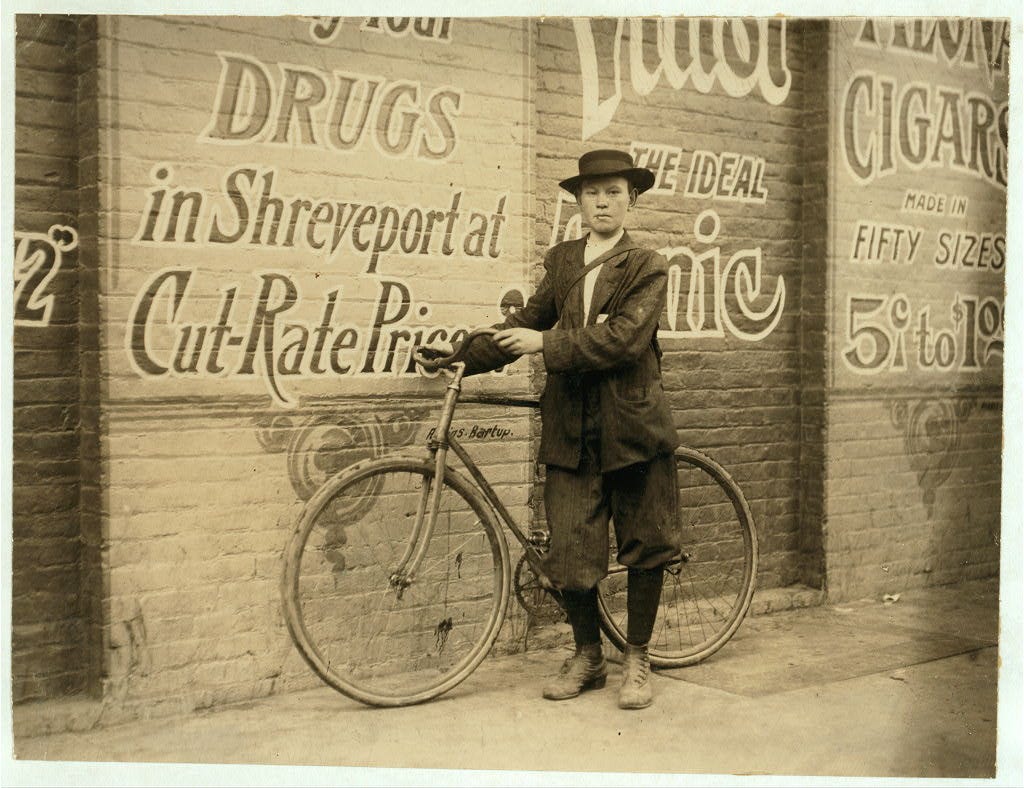
Some, called “breaker boys,” worked for ten hours a day at the base of coal chutes picking out slate and other impurities while a supervisor with a stick kept them in line. Many of the youngest newsboys who sold papers on the streets were sexually abused by older guys who worked on newspaper docks (p. 106). Some kids worked in coal mines, earning 75 cents a day for a ten-hour shift. Injuries were common, such as a boy named Lawrence Hill who “had four fingers mashed off by a stamping machine in a lamp factory” (p. 106). Another nine-year-old boy, Howard Williams, delivered medications on his bike for thirteen hours a day, usually into the red-light district of Shreveport, Louisiana (p. 121).
“Commercial modernity [in the early 1900s] is an implacable god hovering above even well-born mortals, redirecting the wind, changing the weather, storming at them as if to proclaim that even souls immune from misfortune should be subject to changes in economic climate brought about by the corporate cloud-splitter,” writes Alexander Nemerov, author of Soulmaker, about the impact of the Industrial Revolution on people, including the children (p. 73).
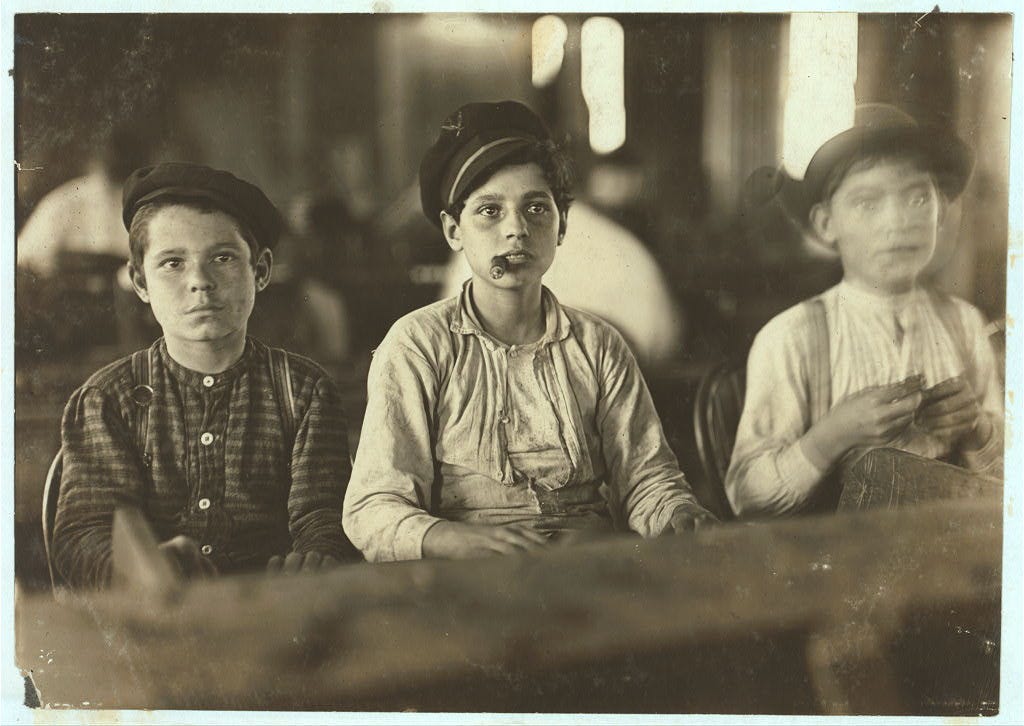
During this era of massive, mechanistic economic transition, a humble, shy man named Lewis Hine from Oshkosh, Wisconsin, traveled around the country with his Graflex camera and photographed thousands of children in their industrial workplaces. He was contracted by organizations opposed to child labor to document the workers’ conditions, but the quality of his work transcends documentation. Many of his photographs are works of art that reveal the intrinsic dignity of human beings.

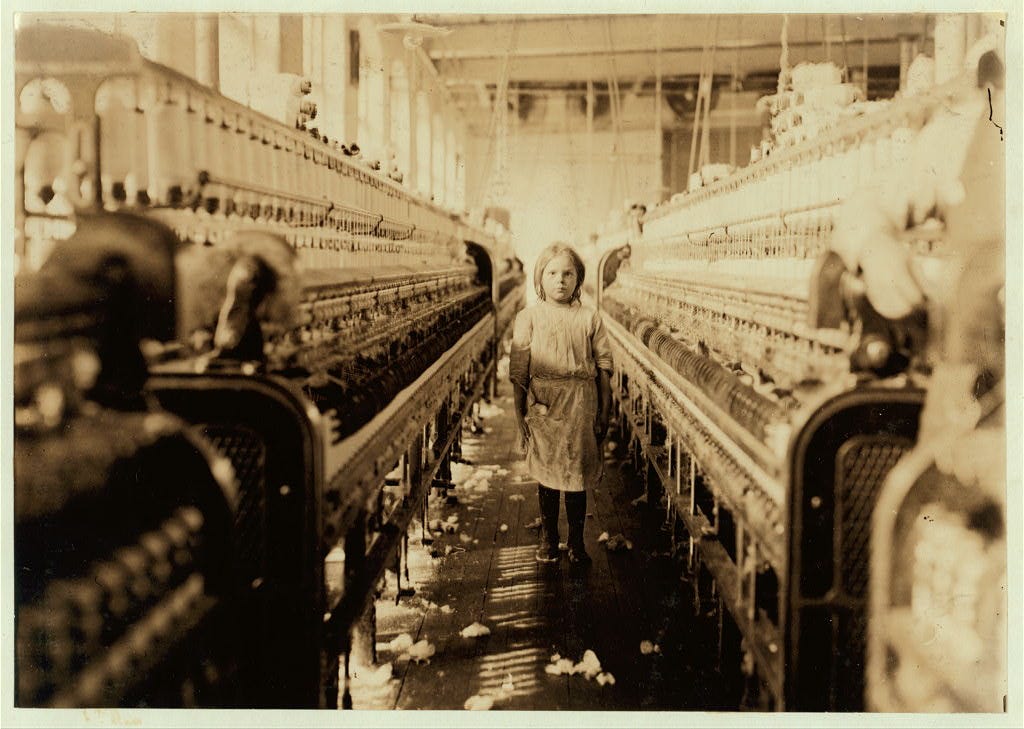
For example, in 1908 Hine photographed Cora Lee Griffin, who was eight years old at the time. The photo shows her standing between a row of factory windows and a long line of hundreds of bobbins. Hair in pigtails, wearing a dirty dress with ruffles, fingers filthy from handling machinery, Cora Lee stares directly into Hine’s camera, stoic. The photograph, which is on the cover of Nemerov’s book, immortalizes her, elevating her soul from the machines and into our hearts. Nearly 120 years later, we still see her and remember her life. Hine makes her an icon for all the kids whose bodies and time were exploited, the children who never went to school and who rarely played games with friends.
“His photographs trail a vast sociological story, one that licenses people understandably to this day to misread his pictures as documents,” writes Nemerov. “But … each truly momentary picture became not so much a statement of the times as a curious departure from them” (p. 14).
Nemerov’s writing is beautiful. He artfully describes the photos while placing them in their historical context. They remind us of a time when businesses operated without labor laws or safety regulations. The children Hine photographed came from impoverished situations. Desperation and hunger made them easy to exploit.
In 1911, Hine photographed Sadie Kelly, age eleven, on her way to pick shrimp all day in Port St. Louis, Mississippi. The photo shows her carrying shrimp baskets on the side of a dirt road. In the background is a small wood shack on stilts. Her shoes are old and flat. She dons a smock tied in front. It is stained by mud and saltwater. Her head is completely shaved, probably due to lice.
“Her environment is not so much a place as a time,” writes Nemerov about Hine’s photograph of Sadie. “Temporary structures and urgent routines combine in rhythms daily and lifelong. Slow rot and speed seem so woven together in this photograph that it is anyone’s guess how the one might be separated from the other. The girl has places to go, but she moves through a world that seems to have slumbered to a state of an almost comatose dereliction of duty” (p. 30).
One writer, seeing the photograph of Sadie Kelly, described her as “walking through the landscape of her own death … a disaster in slow motion” (p. 31).
Hine’s photographs capture the numbing work of the children, but they rarely cause despair. Rather, they elevate human dignity even as technological “progress” disregarded their well-being.
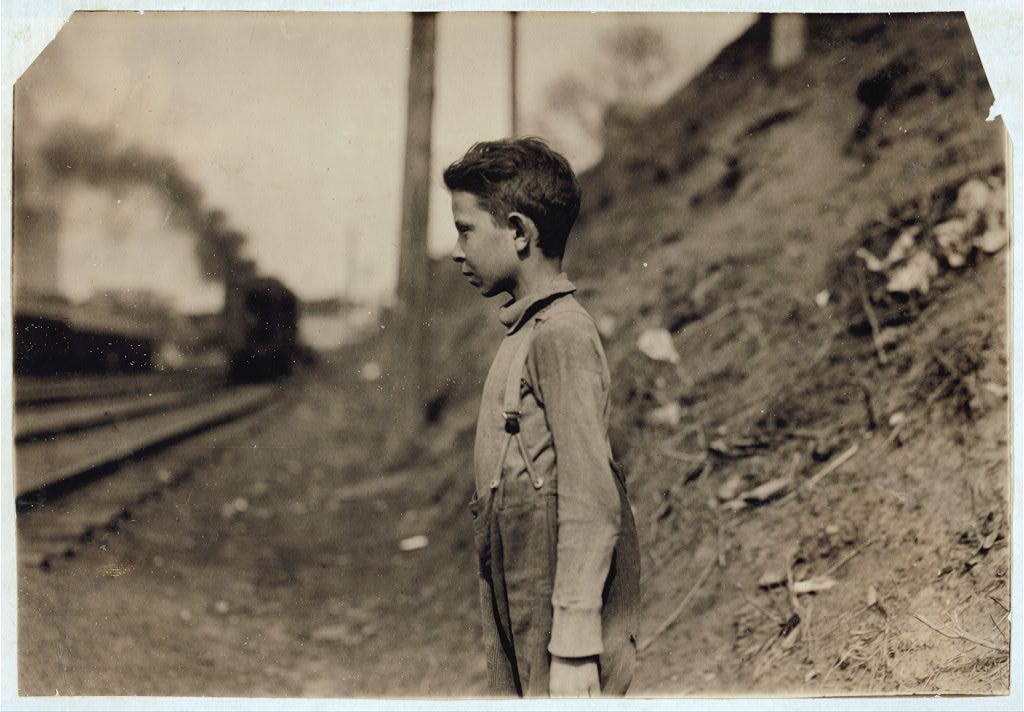
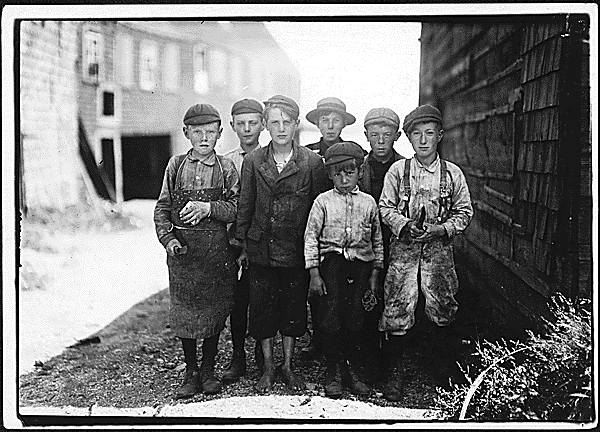
Hine was by all accounts an extremely humble man who had a deep inner desire to help people in need (p. 35). Perhaps this humility and compassion for people proved to be the right blend for photographing children. He was able to quickly gain the kids’ trust, even though most had never seen a camera before (p. 33).
Nemerov, in one paragraph, describes what it must have been like for the children who met Hine and his camera.
“[Hine] has stopped in front of you and your friend and asked to take your picture. The stage is set for an event that is improbable to say the least. You are about to be immortalized, not just in the simple sense in which someone, anyone, might take your picture … Hine, via his special gift, might intuit you as a fellow-being-in-time, barefoot a-skate in the gritty ambit of life’s ceaselessly forgotten moments.”
The book’s title, Soulmaker, is at first odd. It implies that Hine made the souls of the kids he photographed. Nemerov clarifies this question.
“Hine’s intuition of time is one in which, all in a moment, only in a moment, he might invent a person’s soul. Not that you do not have a soul already … But he (Hine) brings something that you do not have … The image he will take might set loose something so volatile you scarcely knew it was a part of you. Indeed, it was not, until he came along. Whatever it is, it may contradict your whole life. The (work) rituals that you have been told daily build your soul now vanish, spread to the winds as inconsequential, replaced by a sensation like a breeze passing across your face. For Hine, who we are is our momentariness, alight in the scatter of our circumstances” (p. 23).
In the late 1920s and early 1930s, Hine turned his camera toward older workers, specifically the men who built the Empire State Building in New York. These photographs were published in his 1932 book Men at Work. These photographs also remind us that “human toil is at the center of things—no matter how dwarfed by machines the worker may be … And if he is a martyr to his labor, we do not see his tragedy but rather the mint of his worth” (p. 159).
Today, many people hypothesize that AI will impose on us a new type of Industrial Revolution. We can hope that people like Hine who believe in the intrinsic dignity of every human will prevent the dehumanization that occurred then from happening now.
“The interests of them who own the property used in industry is that their capital should be dear and human beings cheap.” — Richard Tawney, British educator (1880-1962)
Comments
Nothing yet. Say the first thing.
Sign in to join the conversation.