
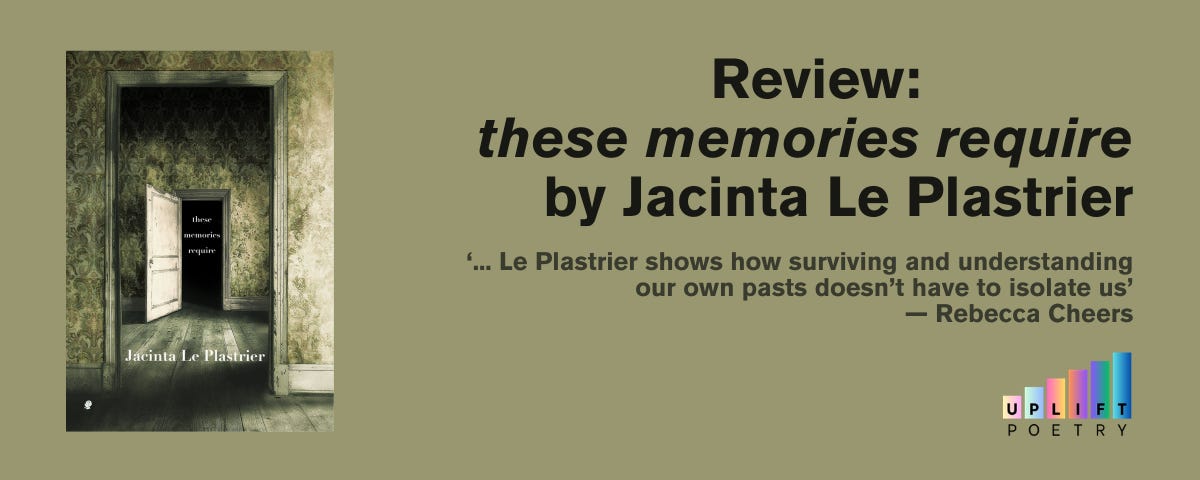
‘… through these poems, Le Plastrier shows how surviving and understanding our own pasts doesn’t have to isolate us. It can give us an affective structure for understanding other harms, from the smallest to the most world-altering.’
Scroll down to read Rebecca Cheers’s full review of these memories require by Jacinta Le Plastrier (Puncher & Wattmann, 2025).
Content warnings: discussion of abuse, violence and trauma
Want to send us books for review?
Uplift Poetry is a poetry community hub that provides poetry resources for the community, by the community. We publish comprehensive weekly poetry newsletters that reach over 1,900 poets across Australia, and worldwide.
If you would like to send us review copies of upcoming poetry releases, you can mail them to: Uplift Poetry, PO Box 465, Toowong DC QLD 4066 or email us at upliftpoetry@gmail.com
these memories require (Puncher & Wattmann, 2025)
by Jacinta Le Plastrier
Reviewed by Rebecca Cheers
I teach a class where we look at the same wonderful Sharon Olds poem every year, ‘I Go Back to May 1937’. The poem stages an impossible temporal heist, using an old photo of the poet’s parents as a portal, one she could climb through to warn them of what’s coming: you are going to do bad things to children, you are going to suffer. But, having weighed every time-rending possibility, the poem ends by conceding to the present. It lands on the only true agency of the poem’s speaker: Do what you are going to do, and I will tell about it.
I love this final line, its defiance and filial disobedience. But if I’ve learned anything over years of writing, of wrestling with vulnerability and self-disclosure and their consequences, it’s that ‘telling about it’ isn’t that straightforward a thing to do. Writers are sold a fantasy, that to write about our past is to expunge it, render it neutral and harmless, take control. But the how, the when, the why of telling it, what it asks of the teller, what it can do for them or to them, is far thornier.
In these memories require, Jacinta Le Plastrier writes into these questions from every angle. The book deals with memories of childhood, and those memories are handled most often in negative space: in brief, brutal detail, or in absences, like the pages of redacted disclosures in ‘Catalogue’ (47). It refuses the demand, constantly made of artists, to bleed all over the page to earn the right to be listened too. It focuses instead on what it means to carry such memories, that impose and recur and neurobiologically reshape us. And the bitter, complex truth that the memories become load-bearing parts of us: it was the house/that taught you/how to write (3).
There are many poems here that resonate with me, and put something wonderfully into words. They understand the way that post-traumatic changes to the mind can give us a different relationship with the past, life becoming a snakes-and-ladders game of involuntary time travel. However well we know that you can’t change/what has happened, can what will (42), that the past is a one-way street, other parts of the mind and body may disagree. That dissonance is so well-articulated here: my tongue split/in so many directions/i could not be understood or trusted (39).
Comments
Nothing yet. Say the first thing.
Sign in to join the conversation.