
I’m a goner for Andrew Sa’s voice. I think his voice first as an instrument with its own distinct sound and timbre. It doesn’t matter what he’s singing, it’s just intoxicating in the best way. There are so many hints of other favorites in there I could point to — Rufus Wainwright, k.d. lang, Chet Baker, Anita Baker, Ella Fitzgerald, Reba McEntire, Wynonna, Patsy Cline — but it all adds up to Andrew Sa alone.
Andrew has become a good friend of mine since I moved to Chicago three years ago, and I’ve been WAITING to share his debut album, American Rough, with you all since I first heard it a few months back. Not to oversell it, but this record is a technical and creative marvel — from his songwriting to his vocal delivery to the production values of H.C. McEntire and Missy Thangs. It’s a whole vibe just perfect for late-night listening — and all that goes with those late-night activities Andrew’s singing about on the album.
So, check out the video or audio of our conversation above, or dive into thewritten Q&A version below, edited for clarity and length. Sprinkled throughout are a few live clips of Andrew’s album release show at The Hideout in Chicago so you can see he delivers all of this live, too.
HK: Andrew, I am so happy this album is here. I’ve been waiting for it, and it’s been nice to let this music unfold over several listens. I’m struck by how alive the albums sounds. You hear the musicians in the room making the music. How important was it to make sure that human element was apparent on American Rough.
AS: What you’re hearing, a lot of that is obviously from my engineer and my producers. Missy Thangs, who produced along with H.C. McEntire and engineered all the sessions, talked a lot about allowing bleed in the mics. We tracked live for drums and bass and guitar and piano, and we didn’t isolate the mics there.
We had a lot of conversations about wanting to make something that sounded both modern and classic at the same time. I think about those old Patsy Cline sessions Owen Bradley produced where they recorded her with the big orchestra in the same room. We didn’t do that, necessarily, but we were reaching for that kind of feeling.
HK: I’ve listened to this album during the day and at nighttime, and I have to say this album really comes alive at night. It’s a very nocturnal album for me.
AS: I’m the type of guy that prefers to not go to a matinee. There’s something about the sun going down and allowing your imagination to take over, your personal vision to become clearer, and allowing the magic to start, as I like to say. So, I love that you said that about night versus day.
HK: Listening at night, I’m able to hone in on your voice. The way the album is produced, there is so much room for your voice to navigate and be the center of attention, which is what I’ve been waiting for. You have such a unique tone to your voice and vocal style, and that’s rare these days. How did you develop that?
AS: God, I don’t know. I’ve been singing forever since I was seven or eight. That’s when my mom was shoving me up on karaoke stages to warm up the crowd. I think a lot of that early development for me was mimicry, parroting what I was hearing. Patsy Cline, obviously, and Roy Orbison, and then later in life, people like Rufus Wainwright and k.d. lang.
I’ve definitely had vocal lessons and trained my ear, and then I had an education in theater, where I broke my habits and tried to find a less personal, unique sound to appropriately convey whatever the character I was inhabiting would sound like.
I think it finally gelled and felt like me maybe seven or eight years ago when I met Patrick Haggerty and returned to country music.
HK: The first few times I listened to American Rough, I really just listened to your voice as an instrument, because it does have such a distinctive sound. It’s the same kind of experience when I’m listening to someone singing in a foreign language I don’t understand. I’m just enjoying the timbre of their voice and the musical choices they’re making.
Then, digging a little deeper, the lyrics started to emerge for me and I eventually read the lyrics. Your writing is very impressionistic. There’s not a lot of words. There’s an economy of words going on. Did you ever start out writing a lot of words and then realizing you needed some space and some long vowel sounds to really spread out a bit for your vocal style?
AS: That has obviously come through trial and error. I definitely used to try and cram too many words into a song early on when I was writing. It’s like the first pancake you have to throw out. I was rhyming a lot, like Dr. Seuss kind of stuff, just ‘cause I thought that was the way to write a song, or write poetry.
It’s so interesting for you to say an economy of words. When I started taking songwriting classes at the Old Town School of Folk Music, I remember my teacher saying, “Listen, you’ve got limited real estate for language in these songs. How do you say something that is concise but also poetic? How do you clearly convey the message but also allow the space for your listener to create their own story or their own perspective on the story?”
I would say reading poetry has really helped me understand that economy of space. I definitely follow the old actor adage of less is more.
HK: Well, this album resonated with me as an unabashedly queer, erotic piece of work, which also ties in to the night time listening I suggested. On a song like “You Turned Me On,” it’s very sexy, but it’s a slow-burn eroticism. Tell me about owning that approach on this record.
AS: I think back to this Dolly Parton quote, which is something along the lines of, “Find out who you are and do that on purpose.” I’ve really been leaning into things that maybe I’ve felt shame about…certainly certain things that others have put shame upon me about.
I definitely want to write music for lovers. And who doesn’t love sex? I really wanted it to feel romantic sexually, and sometimes when you get into very clear, explicit lyrics there, it doesn’t leave room for romance, or interpretation of that eroticism. These are things I wanted to offer my audience.
These songs are a collection of what I call devotionals. These are songs where I am placing myself as the devotee, basking in the light of my other. That is a way that I love other people. That’s a way that I love to love other people, which is kind of hard to convey or portray as a man.
With a song like “Under You,” which is very much about submitting to someone else and loving that person in that way, I can’t tell you how many straight men have come up to me and expressed their gratitude for a song like that.
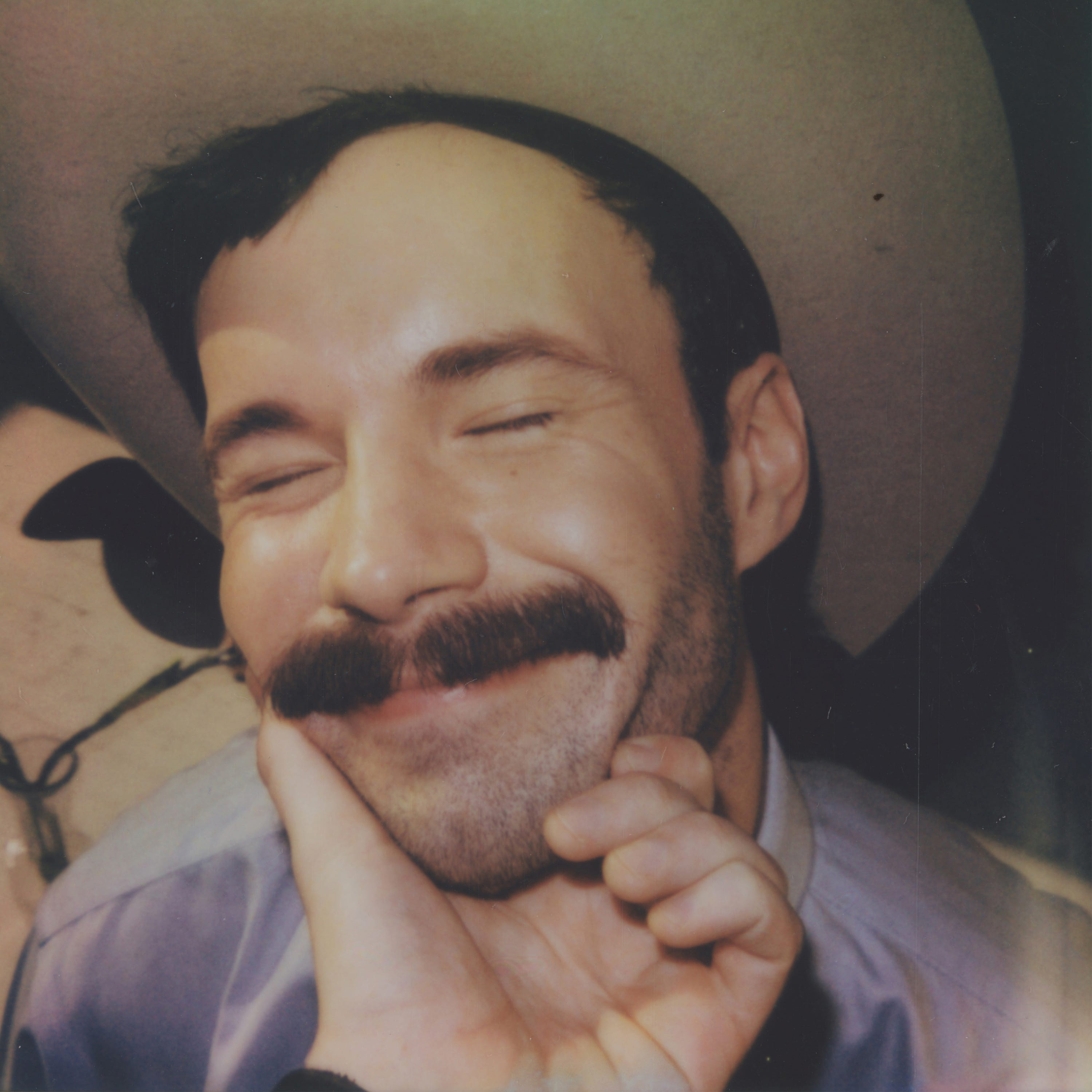
The album cover is also based in eroticism. The hand holding up my face — I call it the “Good Boy” cover, in relation to a bunch of photos that I’d seen of people holding up their dogs’ smiling faces. And I’m not necessarily alluding to puppy, or pup culture, which is great. Maybe people would see themselves in the album cover in that way, right?
For the cover, I knew I wanted something that was evocative, even provocative. I wanted it to be a Polaroid, which it is. It’s an untouched Polaroid. We were really inspired by the art of Robert Mapplethorpe for that photo shoot. Also my partner told me that Hugh Hefner wanted the presence of a man in every photo. That could be anything, right? It could be a cigar sitting in an ashtray — or in this case, a man’s hand reaching into the frame. So, that was also part of the cover.
HK: Going back to the eroticism of this album, you do get very straightforward about sex on the opening track, “American Rough,” using the phrase “bumping uglies” as a euphemism for sex.
AS: Which I heard for the first time watching Sweet Dreams with Jessica Lange as Patsy Cline. They said “bumping uglies,” and since I’m from California I’d never heard “bumping uglies.”
HK: Oh, I’m from Alabama, and I’d definitely heard that.
AS: I love that expression.
HK: Even with that phrase, “American Rough,” it brings to mind the Marlboro Man — a cowboy who’s in control that you are submitting to. So, did you want to set a tone with that kind of crass, upfront statement at the top of the album?
AS: I didn’t think “American Rough” was gonna be the first track. I didn’t think it was gonna be the title of the record initially. I wasn’t even sure if that song was gonna make the record, ‘cause it was just me snapping my fingers and singing along with that harmony. But my collaborator, H.C. McEntire, said, “Oh, there’s something in this that is overarching on the record.” And she’s not wrong. This character, or this cast of these men really fit that picture of “American Rough.” I think of rough trade, blue collar, kind of DL guys.
It ultimately felt like a very strong title for the record, and also something that I think people can look at or read or even hear and think, “What does that mean?” “American Rough.” They get a feeling from it, but they don’t necessarily know exactly what it means.
It also came out of me reading Leaves of Grass by Walt Whitman, and there’s a collection of poems called the Calamus poems, which are truly about manly love between men, masculine affection between men. And I don’t remember when those two words came together from reading those poems, but they did, and it came strong.
HK: It sets up the entire album of you wanting to submit to someone and for that person to lead the way. I hear it in later songs like “Follow,” “You Turned Me On,” where you’re looking for guys that look like him.
I also love “Gorgeous Things,” which has a little bit of that danger of being somewhere you shouldn’t with someone you shouldn’t be with.
AS: There’s a real balance with the songs later on the record — “Where It Lands” and “Fightin’ to Be Fightin’” — where there’s maybe a consequence to that danger.
HK: H.C. McEntire is a producer and co-writer on several songs on this album. How did you meet and what was your collaborative process like?
AS: We were both interviewed separately during the pandemic for this No Depression article about the intersection between queerness, cosmic country, and astrology. I remember seeing her photo and her name and thinking, “Oh my God! Is she related to Reba?” She’s not, but that was my initial intrigue. Then I listened to her record, Axis, and thought, “Woah! This person has a truly beautiful, authentic country voice.” And I was really taken by her poetry. I wasn’t hearing other country-leaning artist write the way she writes.
She lives in Durham, North Carolina and put together the band for us made up of her players, like her amazing guitar player, Luke Norton. I saw them play at Scuba’s here in Chicago just after the pandemic, and I was so taken by both of them. I was so nervous to talk to them after the show, but my manager was with me and said, “We should ask her to produce the record.” She had never produced anyone else’s record before, so we were both taking some big risks together. She and I are actually very similar in our family backgrounds and the way we were raised in the church, even though we grew up on opposite sides of the country.
Writing songs is truly the most human, magical, dreamlike fantasy for me, and that’s especially true when I sit down and write with H.C., another queer person who wants to make the same kind of music that I want to make, and who balances me. She’s a butch lesbian person, and I’m a rather femme gay person, and somehow we become this every-person.
HK: You mentioned him earlier, but the late Patrick Haggerty, who performed as Lavender Country, was a huge inspiration for you and inspired your song on the album, “Lavender Cowboy.” I hear so much of his musical approach in your music — his candor about queer life and not being afraid to expose and even celebrate the seedy underbelly of that experience. How did his approach to country music shape you?
AS: I was introduced to Patrick when I opened for him at The Hideout in Chicago in 2018. I didn’t know anything about him before that, so I listened to his record. I was raised with country music, but I never saw myself clearly portrayed. Sure, I can align with Patsy or Reba or Trisha [Yearwood] or Wynonna, but I’m not a woman. There are so many nuances to what it means to be a gay man, especially in America and especially in country music. So, hearing Lavender Country for the first time, I thought, “Oh, this is something special. This is a window or a doorway for me.” It was that night at that show that I realized I could return, and I wanted to return, to country music. I wanted to dig back in to the inception of my love for music, so I often say that he gave me permission.
That’s happened a lot in my life. I remember I was in my teens when I heard Rufus Wainwright’s Poses for the first time. It was a similar experience. I saw myself. I saw the possibility for me to be an out, outspoken, queer crooner singing romantic, longing songs. Rufus gave me permission to even dream that this would be possible, much like Patrick did.
Patrick was so brave. He was so brave and strong at times, but he would tell stories during his performances that were aching, breaking. He would have the entire room in stitches and then in tears, and I wanted to be able to do that sort of thing as well. My background in theater meets my love for country music. I just saw so much of what I wanted to do in Patrick’s performance. We became fast friends. I’ll always remember the wonderful times that we got to share together, and the projects we’d planned together that didn’t come to fruition, and the bowls we smoked together. All the good stuff.
HK: Let me just say, your album taps into the intersection of jazz/pop vocal and country that I love so much. I’m thinking about Willie Nelson’s Stardust album and k.d. lang’s country stuff, Shadowland and Absolute Torch and Twang. All of that influenced or was at least marketed as mainstream country music at one point, but now I don’t see much of anything in mainstream country that touches that style. There are a lot of guys who want to play at being “American Rough” in the format, but it’s not a real confidence. They just seem like insecure little boys who haven’t done any introspection whatsoever.
AS: The presentational masculinity that we see… My name, Andrew, actually means “strong” and “masculine,” and for a long time I made a joke about that. “Oh, little did they know I’d turn out be who I am.” Yet, I think I’d like to challenge what we believe to be strong. What is strength? And what is masculinity? ‘Cause I think we’ve lost our way in that.
HK: I feel like I should add that your partner of 12 years [now Andrew’s fiancé] is very tall and very attractive. So, in listening to a song like “Where It Lands” and so many songs on American Rough, it’s very easy for me to put him in that role of the person you’re having sex with.
AS: He’d be real happy to hear that. He’s certainly of the “American Rough” ilk, in his own way. He may have a bit of makeup on, but he is still “American Rough.”
HK: In closing, I want to talk about our mutual hometown of Chicago and the role that it plays in this album. You’ve certainly been an anchor for me since I moved here three years ago. But there’s this entire galaxy of queer, creative freedom that exists here among artists. So, how has this city nurtured you and how does that show up on the record?
AS: First and foremost, because of the subject matter, Chicago truly was my sexual awakening, my sexual liberation. I would even say my romantic liberation. I’ve had so many life-changing, life-affirming romantic and sexual experiences in Chicago. I met my partner 12 years ago here in Chicago. So, I want to say that.
But musically, Chicago was the place where I started learning how to write songs at the Old Town School of Folk Music. I started playing out in bars for the first time. The first open mic I ever did, these guys walked in off the street and started booing me and telling me that I sucked. I moved to Chicago saying I wanted a challenge, and I sure got it. And I kept going.
The music community that I am a part of, that I have been included in is very supportive of each other. Liam Kazar, who wrote “Under You” for me and co-wrote “Gorgeous Things” with me, is a dear friend and a brilliant songwriter. He was the first person to really encourage me to start reading poetry, and he’s made me a much better songwriter.
And then there’s all the incredible musicians I’ve been able to play with in Chicago. I found after many years of doing this that I didn’t have to be the source. I didn’t have to be the person playing the instruments, and the one writing the material, and the one belting my face off. Together as a group, working with others, we are all so much stronger. I think it’s so easy to feel isolated and to think you can’t reach out for support. But asking for help has changed my whole musical career. My music community in Chicago has not only opened their arms to me since I got here in 2009, but they’ve kicked me in the ass when I needed to get kicked in the ass.
Catch Andrew Sa on tour:
July 28 — Los Angeles, CA, Zebulon
September 15 — Nashville, TN, Americana Fest
October 8 — Chicago, IL, The Chicago Theatre (John Prine 80th Birthday Tribute with Hurray for the Riff Raff, Joy Oladokun, Margo Price, Shemekia Copeland, Steve Earle and more)
Comments
Nothing yet. Say the first thing.
Sign in to join the conversation.