
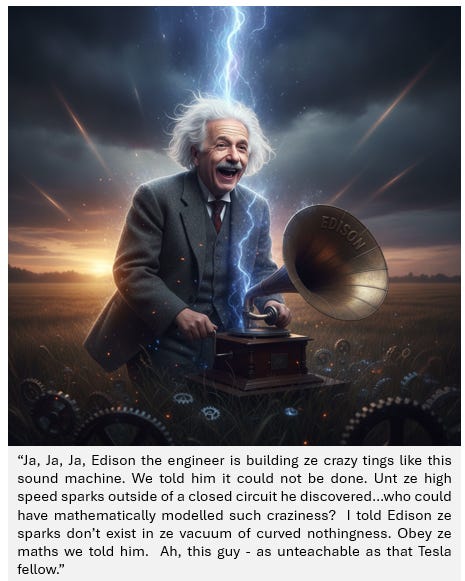
“This phenomenon [etheric force] is an entirely new force of nature... operating directly through the ether substrate without ordinary electrical charge.” Thomas A. Edison, 1875 Laboratory Notes and Press Briefings.
“I don’t think anything of Einstein’s theory because I can’t understand it... [My son] may go flying into the clouds with that fellow Einstein. And if he does that, I’m afraid he won’t work with me.” Thomas A. Edison, 1923 Interview following his son’s graduation from MIT. I wonder what Thomas would think of MIT and the Ivy League now….
Yet another aetherist and mechanic whose true story is rarely taught.
The real work of Thomas Edison embarrasses the thin armed math wizards with their abstruse claims and declamations that all technological progress was a top-down victory by geniuses and theoretical mathematical models. Misinformation and propaganda are spoon fed to young minds and the masses that the mathemagician-druids with chalkboards and pencils, scribbled abstract equations, declared truth and reality, conjured a design which they then handed over to ordinary mechanics and engineers, who after bowing low to the ground, went off and built the toys.
Piffle.
Real scientific history tells us the exact opposite story. Witness electricity. The modern grid was not built by the blackboard deduction wizards; it was developed out of the physical environment by tough, self-taught practical engineers who completely ignored the academic ivory tower. Chief among these ‘science-deniers’ was none other than one of history’s greatest practical scientists and inventors: Thomas Alva Edison. Edison’s story ends with a surprise twist; and his physics and belief in an aether are always ignored by the gatekeepers.
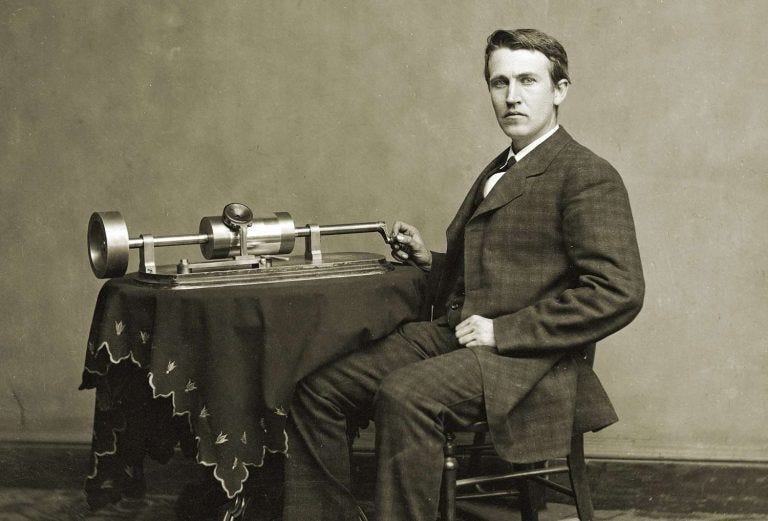
Thomas Edison was not a “scientist” in the modern, institutionalized sense of the word. He was an aggressive, relentless industrial engineer, material strategist, and very capable businessman. Largely homeschooled and entirely decoupled from the rigid academic tracks of his era, Edison viewed the universe not as a mathematical equation to be solved, but as a physical workshop to be organised. He operated on a simple, brutal philosophy: if it doesn’t have immediate, real-world utility and commercial viability, it was a waste of time and not worth pursuing.
Unlike Ben Franklin, Edison was not birthed into grinding, suffocating, working class poverty, but he certainly suffered from precarious economic circumstances. Little in the way of White Privilege was attached to Thomas Edison. He was born in 1847 in Milan, Ohio and his Canadian-born father ran a highly successful timber and shingle mill, ensuring that the family enjoyed a relatively stable, middle-class life. Then in the mid-1850s a new railroad was built which bypassed Milan and eviscerated the town’s canal trade. The local economy collapsed, taking the family’s business and related financial security with it. The Edison’s were forced to move to Port Huron, Michigan, to start over in severely modest circumstances.
This sudden slide into financial hardship left a permanent impact and attitude on the very young Alva Edison. By age 12, he was working on the Grand Trunk Railroad, wallowing in his White Privilege selling candy, sandwiches, and newspapers to passengers. But this is Edison. The young boy did not just hand out and sell newspapers; he decided to buy an old printing press and established a printing business in the baggage car. He wrote, promoted, printed and distributed his own newspaper, complete with spelling mistakes and his own opinions, to train workers and travellers - at the age of 12…..
Edison’s train newsletter prospered but he was not content with this single endeavour. In 1859 Edison’s White Privilege meant a daily ride from Port Huron to Detroit and back on the Grand Trunk Railroad. The train would arrive in Detroit in the morning and return in the evening, leaving the young Edison with a 5 hour layover to fill. Today most parents would not allow ‘their 12 year old Edison’ to ride once on such a journey without a drone filming every second of every minute.
So what did the 12 year old, mired in his White Privilege do with the 5 hours granted to him each day? Well of course Edison sat in the Detroit Public Library and taught himself science and mechanics. What 12 year old today doesn’t do the same? He was especially interested in energy and electro-chemistry. But this is Edison we are discussing. He wasn’t interested in theory and reading and falling asleep after wading through a textbook. Edison wanted to know if any of what he was ingesting was real or practical.
By the age of 15 he convinced the conductor of his train to let him utilise an unused corner of the baggage car so he could run his chemistry experiments during the layover and transit. This would allow him to test what he had read and documented. In 1862 the train had a near accident, careening on the rails and knocking one of Edison’s phosphorous vials to the floor which burst into flame setting the baggage car on fire. The fire was extinguished and Edison was punished, his equipment dumped from the moving train.
A few months after this event the 15-year-old Edison found himself in Mount Clemens, Michigan on a short layover. He spotted a runaway boxcar rolling uncontrolled down the tracks toward a three-year-old boy, James MacKenzie, who was playing in the dirt. Edison reacted and was quick enough to rescue the boy and save him from being crushed. Good fortune for Thomas. Fate had intervened.
James MacKenzie’s father just happened to be J.U. MacKenzie, the station master. Deeply grateful to the teenager who saved his son’s life, MacKenzie offered Edison a reward and future investment that money couldn’t buy: he taught the young man the art of railroad telegraphy in the station’s office. This was significant and changed Edison’s trajectory (1863-1869).
Telegraphy in the 1860s was the leading edge of technology, akin to AI and agent-process automation today. Learning this ‘high tech’ hands-on turned Edison into a highly specialised, mobile asset. For the next six years, he became what was known as a “tramp telegrapher,” wandering from city to city across Ontario, the US Midwest and South (including stops in Cincinnati, Louisville, and Memphis) taking night shifts at telegraph offices. He was charged with relaying messages using Morse code, a technology that was used effectively by the North in the US civil war.
For Edison, the practical young man now in his late teens, such a transient lifestyle was both a cross and crucible. Edison deliberately took the midnight-to-8 AM shifts since it conferred hours of uninterrupted engagement with experimentation. Edison spent his time taking apart equipment including Western Union telegraph keys, testing batteries, and studying how electrical currents moved through lines. Telegraphers in the 1860s had to understand the physical behaviour of wires, ground loops, and the atmospheric conditions which affected signal strength.
Edison learnt how to read the “feel” of a wire through his fingers rather than relying on a textbook or a maths equation. He even invented a device to send signals automatically over the wire (to signal to his boss that his station was alive and well) and experimented with a duplex and quadruplex box, sending 2 and 4 signals over the same line at the same time.
Edison had knowledge and skills but his White Privilege was in short supply. In poverty and rags he traveled to Boston where he found employment and after spending 2 years earning a reasonable wage he left for New York, mired in debt from overspending. His income was never enough to match his expenditure on books and experimentation.
In 1869, at age 22, Edison arrived in New York impecunious and sleeping on the floor of a battery room in the Wall Street district. His salvation appeared when the mechanical telegraph system in the Gold Indicator Company broke down, causing mass panic on the trading floor. Edison had somehow found himself at the scene and identified a broken spring in the telegraph machine that had jammed the gears and fixed it in minutes. The company hired him as their supervisor.
Edison being Edison re-engineered what he saw as fairly primitive processes. He rebuilt the ‘stock tickers’ and the upstream processes providing ticker information. He created the ‘Universal Stock Printer’, a highly resilient ticker that synchronised multiple machines to print identical financial data over a single wired connection. He patented his work. The inventions were so transformative that Edison approached the President of the Gold and Stock Telegraph company for money in exchange for his patents. He was offered $1 million in today’s currency and was so stunned by the compensation he almost fainted.
This transaction was the launch pad. Edison took this impressive pile of capital and did exactly what a hyperactive inventor would be expected to do: he bought machinery, hired engineers, and opened his very first dedicated industrial invention factory in Newark, New Jersey. The poor train-boy who set his own baggage car on fire had officially become a professional industrial force and businessman. White Privilege hard at work.
While the sundry theoretical physicists of the late 19th and early 20th centuries were busy inventing abstract dimensions to balance their equations, defend their philosophies, polish their mathematical bona fides and impress the ladies in the salon, Edison’s Menlo Park (a small lab with 8-10 assistants) and West Orange laboratories were producing the foundations of what in part would become modern living (Baldwin, 2001):
The Phonograph (1877): The first machine in human history capable of mechanically etching and reproducing acoustic vibrations from solid wax and foil cylinders. The mathemagicians said this was impossible.
The Incandescent Light Bulb (1879): This truly is an epic triumph of material science, requiring thousands of exhausting trials to find the perfect carbonised bamboo filament that could survive electrical current inside a structural man-made vacuum. The mathemagicians ran their equations and pronounced this to be unachievable.
The Carbon Microphone (1877-1878): This was the vital component which compressed carbon granules under acoustic pressure, transforming telephone and broadcast tech from a faint whisper into a high-utility reality. We briefly referenced this when discussing the telephonic hardware of Alexander Graham-Bell (Forbes, 1920). The mathemagicians had informed Bell that sound down a wire was infeasible.
The Electromotograph or the Chemical Telephone (1877-1879): In 1877, to bypass Bell’s restrictive patents on electromagnetic telephone receivers, Edison invented the Electromotograph (often called the “chalk receiver” or chemical telephone). It was the first loudspeaker and was created to rival Elisha Gray’s ‘Musical Telegraphy’. Edison was told by the academics that such a system was impracticable.
The Commercial Electrical Grid (1882): The deployment of the Pearl Street Station in New York City was the world’s first central power plant utilising a massive, localised network of copper conductors, dynamos, and switches. This power station employed the Direct Current model, which was superseded by the vastly more scalable method of Alternating Current, developed by Tesla. Tesla worked for Edison and was instrumental in fixing and redesigning many of Edison’s technologies. The mathemagicians declared that generating the required current strength could never be sustained over any distance.
The wizards had one refrain: “Stop Thomas, it cannot be done”.
Consider the lightbulb. When Edison announced his plan to subdivide electricity and bring an incandescent lamp into every living room, the ‘titans’ of European and American academia formed a united group and declared him to be a fraud. Sir William Preece and his mathematical cohorts ran Edison’s plans through the Ohm’s equations and Joule’s ‘laws’, triumphantly declaring that a parallel electrical grid would require infinite current and copper mains thicker than redwood trees. Yes that is what they said.
Of course the math was elegant, noble, well dressed, articulate and pristine. The same would be true of the mathemagicianism from the Messiah Einstein and his impressively mutilated tensor calculus. They were pretty and completely wrong.
Edison, unburdened by university dogma or state propaganda, bypassed the irrelevant formulas by directly investigating raw material. Edison and his lab created a high-resistance carbonised thread inside a mechanical chamber, and reduced the required current to a small fraction of what was mathematically calculated, rendering the academics’ tree-trunk calculations incoherent and ridiculous. Thus was the incandescent bulb developed and realised.
Maths is often described as the ‘language of science’. More nonsense. Maths should notate mechanical experimentation and reality. If you feed any equation a broken, short-sighted assumption about the material world, it will flawlessly calculate a lie every single time. This is one of the issues with AI of course.
Edison is an inventor who can be cited within a continuous line of some 200 years of experimentation performed by men who believed in an energised substrate and aether. Before the twentieth-century and before the mathemagicians had declared space to be an empty curved void, the keenest intellects in physics understood that energy could not travel without a physical substrate. Edison’s practical mastery of electricity directly inherited the mechanical insights of his predecessors.
1. Hydraulic Foundation: Benjamin Franklin
As we previously discussed Franklin proved that electricity is not an abstract charge but a single, highly elastic atmospheric fluid plenum. He established that electrical phenomena are simply localized pressure imbalances (positive excesses or negative deficits) seeking equilibrium within a continuous matrix.
2. Physical Lines of Force: Michael Faraday
In the 1820 and 30s, Michael Faraday took Franklin’s fluid concept and mapped it to magnetism. Faraday completely despised abstract “action-at-a-distance” mathematics. When he placed iron filings over a magnet, he didn’t see an equation, he saw physical lines of force. He deduced that space is a dynamic dielectric (insulating, capacitor) medium, and that electric and magnetic forces are literally the mechanical tension, stress, and shear strains taking place inside that underlying aether substrate. Faraday built the first batteries.
3. Vortices: James Clerk Maxwell
James Clerk Maxwell took Faraday’s raw mechanical intuition and provided the concrete engineering blueprints. In his 1861 treatise, Maxwell didn’t invent abstract spacetime. He modelled the aether as a literal; physical fluid network composed of spinning molecular vortices separated by rows of rolling idle wheels acting as ball bearings.
When Maxwell calculated the mechanical elasticity and density of this physical vortex network, the wave speed of its internal vibrations matched the speed of light. He proved that light is not a magical packet flying through nothing; it is a physical wave propagating through a mechanical medium.
4. Acoustic and Electrical Waves: Alexander Graham Bell
Alexander Graham Bell directly applied this medium-based worldview to communication. Bell understood that sound waves are compression and rarefaction ripples moving through a physical air medium. His telephone simply took those physical acoustic waves and mapped their exact geometric frequencies onto corresponding electrical pressure waves traveling through a physical copper wire medium.
Building on the aforementioned engineers Edison’s validation of the medium continuum occurred in 1875. While tweaking a high-speed telegraph key, he noticed a strange, microscopic spark jumping between un-connected metal objects in his lab. According to standard electrical circuit laws, this was impossible because there was no closed loop or return wire.
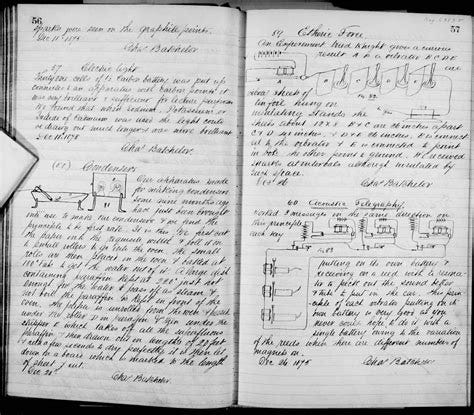
Rather than dismissing it or trying to force it into a textbook equation, Edison recognized it as a radical mechanical phenomenon. He named it “Etheric Force” (Edison, 1875). The establishment howled and laughed, Scientific American and other gatekeepers mocked Edison. As usual they were wrong.
Edison understood that he had cracked open the universal fluid medium itself.
By rapidly interrupting the electrical current, Edison and his assistants weren’t just moving charges down a wire; they had created a sudden, violent kinetic shockwave that rippled outward through the atmospheric aether matrix, causing distant metal objects to vibrate in sympathy like tuning forks. They had chanced upon the beginning of radio and networking. What Edison built:
Transmitter: A battery-powered spark gap vibrating at high frequencies, connected directly to a 12 x 8-inch sheet of tin foil which acted as the world’s first rudimentary radio antenna.
Medium: The spark gap discharged high-frequency electromagnetic pulses directly into the aether plenum.
Receiver: A second sheet of tin foil placed feet away, connected to the ground. Sparks could be seen jumping across a minute gap in the receiver plate, physically proving the wireless transit of energy.
Marconi later bought Edison’s radio patents. The Establishment never apologised to Edison who had built the world’s first viable radio and set a foundation for understanding wireless transmssion.
As usual ‘The Science’ and academic elite later rebranded Edison’s aetheric ripples as “Hertzian waves” and eventually “electromagnetic radiation”. They never credited Edison who knew that you cannot have a wave without a physical medium to carry it, and you cannot build a global electrical grid without mastering the pressures of the universal plenum (Jehl, 1937). That is how ‘The Science’ plays the game.
Edison’s contempt for the academic elite and theoretical mathematicians was legendary. This is one reason why the author admires Edison (amongst a 100 other reasons). Edison famously remarked:
“Men who have gone to college I find to be amazingly ignorant. They don’t seem to know anything... I can hire mathematicians at fifteen dollars a week, but they can’t hire me.”
Amen Thomas. I think you meant ‘mathemagicians’.
For Edison the mathematical “wizards” were of no value. They wrapped simple mechanical facts in complex, esoteric geometry to justify their university salaries, while contributing absolutely nothing to the physical optimisation of human life. He recognised that when you substitute abstract formulas for hands-on, empirical trials, you stop interacting with sreality and start building a secular theology.
The 1921 Edison Test: Sifting the Ignorant
By 1921, Edison had grown so completely exhausted by arrogant, college-educated applicants who couldn’t handle basic real-world infrastructure that he designed a brutal 146-question employment test for his manufacturing sites. He used it as a “brainmeter” to weed out the credentialed elite, asserting that their expensive university degrees had left them functionally useless in a real engineering environment (Hounshell, 1980).
The test became a massive public scandal. University students across the country failed it miserably. But the test’s most high-profile casualty was none other than the theoretical Messiah of physics himself: Saint Albert of the Einstein.
During his first triumphant tour of America in May 1921, to raise money for Zionist causes and the Rothschilds; eager reporters in Boston ambushed Einstein with questions lifted directly from Edison’s recruitment exam. Einstein was immediately stumped. When asked a basic physical fact ‘the speed of sound’ the Messiah, the ‘lone genius’ who had saved ‘science’ and rescued humans from ineffable stupidity couldn’t provide an answer (The New York Times, 11 May, p.1.).
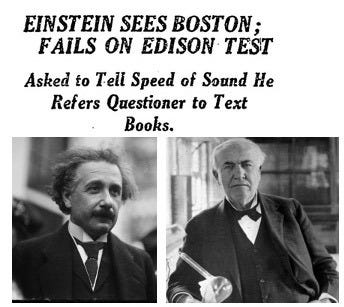
Einstein offered the classic quackademic rationalisation, stating he felt no need to “carry such information in my mind since it is readily available in books” (Frank, 1947). But to Edison and the mechanical realists, this was a total admission of the fraud. The theoretical elite could calculate the curvature of imaginary spacetime billions of lightyears away, but they were completely blind to the empirical reality confronting them in their daily lives (Halpern, 2015).
Sample Questions From the 1921 Exam
Here is a sample of some of Edison’s exam questions. I wonder how many graduates in physics would pass it today - far less than half would be a solid estimate.
What is the speed of sound? (The exact question Einstein failed).
Of what kind of wood are axe handles made?
What ingredients are in the best white paint?
How is leather tanned?
What causes the tides? (we discussed in another post why the Newtonian-Laplacian explanation is a laughingstock and utterly wrong, but still taught of course)
What city in the United States leads in making laundry machines?
Who was Bessemer and what did he do?
What is a caisson?
What is celluloid made from?
Who invented the modern paper-making machine?
Who invented the typesetting machine?
Who invented printing?
How is leather tanned?
What is artificial silk made from?
What is shellac?
How practical and relevant is ‘modern education’?
Then we have the curious affair of Edison’s wealth. When Edison died at age 84 in 1931 his total gross estate value, including stocks and all assets, was U$12 million or roughly 10% of what Ford had accumulated. From humble, impoverished beginnings Edison had done very well, but he was not nearly as wealthy as most assume. In the pursuit of innovation and mechanical engineering Edison was a profligate spender and that negative balance sheet consumed a lot of his personal wealth.
In 1931 by the laws of US estate tax, death taxes or ‘probate fees’ were calculated on the fair market value of the assets at the exact date of death. Under normal economic conditions, the IRS and the state of New Jersey (where Edison resided) would have written a tax bill demanding a percentage of his estate’s $12 million value. However, most of this was paper wealth, not hard material assets.
The bulk of the Edison estate was invested stock in Thomas A. Edison, Inc. and various private industrial holdings. Because the stock was privately held, its “value” was calculated using pre-1929-crash balance sheets and past earnings. This was the era of the ‘Great Depression’. In the illiquid, crushed economy of 1931–1932, those shares couldn’t be sold. If the executors had tried to liquidate the stock on the open market to raise cash for the taxes, the stock price would have crashed to zero.
The Edison family was forced to hire lawyers and fight the state and federal tax agencies. The estate was drastically marked-down to U$1.5 million by the mid-1930s. Even with the markdown, New Jersey’s state inheritance tax and the federal estate tax still ate up a massive portion of the estate’s liquid cash, forcing the family to tighten operations and eventually merge or sell off non-core Edison assets just to stay afloat. So ended the Edison empire.
Tesla died in poverty. Edison did not. But one would have expected that one of history’s most notable inventors would have amassed a larger fortune in ‘capitalistic’ America. When Einstein died some 20 years after Edison, after inventing nothing of value, his estate was worth U$14 million or more. Much of that was due to the support of the Rothschilds. Edison did not have such lustrous financial backers.
There is much more about Edison and his inventions and output that could be written. His golden decade was the 1870s, when energy and genius met necessity and capable assistants. Many of Edison’s inventions were connected to electricity and signalling. In 1902 he was working on an electric car for example, but could never realise a functioning model. Not all of his ideas were good ones of course. His patent for a ‘flying machine’ in 1909 was a dangerous and impractible design which included a set of rotating kite boxes attached with piano wire. No thanks Thomas. Many other designs were just as daft.
By any metric Edison is one of the most interesting of American characters: self-taught, self-made, beyond energetic, intelligent, fertile, creative, ruthless, sometimes a clown, lucky, an opportunist, a bully, a polymath and a poor father. Edison created over one thousands patents (~1093) and dozens of devices. His last patent was granted when he was 83 (Israel, 1998). Today we have thousands of ‘particle physicists’ playing with one single experiment and achieving nothing.
Edison was another engineer who proved the existence of the aether and its inherent energy and viscosity. He was a mechanic connected to some 200 years of continuous practical engineering and associated technological advancement, developed by men who believed and proved that a container medium existed and could be harnessed. Based on this reality, Edison contributed and produced more output and technological innovation than any single personality in history (Stross, 2007).
Yet Edison’s underlying physics and experimental proofs are rarely taught. They are studiously ignored given that he was a trenchant and perceptive critic of the mathemagician wizards who could not work in a practical lab and knew nothing of reality. This included the fraud Einstein who did not know the speed of sound and lost the very few public debates he entered into. These little wizards were incapable of digging a hole, inventing a toothbrush, and had no idea how to tan leather, or vulcanise rubber, but were 100% certain of physics, cosmology and how the universe operates.
None of the mathematical druids invented a single device.
Newton had no experiments to prove his theory of ‘gravity’ and Einstein did not expend one minute of time developing physical proofs for the insensible and offensively tautological maths of Relativity. We should be thankful that men like Faraday, Bell and Edison ignored the ‘consensus’ and ‘the Science’ and deployed their genius in creation and practical engineering. These engineers are the real scientists.
All hail.
===
Sources
Baldwin, N., 2001. Edison: Inventing the Century. Chicago: University of Chicago Press.
Edison, T.A., 1875. Laboratory Notebooks: Etheric Force Series. West Orange: Edison National Historical Park Archives.
Forbes, B.C., 1920. Edison Working on Apparatus to Communicate with ‘Next World’. The American Magazine, October, pp.11-14.
Frank, P., 1947. Einstein: His Life and Times. New York: Alfred A. Knopf.
Halpern, P., 2015. Einstein, Edison and an Aptitude for Genius. Washington: Starts With A Bang! Publications.
Hounshell, D.A., 1980. Edison and the Pure Science Ideal in 19th-Century America. Science, 207(4431), pp.612-617.
Israel, P., 1998. Edison: A Life of Invention. New York: John Wiley & Sons.
Jehl, F., 1937. Reminiscences of Menlo Park. Dearborn: Edison Institute.
The New York Times, 1921. Edison Questions Stir Up College Men: Applicants Fail in Test of General Knowledge. The New York Times, 11 May, p.1.
Stross, R.E., 2007. The Wizard of Menlo Park: How Thomas Alva Edison Invented the Modern World. New York: Crown Publishers.
No posts
Comments
Nothing yet. Say the first thing.
Sign in to join the conversation.